Indiana Social Studies 8.C.1
The Standard
Identify and explain essential ideas of constitutional government, which include limited government; rule of law; due process of law; separated and shared powers; checks and balances; federalism; popular sovereignty; republicanism; representative government; individual rights to life, liberty, and property; and freedom of conscience.
2026 Indiana Academic Standards: K-12 Social Studies
Teacher's field guide
What This Standard Means
What Students Need to Do
- Students identify the principle behind a government action and explain how it limits power or protects a person. They show how branches check each other, how states and the national government divide power, and how voters choose officials to make laws.
What Mastery Looks Like
- Given a case where a mayor takes a shop without a hearing, students explain how due process, property rights, and limits on government apply. They explain why a veto checks lawmakers and why officials must obey court orders. They connect elections to power held by the people and explain why a vote cannot erase rights to life, liberty, property, or freedom of conscience.
Common Misconceptions
- Students confuse power split among branches with power split between national and state governments. Some think an election lets a majority erase individual rights, or that due process means a person cannot be punished. Others assume voters make every law directly instead of choosing representatives.
How to Assess It
- Exit ticket: Town officials take a family's home without notice, a hearing, or payment, and say voters approved it. Name two principles they violated and explain why the vote does not settle the issue.
Lesson moves
Ways to Teach It
Hand pairs three branch cards and veto, override, and judicial review slips; ask them to draw arrows showing each check.
Ask: 'If most voters want to require one religion, can lawmakers do it?' Have students explain popular sovereignty and freedom of conscience.
Put veto, state school rule, fair hearing, and senator election on index cards; pairs match each to a principle and explain their choice.
Show a local school board election flyer; students name who gives members power and why the board cannot require students to join a prayer.
Free download
Printable 8.C.1 Worksheet
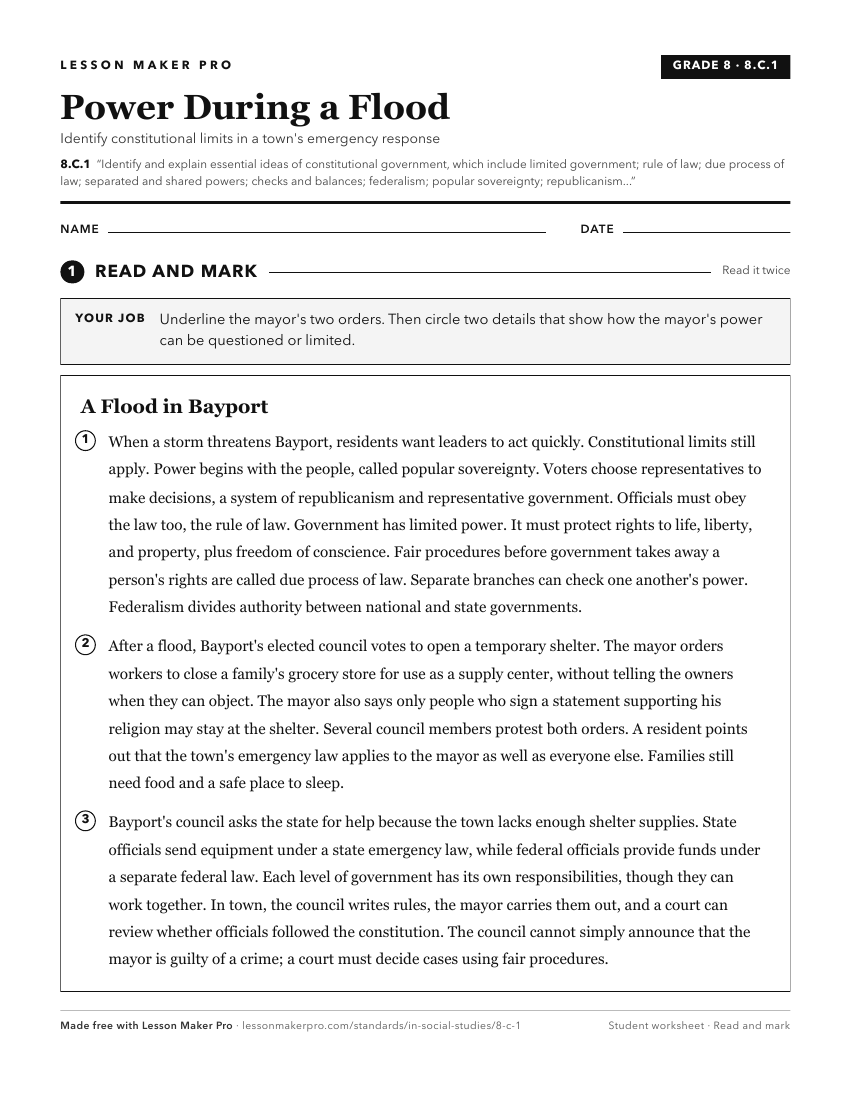
A ready-to-print activity worksheet aligned to 8.C.1, with an answer key for the teacher on its own page. No account needed.
PDF, US Letter, prints cleanly in black and white.
Download the worksheetKeep exploring
Related Standards
- USG.3.2
Explain the constitutional principles of federalism, separation of powers, the system of checks and balances, and republican government. Provide examples of the...
- USG.1.6
Define and provide historical and contemporary examples of constitutionalism, rule of law, limited government, and popular sovereignty in the United States Cons...
- 5.C.3
Identify and explain key ideas about government as noted in the Declaration of Independence, Articles of Confederation, Northwest Ordinance, United States Const...
- USG.2.4
Explain and analyze historical and contemporary examples of Founding Era principles of American government including natural rights, federalism, social contract...
Turn this exact standard into a lesson
Grade, subject, topic, and the complete standard are prefilled. Create one free, no account needed.
Also for this standard:Make a WorksheetMake a QuizMake a Sub Lesson