Indiana Social Studies USG.3.2
The Standard
Explain the constitutional principles of federalism, separation of powers, the system of checks and balances, and republican government. Provide examples of these principles in the governments of the United States and Indiana.
2026 Indiana Academic Standards: K-12 Social Studies · Students understand the nature of citizenship, politics, and governments, understanding the rights and responsibilities of citizens and how these are part of local, state, and national government. Students examine how the United States Constitution protects rights and provides the structure and functions of various levels of government. Students examine how the United States interacts with other nations as well as the government's role in world affairs will be examined.
Teacher's field guide
What This Standard Means
What Students Need to Do
- Students explain which decisions belong to the U.S. government and which belong to Indiana. They show how each government divides work among branches, how branches limit one another, and how voters choose lawmakers.
What Mastery Looks Like
- A student can explain why the U.S. issues passports while Indiana issues driver’s licenses. They can explain that Indiana legislators pass bills, the governor can veto them, and voters elect the legislators. They can give a similar example using Congress and the president.
Common Misconceptions
- Students may think Indiana needs Congress’s permission to make every state law. They may treat writing a bill and vetoing it as the same branch job. Some think voters decide every law directly instead of electing lawmakers.
How to Assess It
- Give students four examples: U.S. passports and Indiana driver’s licenses; voters elect Indiana legislators; legislators pass a bill and the governor signs it; the governor vetoes a bill. Ask them to name the principle each shows and explain their choice in one sentence.
Lesson moves
Ways to Teach It
Have pairs sort printed Congress, president, Indiana General Assembly, and governor cards into lawmaking and veto roles, then draw arrows showing vetoes.
Ask students to write two sentences answering, “Why can Indiana issue driver’s licenses while the U.S. issues passports?”
Play four corners with passports versus licenses, elected legislators, separate branch jobs, and a governor’s veto; students defend each choice.
Open a bill on the Indiana General Assembly website and have students find its elected sponsor and where a governor’s veto could occur.
Free download
Printable USG.3.2 Worksheet
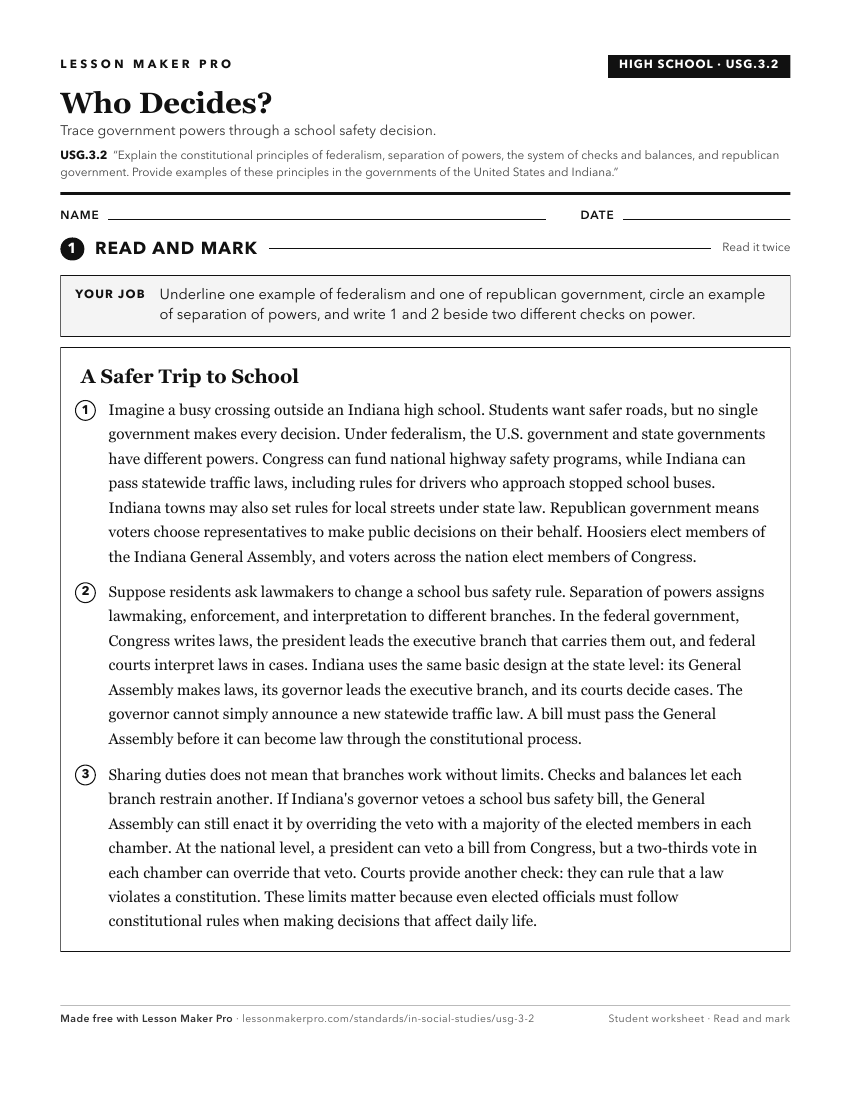
A ready-to-print activity worksheet aligned to USG.3.2, with an answer key for the teacher on its own page. No account needed.
PDF, US Letter, prints cleanly in black and white.
Download the worksheetKeep exploring
Related Standards
- 8.C.1
Identify and explain essential ideas of constitutional government, which include limited government; rule of law; due process of law; separated and shared power...
- 8.C.3
Compare and contrast the different functions of federal and state government within the federal system by analyzing the United States Constitution and the India...
- USG.3.4
Explain the relationships among branches of the United States government and Indiana government, which involve separation and sharing of powers as a means to li...
- USG.1.6
Define and provide historical and contemporary examples of constitutionalism, rule of law, limited government, and popular sovereignty in the United States Cons...
Turn this exact standard into a lesson
Grade, subject, topic, and the complete standard are prefilled. Create one free, no account needed.
Also for this standard:Make a WorksheetMake a QuizMake a Sub Lesson