Indiana Social Studies P.7.3
The Standard
Analyze the studies that lead to current understandings of conformity, obedience, nonconformity, and compliance, including Asch, Milgram, and Zimbardo.
2026 Indiana Academic Standards: K-12 Social Studies
Teacher's field guide
What This Standard Means
What Students Need to Do
- Students describe what participants did in Asch's line test, Milgram's shock experiment, and Zimbardo's prison simulation. They tell apart group pressure, orders, requests, and resistance. They explain what the evidence supports and where it falls short.
What Mastery Looks Like
- Given a new situation, students identify conformity, obedience, compliance, or nonconformity and explain their choice. They use details from the studies to back up their claims. They name a limit, such as researcher influence in Zimbardo's simulation.
Common Misconceptions
- Students may call every change in behavior conformity, even when someone follows an order or agrees to a request. Some think Milgram's participants delivered real shocks. Others think Zimbardo's simulation proves that assigned roles alone cause abuse.
How to Assess It
- Exit ticket: One student repeats a wrong answer after classmates agree on it; another follows a teacher's direct order. Label each behavior, connect one to Asch or Milgram, and name one limit of that study.
Lesson moves
Ways to Teach It
Use line-length cards: students answer privately, hear volunteers read openly assigned wrong answers, then answer publicly and compare their choices.
Read a one-page summary of Zimbardo's prison simulation, then ask: Do assigned roles alone explain the guards' behavior? Name one design concern.
Label four corners conformity, obedience, compliance, and nonconformity; read scenario cards and have students move to a corner and explain their choice.
Compare a 'most students recycle' cafeteria sign with a principal's recycling request; have students label each pressure and predict its effect.
Free download
Printable P.7.3 Worksheet
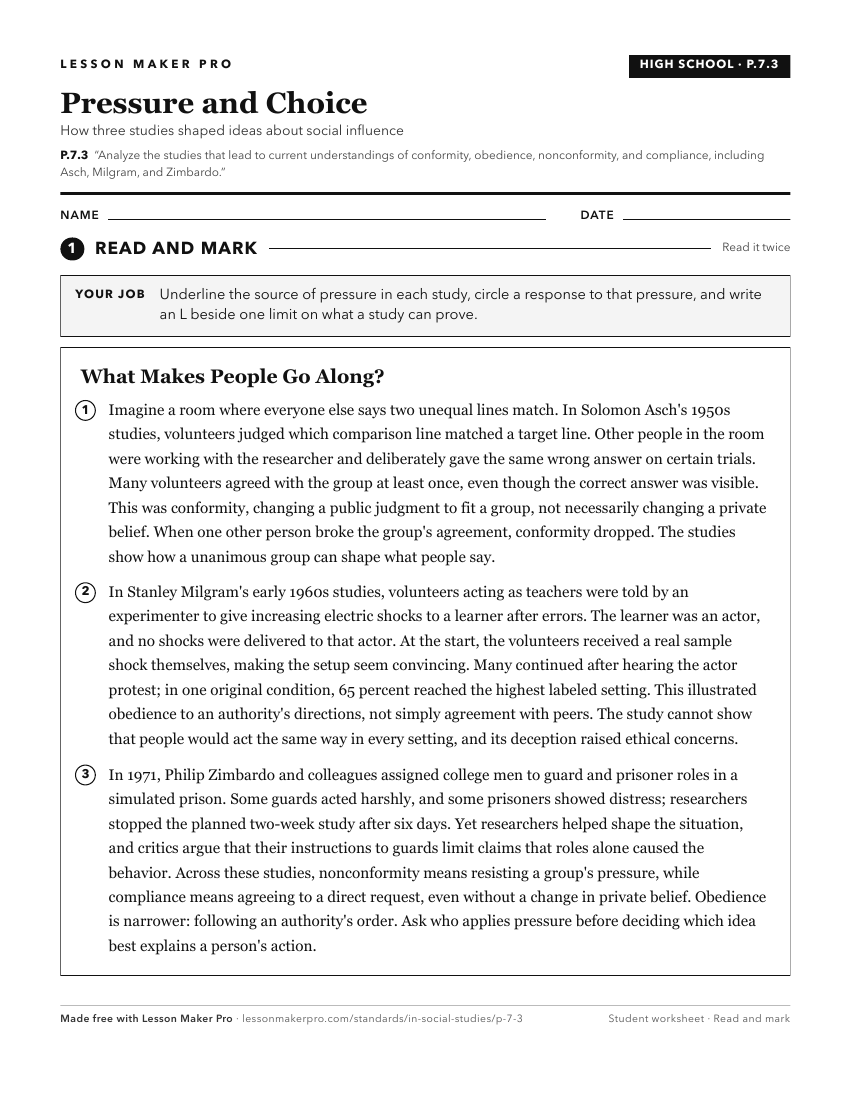
A ready-to-print activity worksheet aligned to P.7.3, with an answer key for the teacher on its own page. No account needed.
PDF, US Letter, prints cleanly in black and white.
Download the worksheetKeep exploring
Related Standards
- S.8.7
Discuss theories that attempt to explain collective behavior.
- P.7.4
Explain the concepts of group dynamics, including groupthink, deindividuation, social loafing, group polarization, and the bystander effect.
- S.10.3
Explore explanations of deviance such as the Strain Theory, the Differential Association Theory, and the Control Theory.
- P.1.7
Analyze human behavior (biological, evolutionary, behavioral, cognitive, humanistic, psychodynamic, sociocultural, biopsychosocial) from contemporary perspectiv...
Turn this exact standard into a lesson
Grade, subject, topic, and the complete standard are prefilled. Create one free, no account needed.
Also for this standard:Make a WorksheetMake a QuizMake a Sub Lesson