Indiana Social Studies P.4.6
The Standard
Compare and contrast between explicit (semantic) and implicit (procedural) memory.
2026 Indiana Academic Standards: K-12 Social Studies
Teacher's field guide
What This Standard Means
What Students Need to Do
- Students compare remembering facts with performing learned skills. They explain that facts can be recalled in words, while skills are often shown through action. Both draw on past learning.
What Mastery Looks Like
- A student can identify naming a state capital as semantic memory and tying a shoelace as procedural memory. They can explain one difference and note that both are forms of long-term memory.
Common Misconceptions
- Students may think that knowing the steps for tying a shoe is the same as being able to tie it. They may also think a skill stops being procedural memory if someone can describe it.
How to Assess It
- Exit ticket: A student recalls that Indianapolis is Indiana’s capital and ties a shoe without thinking. Name the memory used in each case, then give one difference and one similarity.
Lesson moves
Ways to Teach It
Give pairs a shoelace and a card with a state capital; have them tie a bow, hide the card, and recall the capital.
Ask students to write two sentences comparing recall of a state capital with tying a shoe, including one thing both have in common.
Have teams sort cards marked typing without looking, defining democracy, tying a knot, and naming a capital into two memory groups.
Ask students why a cook might forget what simmer means but still chop vegetables quickly.
Free download
Printable P.4.6 Worksheet
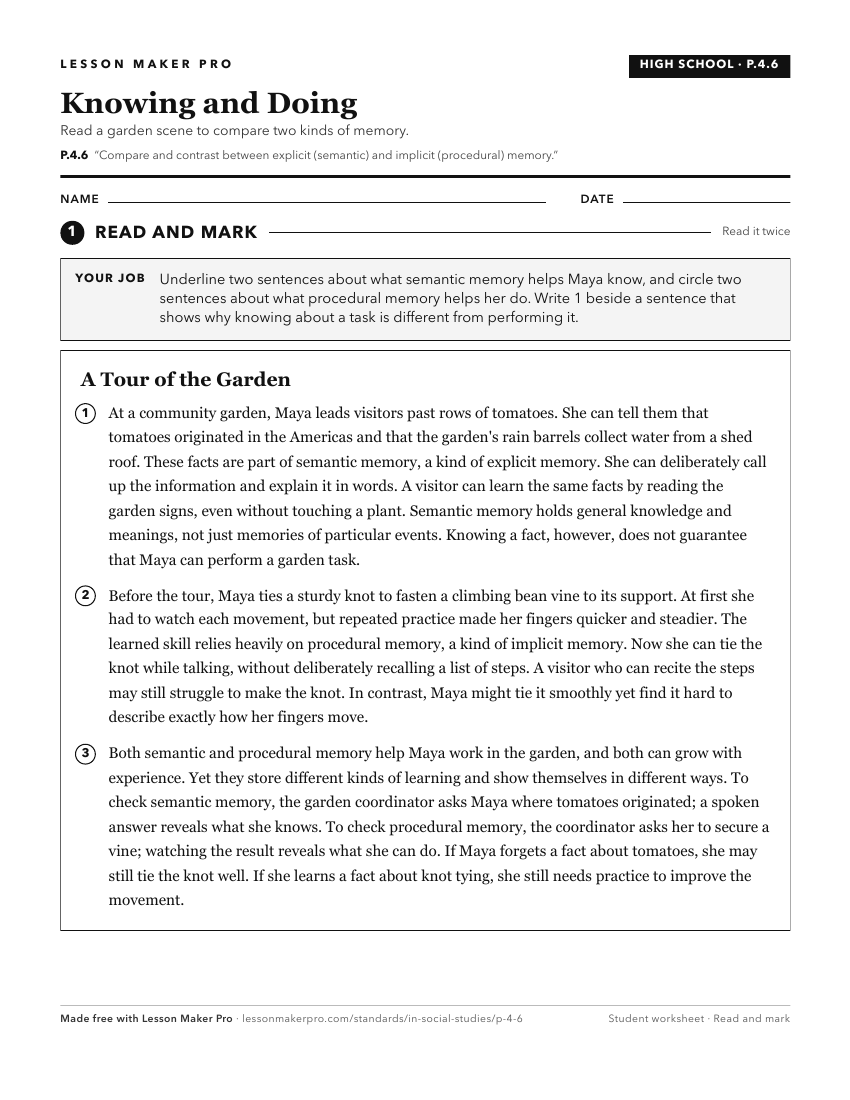
A ready-to-print activity worksheet aligned to P.4.6, with an answer key for the teacher on its own page. No account needed.
PDF, US Letter, prints cleanly in black and white.
Download the worksheetKeep exploring
Related Standards
- P.4.3
Differentiate between the three different stages of memory, including sensory, short-term, and long-term.
- WG.1.3
Create and compare mental maps or personal perceptions of places. Explain how experiences and culture influence these perceptions and identify ways in which men...
- P.4.5
Evaluate various strategies that can be used to improve memory encoding and retrieval.
- P.4.2
Describe the processes of memory, including encoding, storage, and retrieval.
Turn this exact standard into a lesson
Grade, subject, topic, and the complete standard are prefilled. Create one free, no account needed.
Also for this standard:Make a WorksheetMake a QuizMake a Sub Lesson