Indiana Social Studies P.4.2
The Standard
Describe the processes of memory, including encoding, storage, and retrieval.
2026 Indiana Academic Standards: K-12 Social Studies
Teacher's field guide
What This Standard Means
What Students Need to Do
- Students trace what happens when they learn a name and remember it the next day. They use encoding, storage, and retrieval to explain each part.
What Mastery Looks Like
- Given a short story, students label each memory process and explain their choices. They can tell the difference between keeping information and calling it to mind.
Common Misconceptions
- Students may call the moment they remember an answer storage, when it is retrieval. They may also think repetition is the only way to encode information, or that stored information is always easy to recall.
How to Assess It
- Exit ticket: You hear a new locker code, remember it overnight, and enter it the next morning. Label where encoding, storage, and retrieval happen.
Lesson moves
Ways to Teach It
Give pairs 10 picture cards to sort, hide the cards for two minutes, then have students list the pictures and label each memory step.
Ask: Why might you recognize a classmate's name on a list but struggle to say it without the list?
Play a card sort using short memory stories, such as hearing a name, remembering it overnight, and saying it later.
Have students use their class schedule to explain when they learned it, kept it in memory, and recalled their next classroom.
Free download
Printable P.4.2 Worksheet
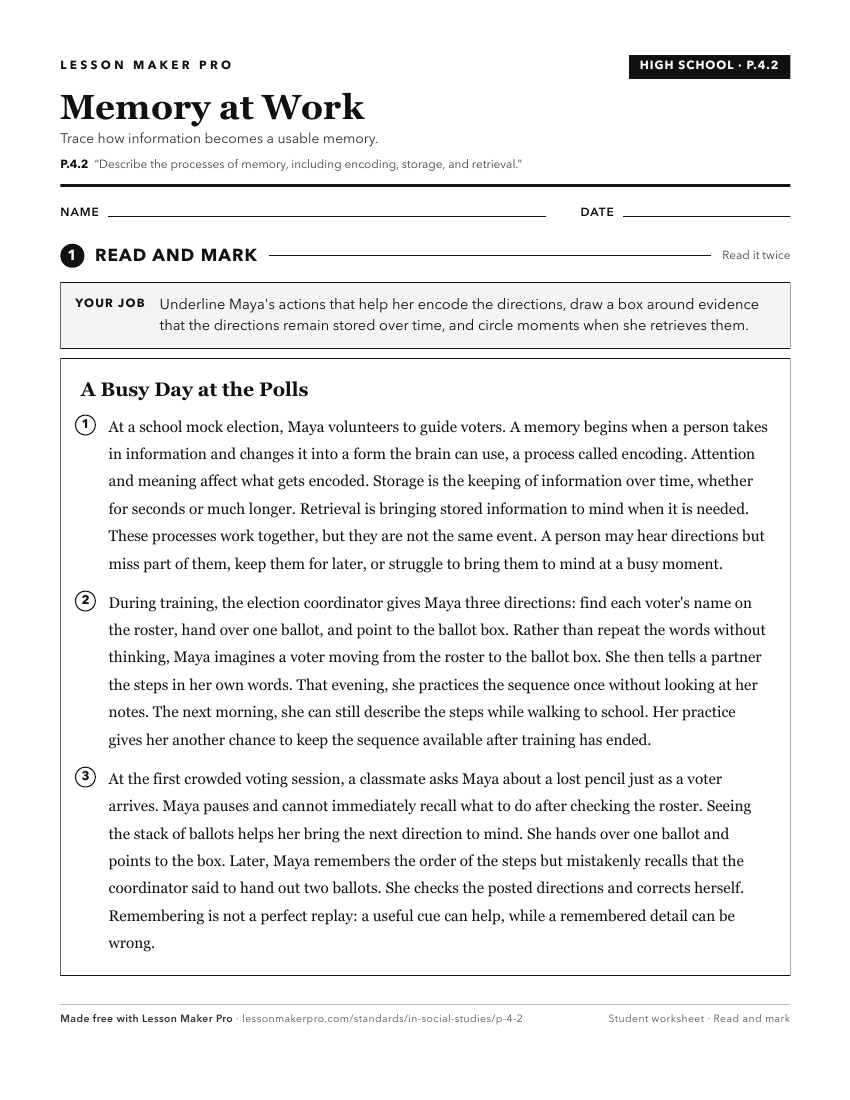
A ready-to-print activity worksheet aligned to P.4.2, with an answer key for the teacher on its own page. No account needed.
PDF, US Letter, prints cleanly in black and white.
Download the worksheetKeep exploring
Related Standards
- P.4.3
Differentiate between the three different stages of memory, including sensory, short-term, and long-term.
- P.4.4
Identify the factors that affect retrieval (storage decay, proactive and retroactive interference) including memory disorders.
- P.4.5
Evaluate various strategies that can be used to improve memory encoding and retrieval.
- P.4.6
Compare and contrast between explicit (semantic) and implicit (procedural) memory.
Turn this exact standard into a lesson
Grade, subject, topic, and the complete standard are prefilled. Create one free, no account needed.
Also for this standard:Make a WorksheetMake a QuizMake a Sub Lesson