Indiana Social Studies P.4.5
The Standard
Evaluate various strategies that can be used to improve memory encoding and retrieval.
2026 Indiana Academic Standards: K-12 Social Studies
Teacher's field guide
What This Standard Means
What Students Need to Do
- Students compare ways to get information into memory and bring it back later. They test methods such as drawing images, spacing review, and self-quizzing, then use recall results to judge what worked.
What Mastery Looks Like
- A student can explain why recognizing notes while rereading is not the same as recalling an answer without them. They can use test results to choose a study method for a specific task and explain their choice.
Common Misconceptions
- Students often mistake familiar-looking notes for information they can recall. They may think one long study session works as well as shorter sessions spread across several days. Some expect a memory cue to help even when they never linked it to the material.
How to Assess It
- Exit ticket: For a permit test next week, choose two methods from rereading, drawing rule pictures, and spaced self-quizzes. Explain which you expect to help recall most and how each method helps information stick or come back.
Lesson moves
Ways to Teach It
Hand out identical word-pair slips; half sketch links, half reread, then give first-word cues after ten minutes and compare recall.
Ask, "Why might someone recognize their notes but forget an answer on a blank test?" Use the word-pair results as evidence.
Play three rounds with vocabulary flashcards: students write answers before checking, then retry missed cards five minutes later.
For a driving-permit quiz, have students build a three-day flashcard schedule and pair each tricky rule with a road-sign image.
Free download
Printable P.4.5 Worksheet
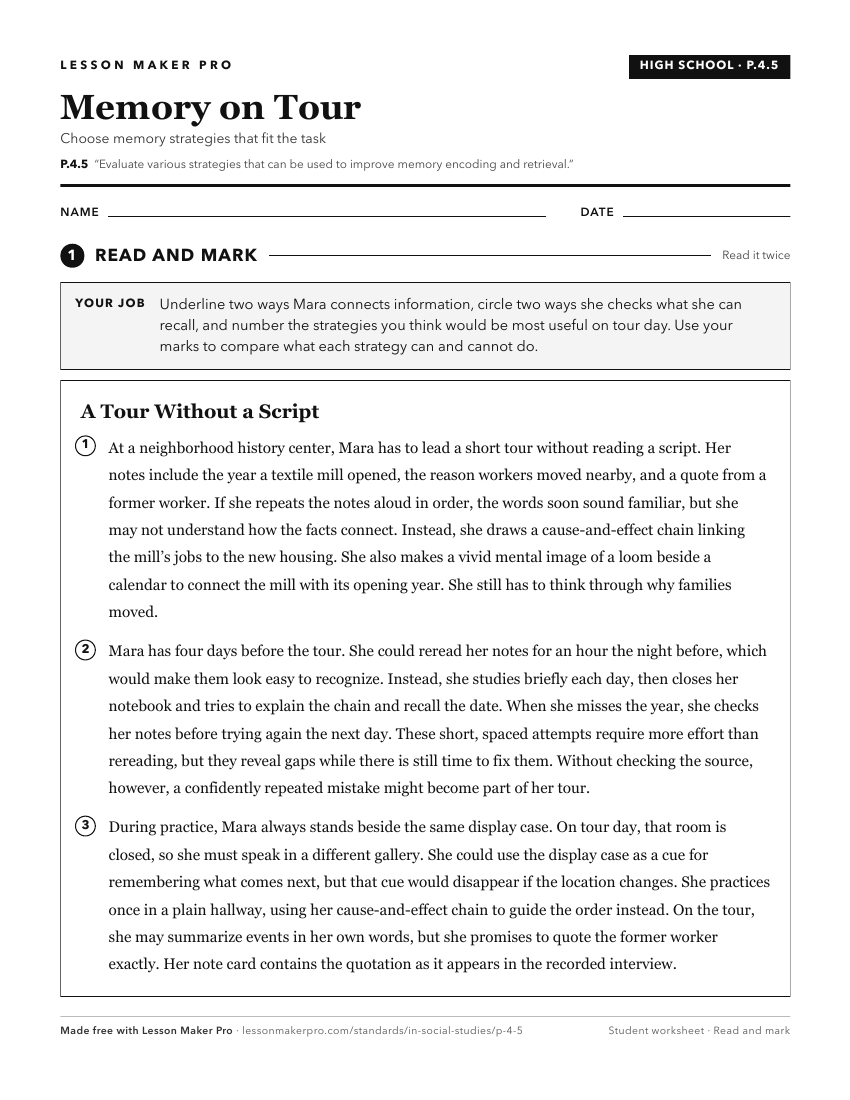
A ready-to-print activity worksheet aligned to P.4.5, with an answer key for the teacher on its own page. No account needed.
PDF, US Letter, prints cleanly in black and white.
Download the worksheetKeep exploring
Related Standards
- P.4.3
Differentiate between the three different stages of memory, including sensory, short-term, and long-term.
- P.4.4
Identify the factors that affect retrieval (storage decay, proactive and retroactive interference) including memory disorders.
- P.4.6
Compare and contrast between explicit (semantic) and implicit (procedural) memory.
- P.4.2
Describe the processes of memory, including encoding, storage, and retrieval.
Turn this exact standard into a lesson
Grade, subject, topic, and the complete standard are prefilled. Create one free, no account needed.
Also for this standard:Make a WorksheetMake a QuizMake a Sub Lesson