Indiana Social Studies P.4.4
The Standard
Identify the factors that affect retrieval (storage decay, proactive and retroactive interference) including memory disorders.
2026 Indiana Academic Standards: K-12 Social Studies
Teacher's field guide
What This Standard Means
What Students Need to Do
- Students explain why memories can fade or become harder to recall when other learning gets in the way. They tell whether old learning blocks new recall or new learning blocks old recall. They recognize how memory disorders can affect what a person remembers.
What Mastery Looks Like
- Given two password examples, students can tell which direction the interference runs and explain why. They can also explain why an unused memory may fade and describe the memory problem in a brief amnesia case.
Common Misconceptions
- Students often mix up which direction each type of interference runs. They may call every forgotten memory decay, even when another memory is getting in the way. They may think amnesia erases every memory a person has.
How to Assess It
- Exit ticket: Label each case: an unused phone number fades, an old password blocks a new one, a new password blocks the old one, and a person cannot recall life before a head injury.
Lesson moves
Ways to Teach It
Give pairs two six-word lists to study for 30 seconds each, then have them recall both and circle words borrowed from the other list.
Ask, 'Why does last year's locker code come to mind when you try this year's code, and what would the reverse look like?'
Play a card sort with 'old address blocks new address' and 'new address blocks old address'; students label each type of interference.
Read a short patient case in which someone recalls childhood but cannot remember new conversations, then ask students to identify the memory problem.
Free download
Printable P.4.4 Worksheet
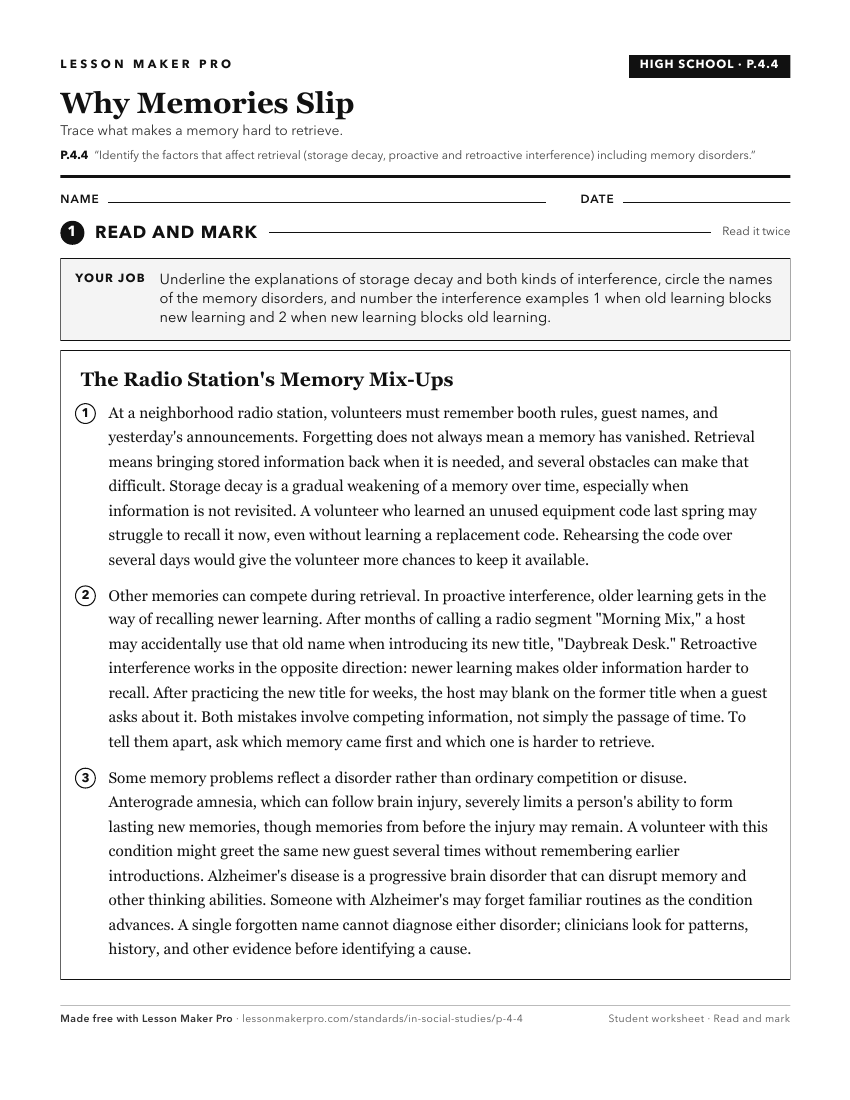
A ready-to-print activity worksheet aligned to P.4.4, with an answer key for the teacher on its own page. No account needed.
PDF, US Letter, prints cleanly in black and white.
Download the worksheetKeep exploring
Related Standards
- P.4.3
Differentiate between the three different stages of memory, including sensory, short-term, and long-term.
- P.4.5
Evaluate various strategies that can be used to improve memory encoding and retrieval.
- P.4.6
Compare and contrast between explicit (semantic) and implicit (procedural) memory.
- P.4.2
Describe the processes of memory, including encoding, storage, and retrieval.
Turn this exact standard into a lesson
Grade, subject, topic, and the complete standard are prefilled. Create one free, no account needed.
Also for this standard:Make a WorksheetMake a QuizMake a Sub Lesson