Indiana Social Studies P.4.1
The Standard
Explain the process of learning, including principles of operant, classical, and observational.
2026 Indiana Academic Standards: K-12 Social Studies
Teacher's field guide
What This Standard Means
What Students Need to Do
- Students explain how a cue can trigger a learned response, how a consequence can change behavior, and how watching someone can teach an action. They match each process to an example and explain what caused the learning.
What Mastery Looks Like
- Given an unfamiliar example, students identify the cue and response, the behavior and consequence, or the model and copied action. They explain why the example fits one process rather than another.
Common Misconceptions
- Students may call a reward given after an action classical conditioning. They may call buckling a seatbelt to stop an annoying chime punishment, though stopping the chime can make buckling more likely. They may think watching someone cannot teach an action unless they also get a reward.
How to Assess It
- Exit ticket: Classify each example and explain your choice: a bell predicts lunch, a point rewards completed work, and a student copies a classmate’s note-taking method.
Lesson moves
Ways to Teach It
Play the same chime before three 20-second stretch breaks, then play it alone and ask students what they expected.
Ask students to explain why feeling hungry at the lunch bell differs from earning a point for finishing homework.
Write “bell predicts lunch,” “points for homework,” and “copying a teammate” on cards; pairs sort them and explain each choice.
Show a short basketball free-throw clip; students imitate the shooter’s stance and name what watching taught them.
Free download
Printable P.4.1 Worksheet
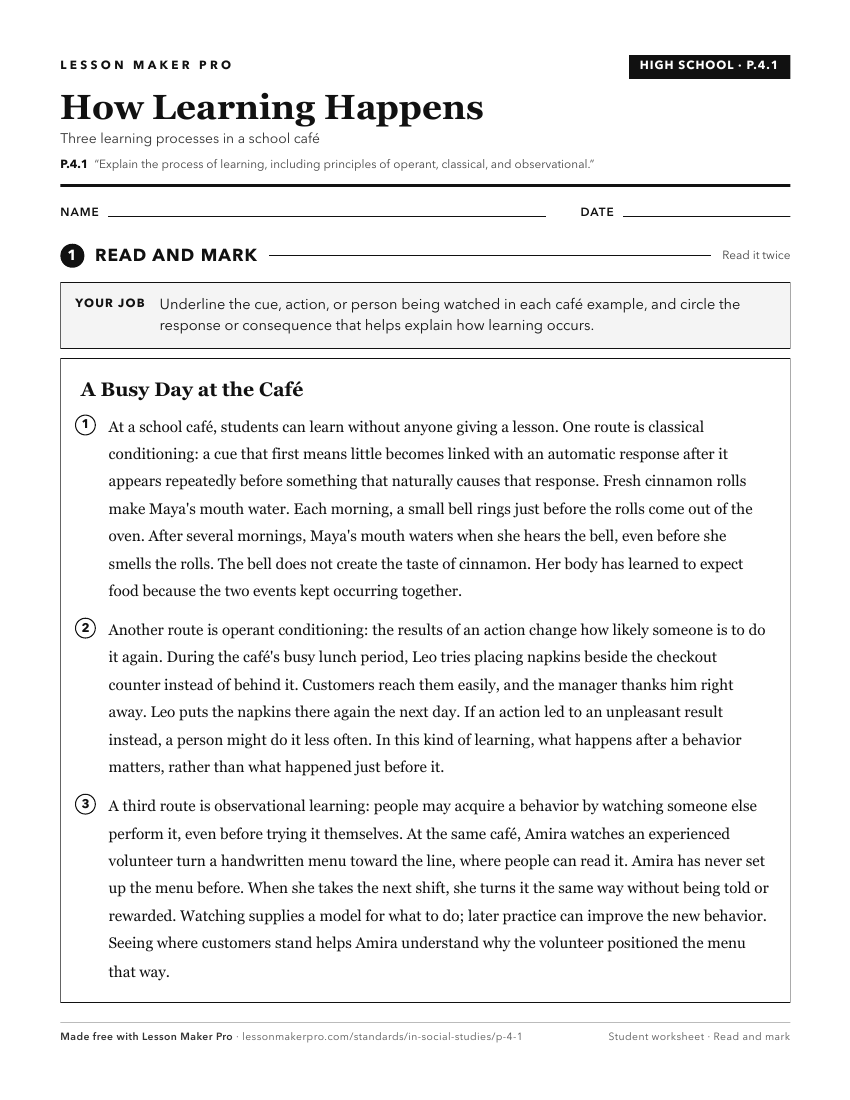
A ready-to-print activity worksheet aligned to P.4.1, with an answer key for the teacher on its own page. No account needed.
PDF, US Letter, prints cleanly in black and white.
Download the worksheetKeep exploring
Related Standards
- P.7.2
Explain how perceptions and attitudes develop, including attribution theory, fundamental attribution error, actor-observer bias, self-serving bias, central vs. ...
- P.4.8
Identify key psychologists in the fields of learning and cognition, including Pavlov, Skinner, and Bandura and explain the impact of their contributions.
- P.3.6
Describe the theories of various developmental psychologists such as Piaget, Vygotsky, Freud, and Erikson.
- P.4.2
Describe the processes of memory, including encoding, storage, and retrieval.
Turn this exact standard into a lesson
Grade, subject, topic, and the complete standard are prefilled. Create one free, no account needed.
Also for this standard:Make a WorksheetMake a QuizMake a Sub Lesson