Indiana Social Studies P.7.2
The Standard
Explain how perceptions and attitudes develop, including attribution theory, fundamental attribution error, actor-observer bias, self-serving bias, central vs. peripheral route of persuasion, and cognitive dissonance.
2026 Indiana Academic Standards: K-12 Social Studies
Teacher's field guide
What This Standard Means
What Students Need to Do
- Students explain why people blame behavior on personal traits or circumstances, and how those judgments can be biased. They compare ads that use evidence with ads that rely on surface cues. They explain how a clash between beliefs and actions can lead someone to change an attitude.
What Mastery Looks Like
- Given a late arrival, they explain why an observer might blame character while the late student cites traffic. They spot when someone credits success to ability but blames failure on circumstances. They identify evidence and surface cues in ads, then explain how someone might justify an action that conflicts with a belief.
Common Misconceptions
- Students may treat an observer's claim that someone is lazy as fact, without considering the situation. They may confuse explaining their own actions differently from others' actions with taking credit for success and blaming failure on circumstances. Some think cognitive dissonance means disagreement between two people.
How to Assess It
- Exit ticket: A student credits an A to talent, blames an F on an unfair test, and says a peer's F shows laziness. Name two biases and explain each.
Lesson moves
Ways to Teach It
Give pairs slips describing a missed deadline; have them sort possible causes into person and situation piles.
Ask students to write an excuse and a changed action for someone who skips recycling after saying it matters.
Play a scenario sort with cards labeled fundamental attribution error, actor-observer bias, and self-serving bias; students match each to a written example.
Show a campaign flyer and a celebrity-backed product ad; students underline evidence and circle attention-grabbing cues.
Free download
Printable P.7.2 Worksheet
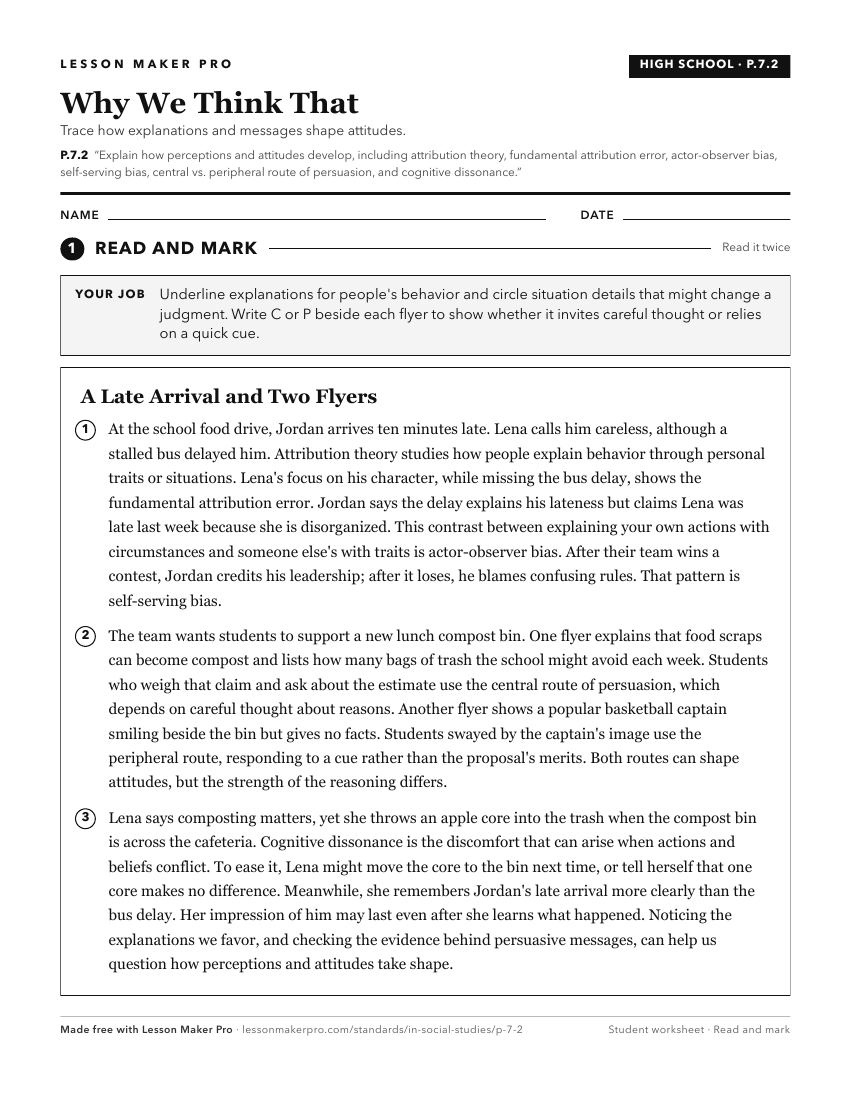
A ready-to-print activity worksheet aligned to P.7.2, with an answer key for the teacher on its own page. No account needed.
PDF, US Letter, prints cleanly in black and white.
Download the worksheetKeep exploring
Related Standards
- P.7.4
Explain the concepts of group dynamics, including groupthink, deindividuation, social loafing, group polarization, and the bystander effect.
- S.10.3
Explore explanations of deviance such as the Strain Theory, the Differential Association Theory, and the Control Theory.
- P.7.6
Explain how stereotypes, prejudice, and discrimination influence behavior.
- WG.1.3
Create and compare mental maps or personal perceptions of places. Explain how experiences and culture influence these perceptions and identify ways in which men...
Turn this exact standard into a lesson
Grade, subject, topic, and the complete standard are prefilled. Create one free, no account needed.
Also for this standard:Make a WorksheetMake a QuizMake a Sub Lesson