Indiana Social Studies P.3.6
The Standard
Describe the theories of various developmental psychologists such as Piaget, Vygotsky, Freud, and Erikson.
2026 Indiana Academic Standards: K-12 Social Studies
Teacher's field guide
What This Standard Means
What Students Need to Do
- Students describe Piaget's stages of thinking, Vygotsky's learning with guidance, Freud's psychosexual stages, and Erikson's psychosocial conflicts. They compare the theories and use them to explain behavior.
What Mastery Looks Like
- Given a short case, students identify a theory that fits and point to a detail that supports their choice. They can explain what a different psychologist would focus on.
Common Misconceptions
- Students may mix up Freud's psychosexual stages and Erikson's psychosocial conflicts. They may treat Piaget's stages as exact birthday rules or think any adult help counts as Vygotsky's guided learning.
How to Assess It
- Exit ticket: Match thinking stages, guided help, psychosexual stages, and psychosocial conflicts to the four psychologists. Choose one match and explain it with an example.
Lesson moves
Ways to Teach It
Give pairs four name cards and four claim cards: thinking stages, guided help, psychosexual stages, and psychosocial conflicts; have them match and justify each pair.
Ask: 'How would Piaget and Vygotsky explain a 7-year-old solving a puzzle after a classmate offers hints?' Have partners write both answers.
Put four psychologist names around the room; read 'identity crisis' and 'learning with a tutor,' then have students move and defend their choices.
Hand out a daycare note saying, 'Mia, 2, buttons her coat after an adult demonstrates'; students label guided help and autonomy.
Free download
Printable P.3.6 Worksheet
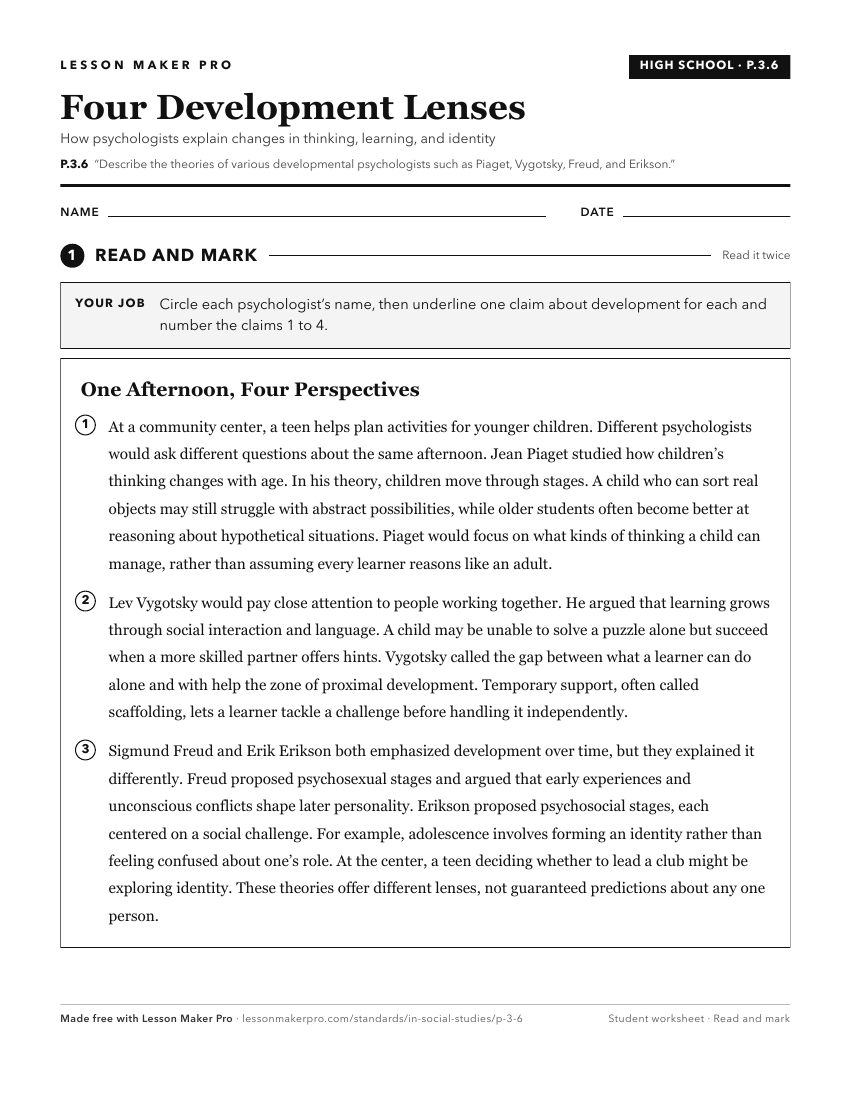
A ready-to-print activity worksheet aligned to P.3.6, with an answer key for the teacher on its own page. No account needed.
PDF, US Letter, prints cleanly in black and white.
Download the worksheetKeep exploring
Related Standards
- S.10.3
Explore explanations of deviance such as the Strain Theory, the Differential Association Theory, and the Control Theory.
- P.5.6
Evaluate the influences of variables, such as culture (belonging to an individualist or collectivist culture), family, and genetics, on personality development ...
- P.3.1
Explain the roles, effects, and outcomes of prenatal and postnatal development on human behavior.
- P.4.8
Identify key psychologists in the fields of learning and cognition, including Pavlov, Skinner, and Bandura and explain the impact of their contributions.
Turn this exact standard into a lesson
Grade, subject, topic, and the complete standard are prefilled. Create one free, no account needed.
Also for this standard:Make a WorksheetMake a QuizMake a Sub Lesson