Indiana Social Studies 2.G.3
The Standard
Compare neighborhoods in the local community or region, and explain how physical features of the community affect people living there.
2026 Indiana Academic Standards: K-12 Social Studies
Teacher's field guide
What This Standard Means
What Students Need to Do
- Students compare two nearby neighborhoods by naming what is alike and different. They identify land and water features and explain how those features affect travel, play, or where people live.
What Mastery Looks Like
- A student can use two neighborhood maps to name one similarity and one difference. They can explain why a creek might mean people need a bridge to reach a park.
Common Misconceptions
- Students may call a road or playground a land or water feature. They may say a creek makes a neighborhood better without explaining what it changes for people who live there.
How to Assess It
- Show sketch maps of two nearby neighborhoods, one beside a creek and one on a hill. Ask: “What is different, and how might that change how people get around?”
Lesson moves
Ways to Teach It
Give pairs maps of two nearby neighborhoods; have them highlight land and water features and add sticky notes showing how people use each area.
Ask: “How might getting to school differ for children near a creek and children on a hill?” Have students write two sentences.
Give pairs creek, hill, bridge, and steep walk cards; have them match each feature to an effect and explain their choices.
On a walk near school, have students spot a slope, flat field, or stream and say how it affects a walking route.
Free download
Printable 2.G.3 Worksheet
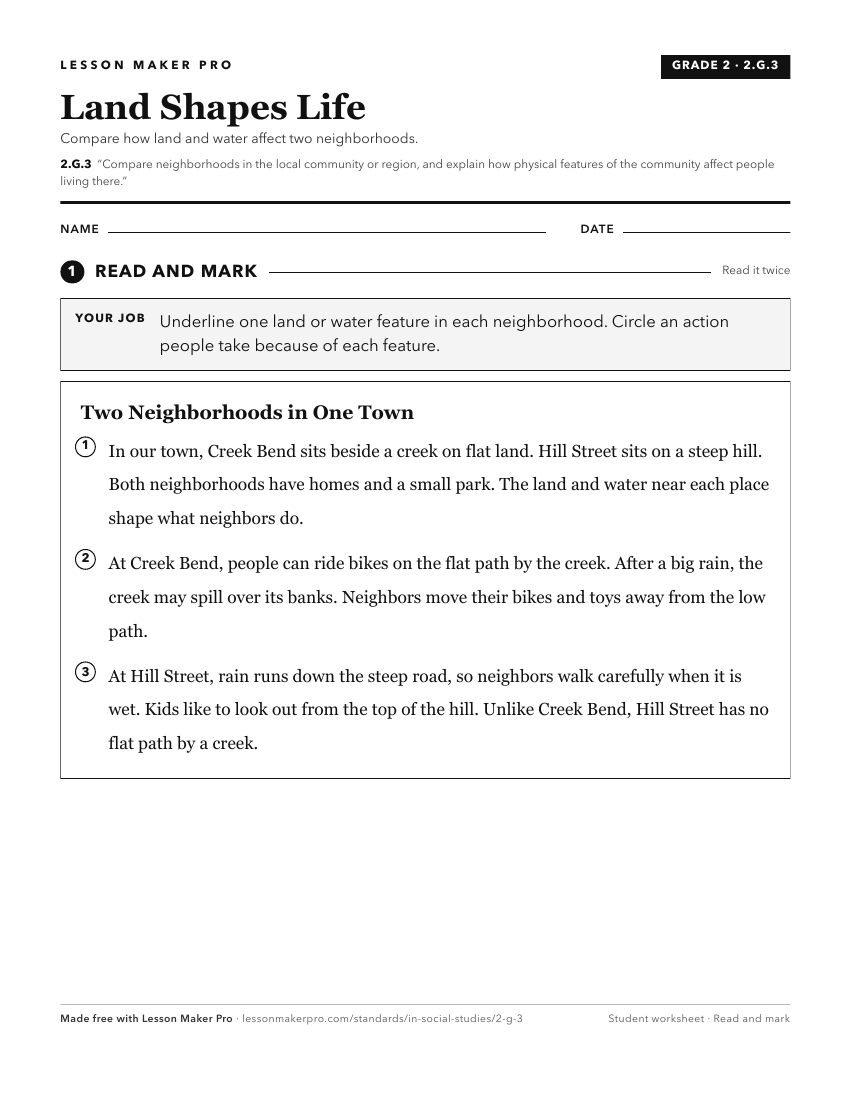
A ready-to-print activity worksheet aligned to 2.G.3, with an answer key for the teacher on its own page. No account needed.
PDF, US Letter, prints cleanly in black and white.
Download the worksheetKeep exploring
Related Standards
- 2.G.4
Compare neighborhoods in the local community or region with those in other parts of the world.
- WG.2.2
Analyze and provide examples of ways in which people's changing views of places and regions reflect cultural changes; explain how people's views of physical fea...
- 1.G.4
Identify and describe physical features and man-made features of the local community, including home, school, and neighborhood.
- 2.G.5
On a map, identify physical features of the local community, and how seasons may or may not impact those features.
Turn this exact standard into a lesson
Grade, subject, topic, and the complete standard are prefilled. Create one free, no account needed.
Also for this standard:Make a WorksheetMake a QuizMake a Sub Lesson