Indiana Social Studies 2.G.4
The Standard
Compare neighborhoods in the local community or region with those in other parts of the world.
2026 Indiana Academic Standards: K-12 Social Studies
Teacher's field guide
What This Standard Means
What Students Need to Do
- Students look at photos and simple maps of a neighborhood near school and one in another part of the world. They describe what is alike and different, using details they can see.
What Mastery Looks Like
- A student can name a similarity and a difference between two neighborhoods. They point to a detail in each photo or map that supports their answer.
Common Misconceptions
- Students may think one photo shows what every neighborhood in a country looks like. They may treat signs written in different languages as proof that the streets have nothing in common.
How to Assess It
- Show one photo of a street near school and one of a street in Tokyo. Ask, “What is one thing both neighborhoods have, and what is one difference? Point to a clue in each photo.”
Lesson moves
Ways to Teach It
Give pairs a nearby street photo and a Tokyo street photo; have them mark shared features with blue stickers and differences with red stickers.
Ask, “How might people get around in each neighborhood?” Have students write one clue from each photo.
Play compare-and-swap: pairs draw two neighborhood photo cards, name one similarity and one difference, then trade cards.
On a school-area map, find a park or shop; then look for the same kind of place on a Tokyo neighborhood map.
Free download
Printable 2.G.4 Worksheet
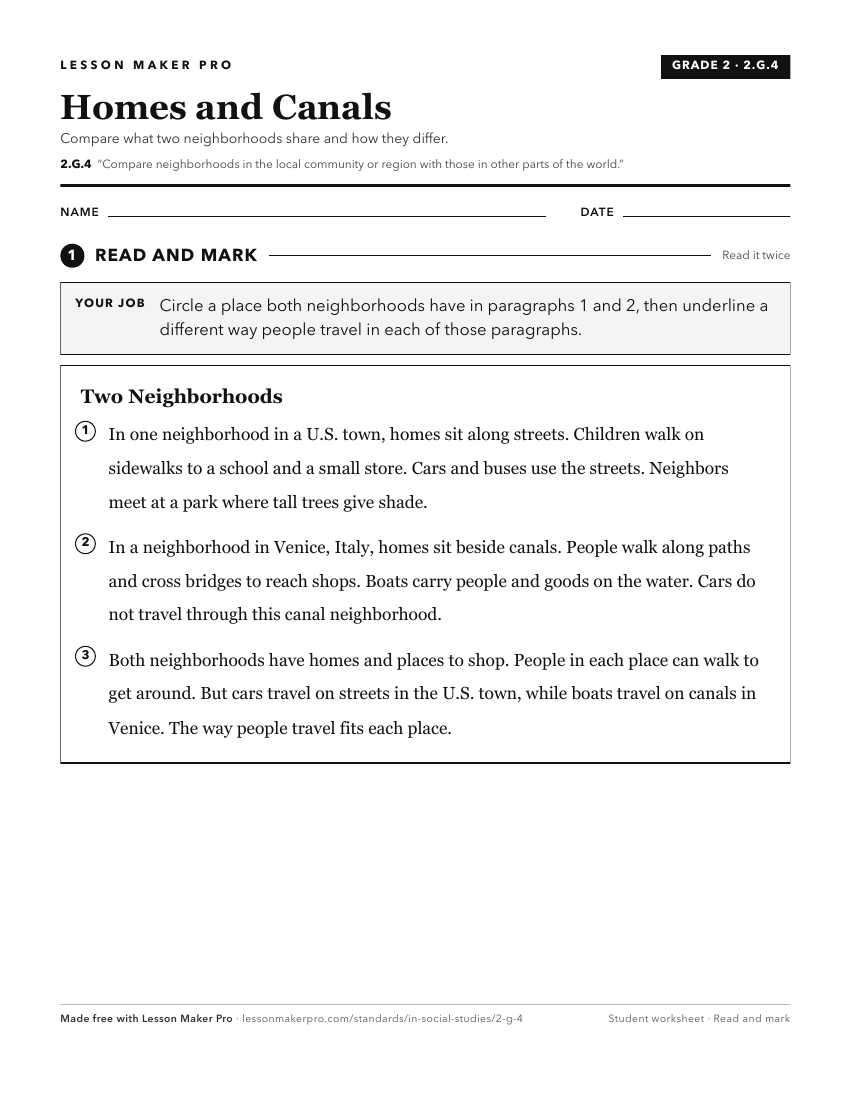
A ready-to-print activity worksheet aligned to 2.G.4, with an answer key for the teacher on its own page. No account needed.
PDF, US Letter, prints cleanly in black and white.
Download the worksheetKeep exploring
Related Standards
- 1.G.4
Identify and describe physical features and man-made features of the local community, including home, school, and neighborhood.
- WG.4.19
Identify and report on the impact of international networks and organizations that connect countries and influence of places, countries, and regions.
- GHW.3.5
Analyze population trends in the local community, and suggest the impact of these trends on the future of the community such as development, employment, health,...
- 2.G.3
Compare neighborhoods in the local community or region, and explain how physical features of the community affect people living there.
Turn this exact standard into a lesson
Grade, subject, topic, and the complete standard are prefilled. Create one free, no account needed.
Also for this standard:Make a WorksheetMake a QuizMake a Sub Lesson