Indiana Science HS-PSII-4.7
The Standard
Apply conservation of energy to determine changes in the electric potential energy, translational kinetic energy, and speed of a single charged object (i.e., a point particle) placed in a uniform electric field.
Indiana Academic Standards for Science (2023) · Electricity
Teacher's field guide
What This Standard Means
What Students Need to Do
- Students track one charged particle moving through a uniform electric field. They use its charge and the voltage difference to find energy changes, then use its mass and starting speed to find its final speed.
What Mastery Looks Like
- A student can calculate the change in electric potential energy and show that kinetic energy changes by the opposite amount. They can use the new kinetic energy to find speed and explain how the charge's sign affects the result.
Common Misconceptions
- Students often assume a negative charge speeds up in the field's direction. They may confuse voltage with electric potential energy, or add an energy change directly to speed instead of calculating kinetic energy first.
How to Assess It
- Exit ticket: A +2 μC particle of mass 1 g starts from rest at a 10 V plate and moves to a 0 V plate. Find its changes in electric potential energy and kinetic energy, then its final speed.
Lesson moves
Ways to Teach It
Tape two parallel plates on a desk, label them 0 V and 10 V, and slide signed charge cards between them while recording energy changes.
Ask why a negative charge moving toward a higher-voltage plate can gain speed while its electric potential energy falls.
Run a two-round card race: +2 μC or -2 μC, 1 g, 0.3 m/s start, 10 V drop; calculate final speed.
Show a cathode-ray tube diagram with plates at 0 V and 100 V; supply electron charge and mass, then calculate its speed from rest.
Free download
Printable HS-PSII-4.7 Worksheet
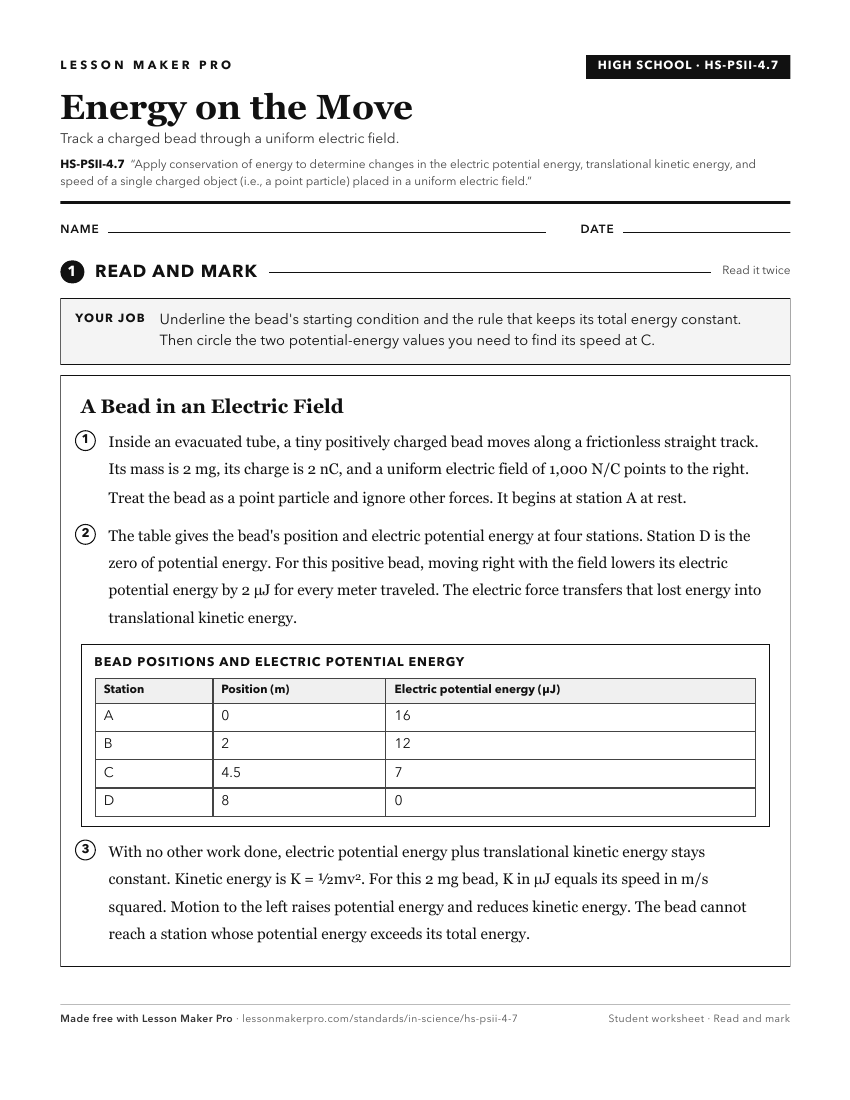
A ready-to-print activity worksheet aligned to HS-PSII-4.7, with an answer key for the teacher on its own page. No account needed.
PDF, US Letter, prints cleanly in black and white.
Download the worksheetKeep exploring
Related Standards
- HS-PSII-4.2
For a single isolated charge, develop and apply graphical and mathematical representations that describe the relationship between the amount of charge, the dist...
- HS-PSII-4.1
Describe the methods of charging an object (i.e., contact, induction, and polarization) and apply the principle of conservation of charge to determine the charg...
- HS-PSII-4.5
Map electric fields and equipotential lines, showing the electric field lines are perpendicular to the equipotential lines, and draw conclusions about the motio...
- HS-PSII-4.4
For a single isolated charge, develop graphical and mathematical representations that describe the relationship between the amount of charge, the distance from ...
Turn this exact standard into a lesson
Grade, subject, topic, and the complete standard are prefilled. Create one free, no account needed.
Also for this standard:Make a WorksheetMake a QuizMake a Sub Lesson