Indiana Science HS-PSII-4.1
The Standard
Describe the methods of charging an object (i.e., contact, induction, and polarization) and apply the principle of conservation of charge to determine the charges on each object after charge is transferred between two objects by contact.
Indiana Academic Standards for Science (2023) · Electricity
Teacher's field guide
What This Standard Means
What Students Need to Do
- Students explain how touching an object, bringing a charged object nearby, or grounding an object affects its charge. They use the starting charges of two identical objects to find each charge after contact.
What Mastery Looks Like
- They know that contact can move electrons between objects. They distinguish charge separation in a neutral object from charging it through grounding. They calculate that identical metal spheres starting at +6 nC and -2 nC each end at +2 nC after contact.
Common Misconceptions
- Students may say protons move between objects or that bringing a charged object nearby always gives a neutral object a net charge. They may split charge evenly between objects that are not identical, or forget that total charge stays the same.
How to Assess It
- Exit ticket: A negative balloon comes near a neutral metal can without touching it. Does the can gain net charge? Then two identical metal spheres starting at +6 nC and -2 nC touch and separate. Find each final charge.
Lesson moves
Ways to Teach It
Rub a balloon on wool, hold it near tissue squares, then touch them with it; have students record what happens before and after contact.
Ask: Why can a charged balloon pull on a neutral tissue square without touching it? Has the square gained a net charge?
Deal cards showing the starting charges of identical metal spheres; partners calculate each final charge after contact and check the total.
Hold a rubbed balloon near a thin stream of tap water; have students explain why the stream bends without gaining net charge.
Free download
Printable HS-PSII-4.1 Worksheet
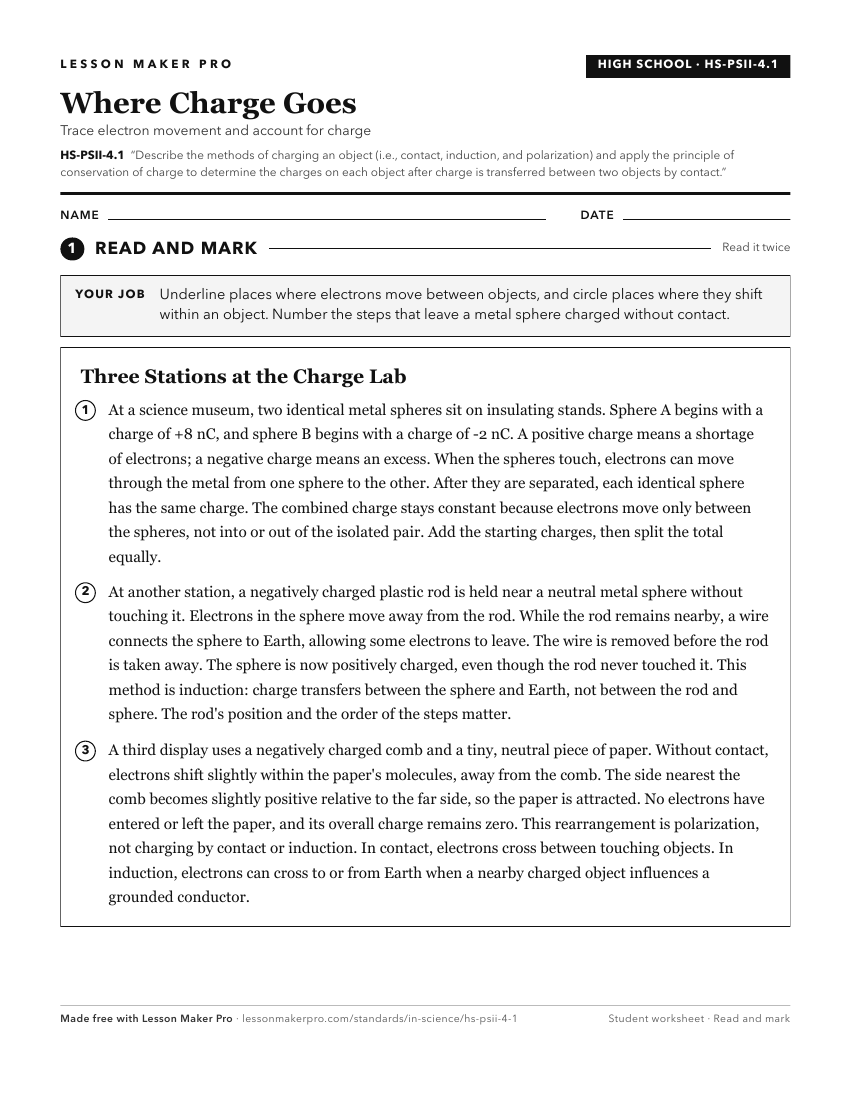
A ready-to-print activity worksheet aligned to HS-PSII-4.1, with an answer key for the teacher on its own page. No account needed.
PDF, US Letter, prints cleanly in black and white.
Download the worksheetKeep exploring
Related Standards
- HS-PSII-4.3
Using Coulomb's law, pictorially and mathematically describe the force on a stationary charge due to other stationary charges. Understand that these forces are ...
- HS-PSII-4.2
For a single isolated charge, develop and apply graphical and mathematical representations that describe the relationship between the amount of charge, the dist...
- HS-PSII-4.7
Apply conservation of energy to determine changes in the electric potential energy, translational kinetic energy, and speed of a single charged object (i.e., a ...
- HS-PSII-4.4
For a single isolated charge, develop graphical and mathematical representations that describe the relationship between the amount of charge, the distance from ...
Turn this exact standard into a lesson
Grade, subject, topic, and the complete standard are prefilled. Create one free, no account needed.
Also for this standard:Make a WorksheetMake a QuizMake a Sub Lesson