Indiana Science HS-PSII-4.4
The Standard
For a single isolated charge, develop graphical and mathematical representations that describe the relationship between the amount of charge, the distance from the charge and the electric potential created by the charge and apply those representations to qualitatively and quantitatively describe how changing either the amount of charge or distance from the charge affects the electric potential.
Indiana Academic Standards for Science (2023) · Electricity
Teacher's field guide
What This Standard Means
What Students Need to Do
- Students calculate electric potential around one point charge using V = kQ/r, with distance measured from the charge. They graph potential against distance and charge, then predict how either change affects potential.
What Mastery Looks Like
- At a fixed distance, students show that doubling the charge doubles the potential, including its sign. At a fixed charge, they graph a curve and calculate that doubling the distance halves the potential.
Common Misconceptions
- Students may use r² in the potential formula, confusing it with the electric field formula. They may think a negative charge produces positive potential because distance is positive.
How to Assess It
- Exit ticket: A +2 nC point charge produces +18 V at 1 m. Find the potential at 2 m, then sketch potential against distance for the positive charge.
Lesson moves
Ways to Teach It
Place a +1 nC charge card on the floor; use a meterstick to mark 0.25, 0.5, and 1 m, then calculate and plot V.
Ask: At 1 m, how do potentials from +2 nC and −2 nC compare, and which has the greater magnitude?
Deal cards labeled +1 nC, −1 nC, 0.5 m, and 1 m; students match pairs and rank their potentials.
Treat a balloon carrying +1 nC as a point charge; calculate its potential at 0.5 m and 1 m.
Free download
Printable HS-PSII-4.4 Worksheet
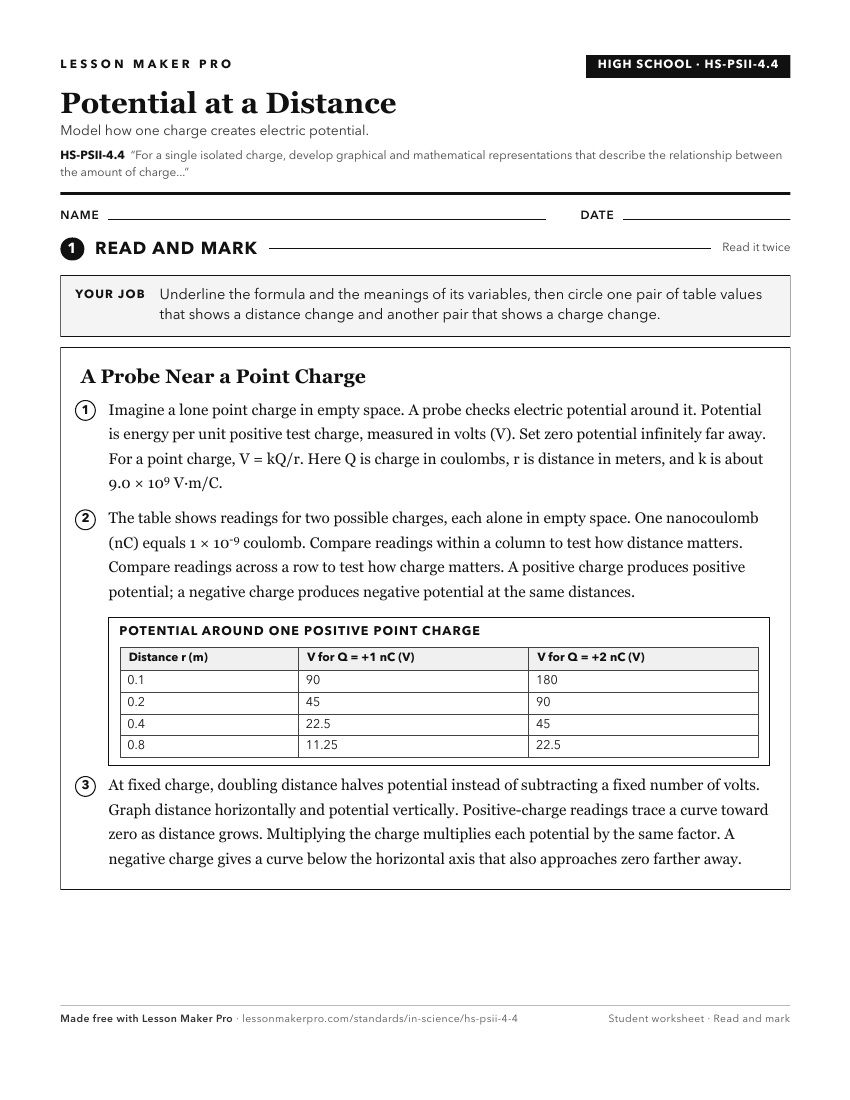
A ready-to-print activity worksheet aligned to HS-PSII-4.4, with an answer key for the teacher on its own page. No account needed.
PDF, US Letter, prints cleanly in black and white.
Download the worksheetKeep exploring
Related Standards
- HS-PSII-4.2
For a single isolated charge, develop and apply graphical and mathematical representations that describe the relationship between the amount of charge, the dist...
- HS-PSII-6.2
Develop and apply a mathematical representation that describes the relationship between the magnetic field created by a long straight wire carrying an electric ...
- HS-PSII-4.7
Apply conservation of energy to determine changes in the electric potential energy, translational kinetic energy, and speed of a single charged object (i.e., a ...
Turn this exact standard into a lesson
Grade, subject, topic, and the complete standard are prefilled. Create one free, no account needed.
Also for this standard:Make a WorksheetMake a QuizMake a Sub Lesson