Indiana Science HS-PSII-4.5
The Standard
Map electric fields and equipotential lines, showing the electric field lines are perpendicular to the equipotential lines, and draw conclusions about the motion of a charged particle either between or along equipotential lines due the electric field.
Indiana Academic Standards for Science (2023) · Electricity
Teacher's field guide
What This Standard Means
What Students Need to Do
- Students connect points with the same voltage to make equipotential lines. They draw electric field lines crossing them at right angles and predict how positive and negative charges accelerate.
What Mastery Looks Like
- Given a voltage map, a student draws field arrows perpendicular to the equipotential lines, pointing from higher to lower voltage. They predict that a released positive charge accelerates with the arrows and a negative charge accelerates against them. They know the field does no work on a charge moved along an equipotential line.
Common Misconceptions
- Students may draw field arrows along equipotential lines or point them toward higher voltage. They may think negative charges accelerate with the arrows, or that a released charge will stay on an equipotential line.
How to Assess It
- Draw three vertical lines labeled 6 V, 4 V, and 2 V from left to right. Ask students to add two field arrows, predict which way a positive charge released on the 4 V line accelerates, and state whether the field does work if the charge moves along that line.
Lesson moves
Ways to Teach It
Use conductive paper, two electrodes, a battery, and a voltmeter to plot equal-voltage points, then draw field lines crossing them at right angles.
Ask: Why does a released positive charge accelerate from 6 V toward 2 V, while the field does no work along a 6 V line?
Give pairs a printed parallel-plate voltage map; have them race to draw field arrows and predict directions for released positive and negative charges.
Show a diagram of a positive inkjet droplet between charged printer plates; students sketch equipotentials and predict which plate attracts it.
Free download
Printable HS-PSII-4.5 Worksheet
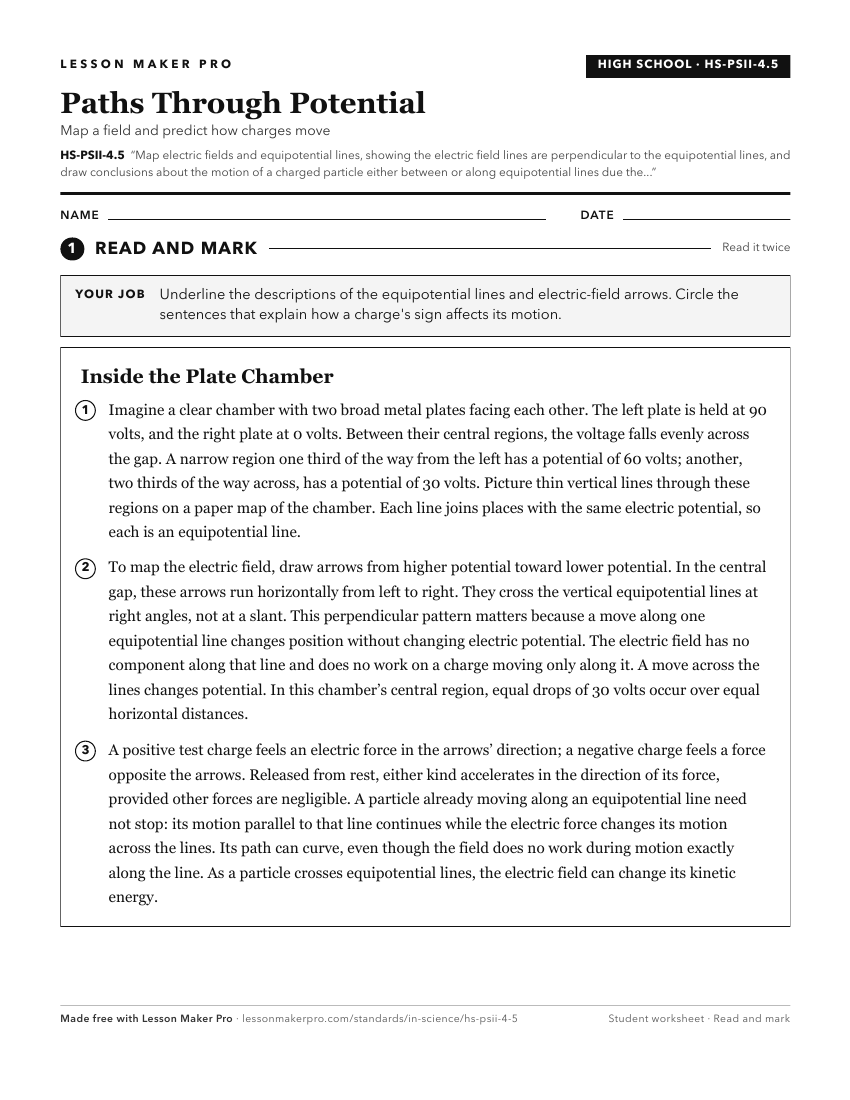
A ready-to-print activity worksheet aligned to HS-PSII-4.5, with an answer key for the teacher on its own page. No account needed.
PDF, US Letter, prints cleanly in black and white.
Download the worksheetKeep exploring
Related Standards
- HS-PSII-6.4
Determine the magnitude of the magnetic force acting on a charged particle moving through a uniform magnetic field and apply the right hand rule to determine th...
- HS-PSII-4.2
For a single isolated charge, develop and apply graphical and mathematical representations that describe the relationship between the amount of charge, the dist...
- HS-PSII-4.7
Apply conservation of energy to determine changes in the electric potential energy, translational kinetic energy, and speed of a single charged object (i.e., a ...
- HS-PSII-4.4
For a single isolated charge, develop graphical and mathematical representations that describe the relationship between the amount of charge, the distance from ...
Turn this exact standard into a lesson
Grade, subject, topic, and the complete standard are prefilled. Create one free, no account needed.
Also for this standard:Make a WorksheetMake a QuizMake a Sub Lesson