Indiana Science HS-PSII-4.6
The Standard
Distinguish between electric potential energy and electric potential (i.e., voltage).
Indiana Academic Standards for Science (2023) · Electricity
Teacher's field guide
What This Standard Means
What Students Need to Do
- Students identify electric potential energy as energy a charge has at a location in an electric field. They identify electric potential as energy per coulomb and voltage as the difference between two potentials. They calculate energy change with ΔU = qΔV.
What Mastery Looks Like
- For a 3 V increase, a student calculates that a 1 C positive charge gains 3 J, while a 2 C positive charge gains 6 J. They explain why the voltage is the same for both charges.
Common Misconceptions
- Students may call voltage the total energy a charge has. They may think doubling the charge doubles the voltage, rather than doubling its energy change across the same voltage.
How to Assess It
- Exit ticket: Two positive charges, 1 C and 2 C, each move to a point 3 V above their starting point. Find each energy change and explain what stays the same.
Lesson moves
Ways to Teach It
Measure one AA battery and two in series with a multimeter, then calculate the energy each setup supplies to 1 C of charge.
Ask students to explain in writing why moving twice as much charge across the same battery does not double its voltage.
Give pairs of charge and voltage cards; have students match each pair to its energy change using ΔU = qΔV.
Read the 5 V and 9 V settings on a phone charger label, then calculate the energy supplied per coulomb at each setting.
Free download
Printable HS-PSII-4.6 Worksheet
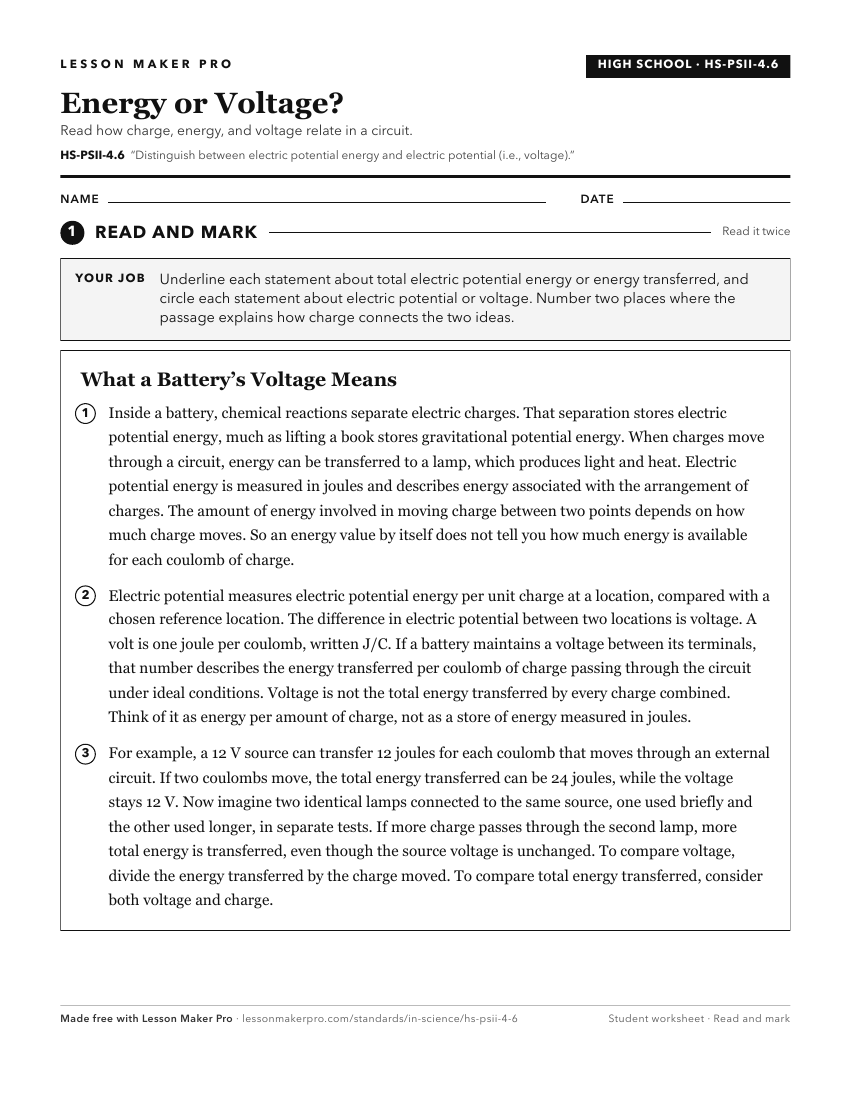
A ready-to-print activity worksheet aligned to HS-PSII-4.6, with an answer key for the teacher on its own page. No account needed.
PDF, US Letter, prints cleanly in black and white.
Download the worksheetKeep exploring
Related Standards
- HS-PSII-4.5
Map electric fields and equipotential lines, showing the electric field lines are perpendicular to the equipotential lines, and draw conclusions about the motio...
- HS-PSII-5.1
Relate the idea of electric potential energy to electric potential (i.e., voltage) in the context of electric circuits.
- HS-PSII-4.7
Apply conservation of energy to determine changes in the electric potential energy, translational kinetic energy, and speed of a single charged object (i.e., a ...
- HS-PSII-4.4
For a single isolated charge, develop graphical and mathematical representations that describe the relationship between the amount of charge, the distance from ...
Turn this exact standard into a lesson
Grade, subject, topic, and the complete standard are prefilled. Create one free, no account needed.
Also for this standard:Make a WorksheetMake a QuizMake a Sub Lesson