Indiana Science HS-PSII-2.6
The Standard
Using PV graphs, qualitatively and quantitatively determine how changes in the pressure, volume, or temperature of an ideal gas allow the gas to do work and classify the work as either done on or done by the gas.
Indiana Academic Standards for Science (2023) · Temperature and Thermal Energy Transfer
Teacher's field guide
What This Standard Means
What Students Need to Do
- Students trace a gas's path on a pressure-volume graph and identify expansion or compression. They find work from the area under the path. They use pressure and volume changes to reason about temperature and who does the work.
What Mastery Looks Like
- A student labels expansion as work done by the gas and compression as work done on it. For a constant-pressure step, they multiply pressure by the change in volume and report joules. They identify zero work at constant volume, even if pressure and temperature rise.
Common Misconceptions
- Students may use only the start and end points, missing that different paths can give different work. Some think a temperature rise always means the gas does work, even when volume stays fixed. Others reverse who does the work during compression.
How to Assess It
- Exit ticket: A gas expands at a constant 200,000 Pa from 0.002 to 0.005 m³, then warms at fixed volume. Sketch the PV path, calculate total work in joules, and name who does it.
Lesson moves
Ways to Teach It
Cover a needle-free syringe tip, push and release the plunger, then sketch compression and expansion on a pressure-volume graph.
Ask: If a gas warms in a rigid container, does it do work? Have students explain using a vertical PV line.
Give pairs constant-pressure PV cards labeled in pascals and cubic meters; they calculate work and identify who does it.
Show a bicycle pump diagram; students trace compression on a PV graph and explain why pushing the handle does work on the air.
Free download
Printable HS-PSII-2.6 Worksheet
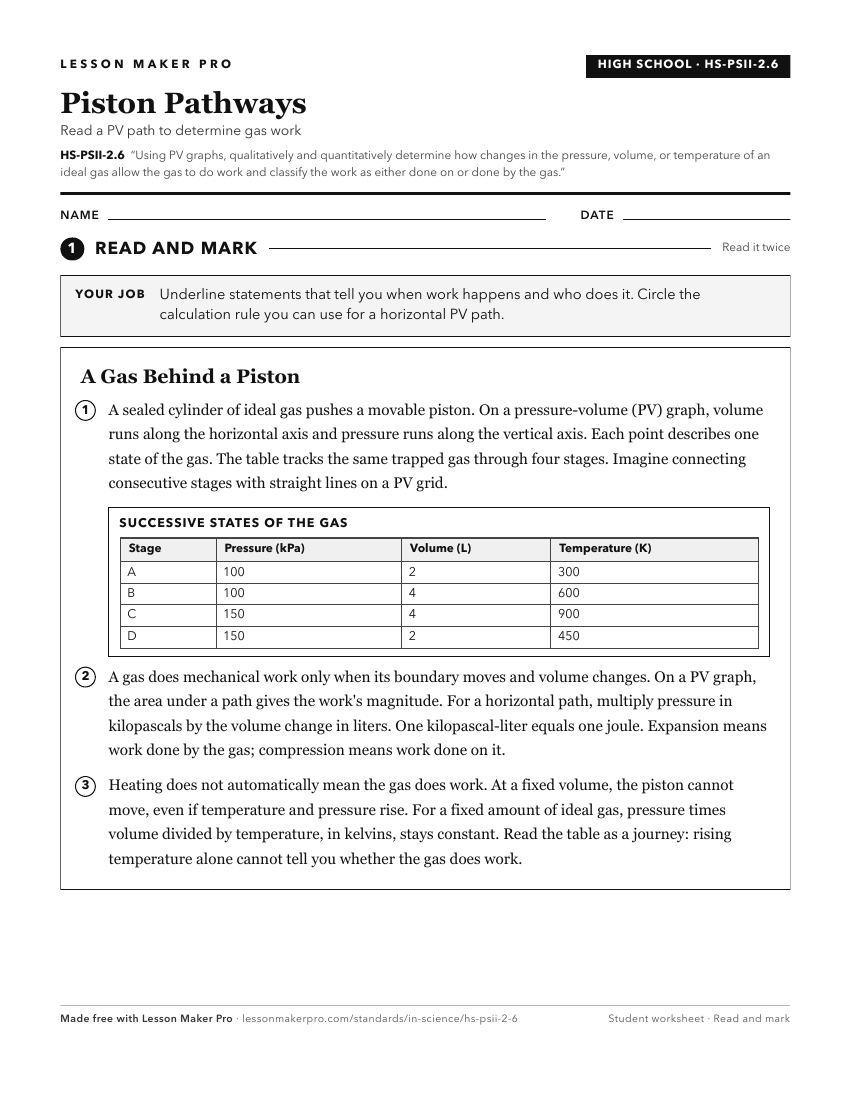
A ready-to-print activity worksheet aligned to HS-PSII-2.6, with an answer key for the teacher on its own page. No account needed.
PDF, US Letter, prints cleanly in black and white.
Download the worksheetKeep exploring
Related Standards
- HS-PSII-2.4
Develop graphical and mathematical representations that describe the relationship among the volume, temperature, and number of molecules of an ideal gas in a cl...
- HS-PSII-2.1
Develop graphical and mathematical representations that describe the relationship among the temperature, thermal energy, and thermal energy transfer (i.e., heat...
- HS-PSII-2.5
Describe the slope of the graphical representation of pressure vs. the product of: the number of particles, temperature of the gas, and inverse of the volume of...
Turn this exact standard into a lesson
Grade, subject, topic, and the complete standard are prefilled. Create one free, no account needed.
Also for this standard:Make a WorksheetMake a QuizMake a Sub Lesson