Indiana Science HS-AP3-5
The Standard
Compare and contrast the major types of joints and construct an argument how these structural components influence functional mobility and stability.
Indiana Academic Standards for Science (2023) · Movement and Support, the Skeletal System
Teacher's field guide
What This Standard Means
What Students Need to Do
- Students compare fibrous, cartilaginous, and synovial joints by their structure and movement. They use features such as socket shape and ligaments to explain why some joints move more freely while others provide more stability.
What Mastery Looks Like
- Given diagrams of a skull suture, spinal disc, elbow, and shoulder, a student identifies each joint type and describes its movement. They can explain why the shoulder moves more freely than the hip but is easier to dislocate.
Common Misconceptions
- Students may think every joint moves freely, including skull sutures. They may also think all ball-and-socket joints have the same range of motion and stability, overlooking socket depth and supporting tissues.
How to Assess It
- Exit ticket: Classify a skull suture, spinal disc, elbow, and shoulder by joint type. Compare how the shapes of the elbow and shoulder affect movement and stability.
Lesson moves
Ways to Teach It
Join two cardboard strips with a brass fastener, then place a ping-pong ball in a paper cup to compare movement.
Show diagrams of a skull suture, knee, and shoulder; ask students which moves most and what limits each joint.
Give pairs cards showing a skull suture, spinal disc, elbow, and shoulder; have them sort by joint type and explain each choice.
Show shoulder and hip diagrams, then ask why a fall may dislocate a shoulder more easily than a hip.
Free download
Printable HS-AP3-5 Worksheet
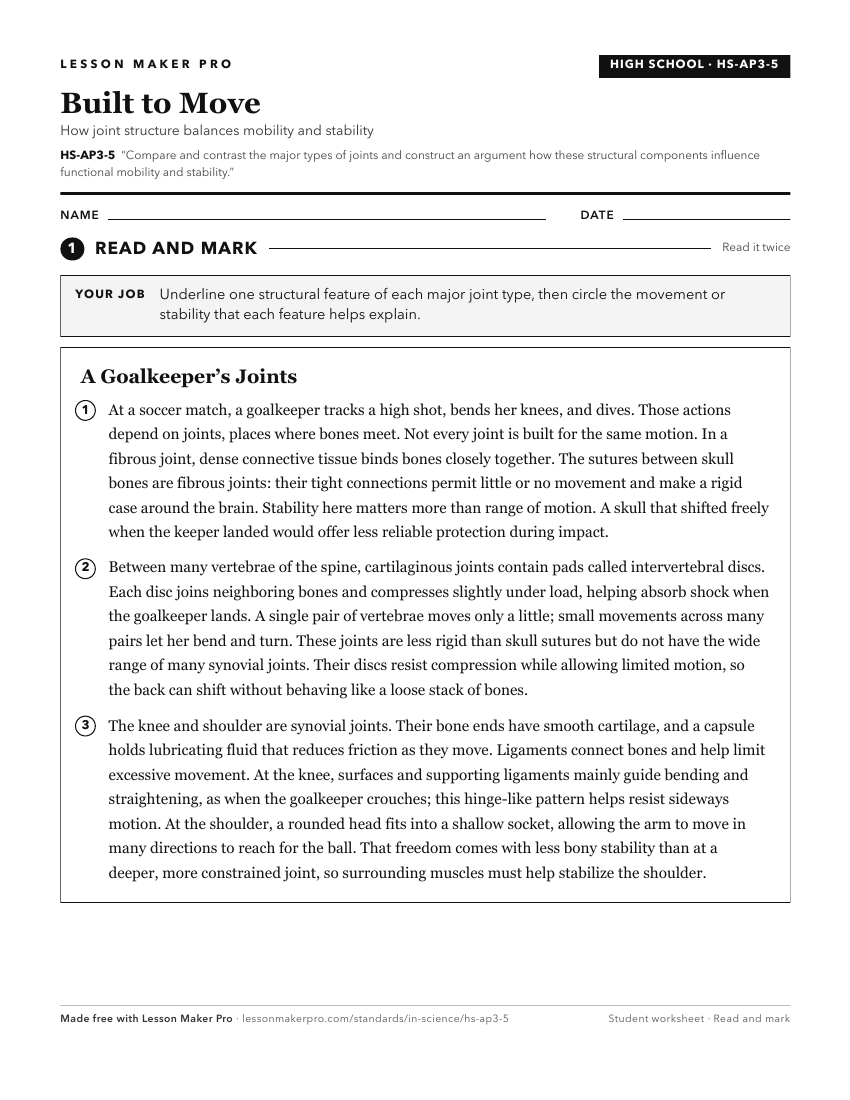
A ready-to-print activity worksheet aligned to HS-AP3-5, with an answer key for the teacher on its own page. No account needed.
PDF, US Letter, prints cleanly in black and white.
Download the worksheetKeep exploring
Related Standards
- HS-AP3-2
Observe the characteristics of a bone from the axial or appendicular skeleton. Then construct an argument to support how the structure determines the function
- HS-AP1-3
Compare and contrast the relationships among the various tissue types as well as the molecular and cellular composition of these tissues.
- HS-AP3-4
Compare and contrast the different types of bone (e.g., long, short, flat, and irregular.
- HS-AP4-1
Compare and contrast between the structural and functional characteristics of skeletal, cardiac, and smooth muscle.
Turn this exact standard into a lesson
Grade, subject, topic, and the complete standard are prefilled. Create one free, no account needed.
Also for this standard:Make a WorksheetMake a QuizMake a Sub Lesson