Indiana Science HS-AP1-3
The Standard
Compare and contrast the relationships among the various tissue types as well as the molecular and cellular composition of these tissues.
Indiana Academic Standards for Science (2023) · Levels of Organization in the Human Body
Teacher's field guide
What This Standard Means
What Students Need to Do
- Students compare epithelial, connective, muscle, and nervous tissue. They describe how the cells are arranged, name molecules that help each tissue do its job, and explain how the tissues work together in an organ.
What Mastery Looks Like
- Given tissue images, a student identifies each type and points to evidence such as cell spacing or visible fibers. They can explain how the stomach’s lining, support tissue, muscle, and nerves work together.
Common Misconceptions
- Students may think all tissues have tightly packed cells. They may mistake collagen fibers for cells or not realize that blood is a type of connective tissue.
How to Assess It
- Give students a labeled stomach-wall diagram showing the lining, support layer, muscle, and nerves. Ask them to name each tissue, give one cell or molecule linked to each, and explain how two layers work together.
Lesson moves
Ways to Teach It
Give pairs beads, yarn, and paper to build four tissue models, then label cells, collagen, and muscle fibers.
Ask students to write why a stomach needs a lining, connective support, contracting muscle, and nerve signals.
Play tissue detective: match four microscope images to cards naming cells, molecules, and jobs, then defend each match.
Show a cut-finger diagram and ask students to mark damaged epithelium, connective tissue, and nerve endings.
Free download
Printable HS-AP1-3 Worksheet
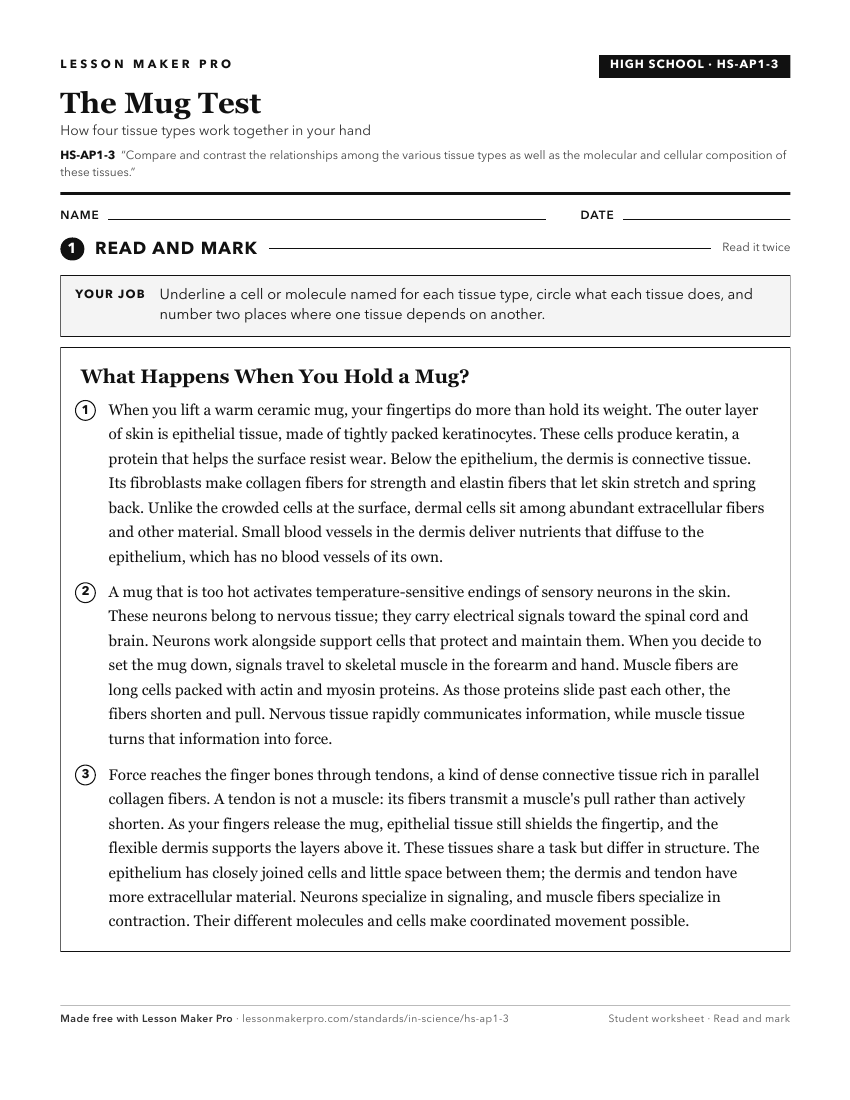
A ready-to-print activity worksheet aligned to HS-AP1-3, with an answer key for the teacher on its own page. No account needed.
PDF, US Letter, prints cleanly in black and white.
Download the worksheetKeep exploring
Related Standards
- HS-AP1-4
Compare and contrast the histological structure between the 4 basic tissue types.
- HS-AP1-5
Compare and contrast the major organ systems and describe their basic functional importance.
- HS-AP3-4
Compare and contrast the different types of bone (e.g., long, short, flat, and irregular.
- HS-AP4-1
Compare and contrast between the structural and functional characteristics of skeletal, cardiac, and smooth muscle.
Turn this exact standard into a lesson
Grade, subject, topic, and the complete standard are prefilled. Create one free, no account needed.
Also for this standard:Make a WorksheetMake a QuizMake a Sub Lesson