Indiana Science HS-AP4-1
The Standard
Compare and contrast between the structural and functional characteristics of skeletal, cardiac, and smooth muscle.
Indiana Academic Standards for Science (2023) · Movement and Support, the Muscular System
Teacher's field guide
What This Standard Means
What Students Need to Do
- Students compare skeletal, cardiac, and smooth muscle by how the cells look, where they are found, and what they do. They explain which muscles they can control and which work without conscious effort.
What Mastery Looks Like
- A student can identify all three types in unlabeled microscope images using stripes, branches, and cell shape. They can connect each image to moving bones, pumping blood, or moving material through organs.
Common Misconceptions
- Students may think all striped muscle is under conscious control, including heart muscle. They may also think smooth muscle moves bones, or that “smooth” means the tissue feels soft.
How to Assess It
- Show three unlabeled muscle images. Ask students to name each type, circle one visible clue, and write one job it does in the body.
Lesson moves
Ways to Teach It
Give pairs printed muscle images and sticky notes; have them mark stripes, branches, and cell shapes before naming each type.
Ask students to write why they can choose to lift a book but cannot choose to stop their heartbeat.
Play three-clue rounds: read cell features and locations aloud, then have students hold up skeletal, cardiac, or smooth cards.
Have students match a sore biceps, a racing pulse, and food moving through the gut to the three muscle types.
Free download
Printable HS-AP4-1 Worksheet
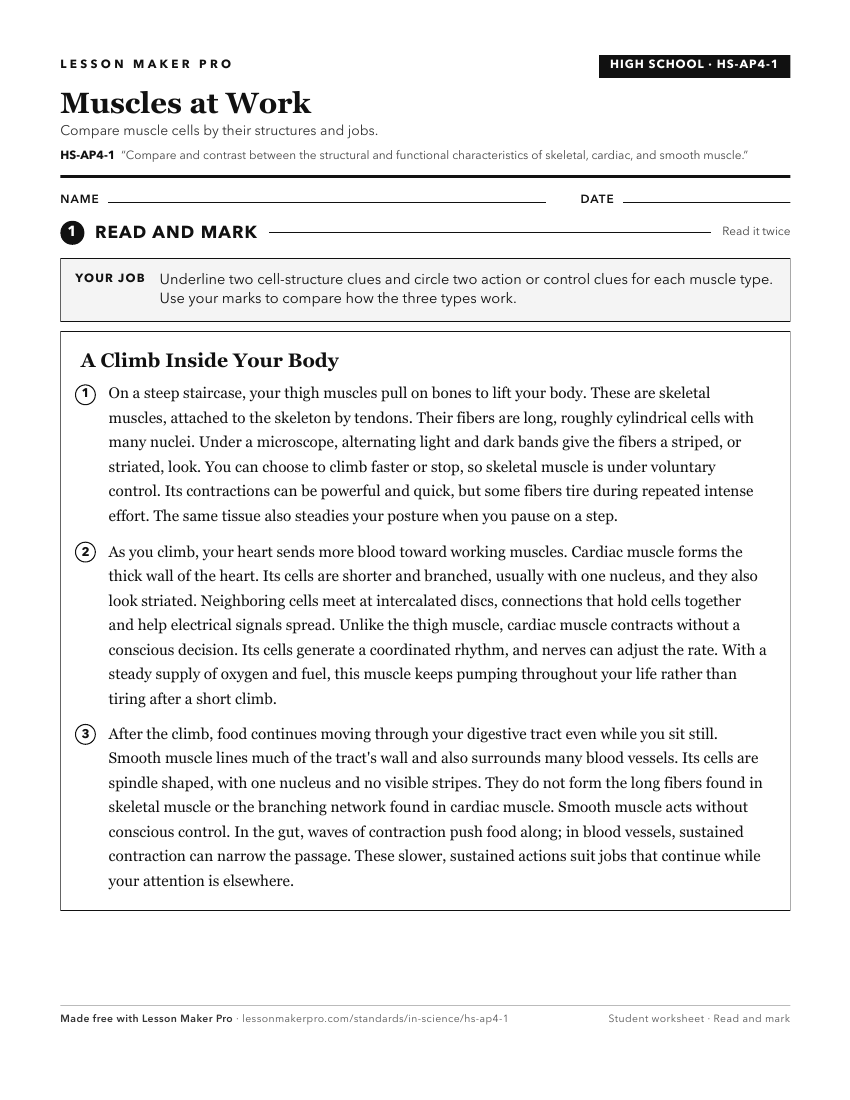
A ready-to-print activity worksheet aligned to HS-AP4-1, with an answer key for the teacher on its own page. No account needed.
PDF, US Letter, prints cleanly in black and white.
Download the worksheetKeep exploring
Related Standards
- HS-AP1-4
Compare and contrast the histological structure between the 4 basic tissue types.
- HS-AP5-3
Compare and contrast the actions, origins, and pathways of nerve fibers in the parasympathetic and sympathetic divisions of the autonomic nervous system.
- HS-AP1-3
Compare and contrast the relationships among the various tissue types as well as the molecular and cellular composition of these tissues.
- HS-AP3-4
Compare and contrast the different types of bone (e.g., long, short, flat, and irregular.
Turn this exact standard into a lesson
Grade, subject, topic, and the complete standard are prefilled. Create one free, no account needed.
Also for this standard:Make a WorksheetMake a QuizMake a Sub Lesson