Indiana Science HS-AP3-2
The Standard
Observe the characteristics of a bone from the axial or appendicular skeleton. Then construct an argument to support how the structure determines the function
Indiana Academic Standards for Science (2023) · Movement and Support, the Skeletal System
Teacher's field guide
What This Standard Means
What Students Need to Do
- Students inspect a bone or bone model and name visible features, such as a vertebra’s opening or a femur’s thick shaft. They explain how a feature helps the bone do its job.
What Mastery Looks Like
- A student can point to the opening in a vertebra and explain how the bone around it protects the spinal cord. They use that visible feature as evidence, not just a general statement about support.
Common Misconceptions
- Students may say every bone only supports weight, missing jobs such as protection and movement. They may think the opening in a vertebra serves no purpose because it looks like empty space.
How to Assess It
- Show a photo of a vertebra viewed from above. Ask: “Name one visible feature, explain what job it helps the bone do, and use its shape as evidence.”
Lesson moves
Ways to Teach It
Pass around a vertebra model and have pairs sketch its opening, then label what passes through it and what protects it.
Ask students to write: “Why does a femur have a thick shaft and a rounded head?” Require a job for each feature.
Give pairs bone photo cards and function cards; have them match visible features to jobs and explain one match aloud.
Show a hip replacement diagram and ask why the artificial femoral head is rounded rather than flat.
Free download
Printable HS-AP3-2 Worksheet
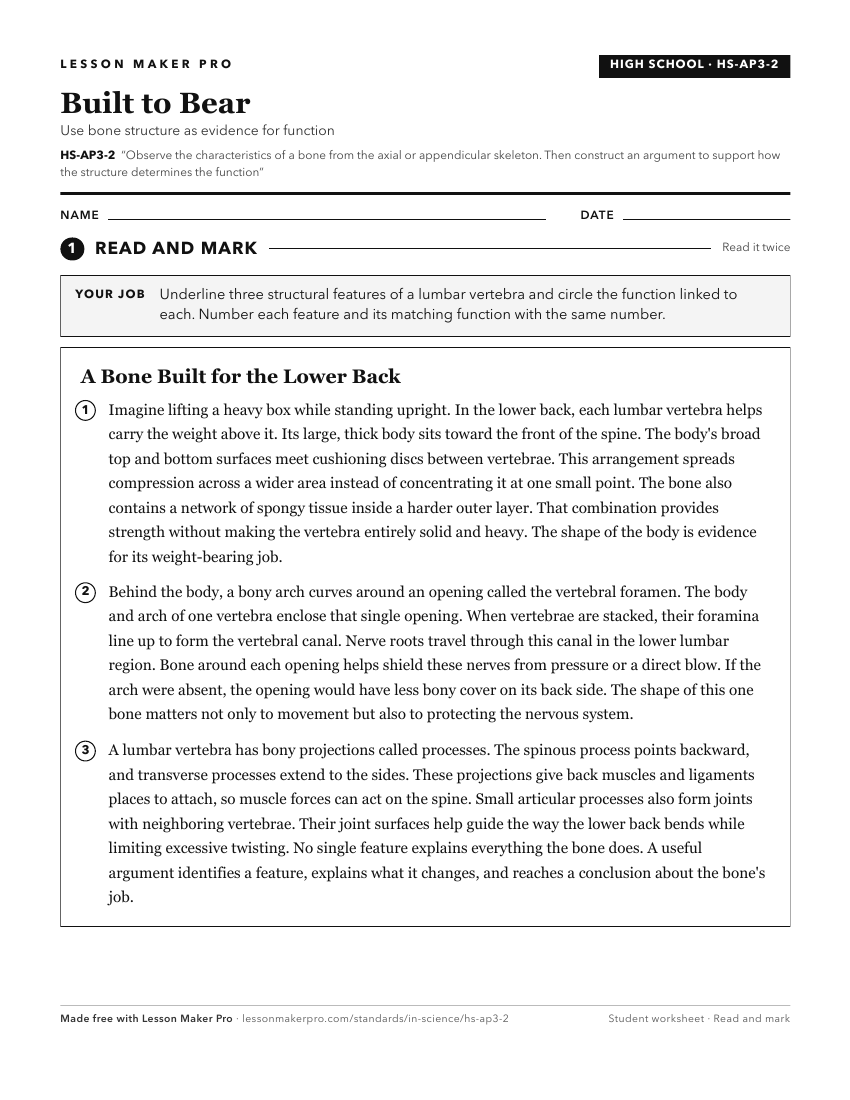
A ready-to-print activity worksheet aligned to HS-AP3-2, with an answer key for the teacher on its own page. No account needed.
PDF, US Letter, prints cleanly in black and white.
Download the worksheetKeep exploring
Related Standards
- HS-AP3-1
Develop a model to illustrate the microscopic structure, development of, maintenance of, and function of compact and spongy bone.
- HS-AP3-5
Compare and contrast the major types of joints and construct an argument how these structural components influence functional mobility and stability.
- HS-AP3-3
Locate and identify individual bones of the axial and appendicular skeleton and unique features of bones.
- HS-AP3-4
Compare and contrast the different types of bone (e.g., long, short, flat, and irregular.
Turn this exact standard into a lesson
Grade, subject, topic, and the complete standard are prefilled. Create one free, no account needed.
Also for this standard:Make a WorksheetMake a QuizMake a Sub Lesson