Indiana Science HS-AP3-3
The Standard
Locate and identify individual bones of the axial and appendicular skeleton and unique features of bones.
Indiana Academic Standards for Science (2023) · Movement and Support, the Skeletal System
Teacher's field guide
What This Standard Means
What Students Need to Do
- Students locate and name bones on a skeleton model or diagram. They sort bones into axial and appendicular groups and point out features such as the head of the femur.
What Mastery Looks Like
- Given an unlabeled skeleton, a student names bones such as the sternum, vertebrae, scapula, and femur. They classify each bone and identify a feature on a close-up image.
Common Misconceptions
- Students may classify the hip bones as axial because they sit next to the spine. They often swap the radius and ulna or mistake a bone's head for a separate bone.
How to Assess It
- Give students an unlabeled skeleton and a close-up of a femur. Ask them to label the sternum, scapula, and femur, classify each, and circle the femoral head.
Lesson moves
Ways to Teach It
Give pairs printed bone cutouts to sort into axial and appendicular piles, then have them circle the head of the femur.
Ask, "Why is the clavicle appendicular even though it sits near the chest?" Have students defend their answer using its connection to the arm.
Show bone photo cards; teams earn a point for naming each bone, classifying it, and pointing to one visible feature.
Show an ankle X-ray; students label the tibia, fibula, and the ankle bump formed by each bone.
Free download
Printable HS-AP3-3 Worksheet
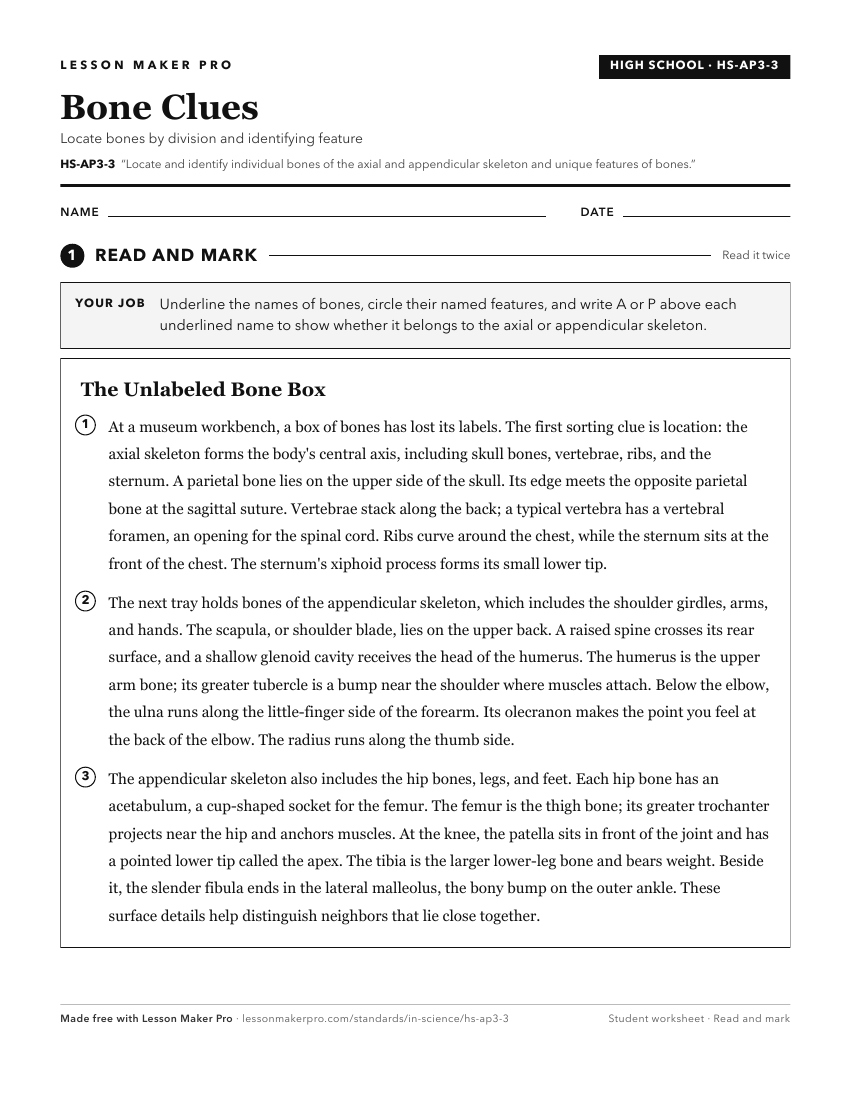
A ready-to-print activity worksheet aligned to HS-AP3-3, with an answer key for the teacher on its own page. No account needed.
PDF, US Letter, prints cleanly in black and white.
Download the worksheetKeep exploring
Related Standards
- HS-AP3-1
Develop a model to illustrate the microscopic structure, development of, maintenance of, and function of compact and spongy bone.
- HS-AP3-2
Observe the characteristics of a bone from the axial or appendicular skeleton. Then construct an argument to support how the structure determines the function
- HS-AP1-6
Identify anatomical terms (including anatomical orientation, regions, planes) on a diagram, model, or through dissection.
- HS-AP3-4
Compare and contrast the different types of bone (e.g., long, short, flat, and irregular.
Turn this exact standard into a lesson
Grade, subject, topic, and the complete standard are prefilled. Create one free, no account needed.
Also for this standard:Make a WorksheetMake a QuizMake a Sub Lesson