Indiana Science HS-AP3-1
The Standard
Develop a model to illustrate the microscopic structure, development of, maintenance of, and function of compact and spongy bone.
Indiana Academic Standards for Science (2023) · Movement and Support, the Skeletal System
Teacher's field guide
What This Standard Means
What Students Need to Do
- Students draw or build a model of compact bone and spongy bone. They show how bone forms during growth, how cells renew it, and how each structure supports the body.
What Mastery Looks Like
- Students place osteons and central canals in compact bone, and trabeculae and marrow spaces in spongy bone. They show cartilage being replaced during long-bone growth, with osteoblasts building bone and osteoclasts removing it. They explain how compact bone resists force and spongy bone handles stress without adding much weight.
Common Misconceptions
- Students may draw spongy bone as soft foam instead of hard, connected struts. They may put osteons in spongy bone or think bone stops changing after growth.
How to Assess It
- Exit ticket: Sketch a growing long bone with one osteon and one trabecula. Label the growth plate, show where osteoblasts build bone and osteoclasts remove it, and explain what each bone structure does.
Lesson moves
Ways to Teach It
Use clay rings around a straw to build an osteon, then connect toothpicks as trabeculae and label the spaces between them.
Ask students to write: Why can a bone be strong without being solid all the way through? Require osteons and trabeculae in the answer.
Give pairs cell, structure, and function cards to match, including osteoblast, osteoclast, osteon, and trabecula.
Show healthy and osteoporosis bone images, then have students mark missing trabeculae and predict how fracture risk changes.
Free download
Printable HS-AP3-1 Worksheet
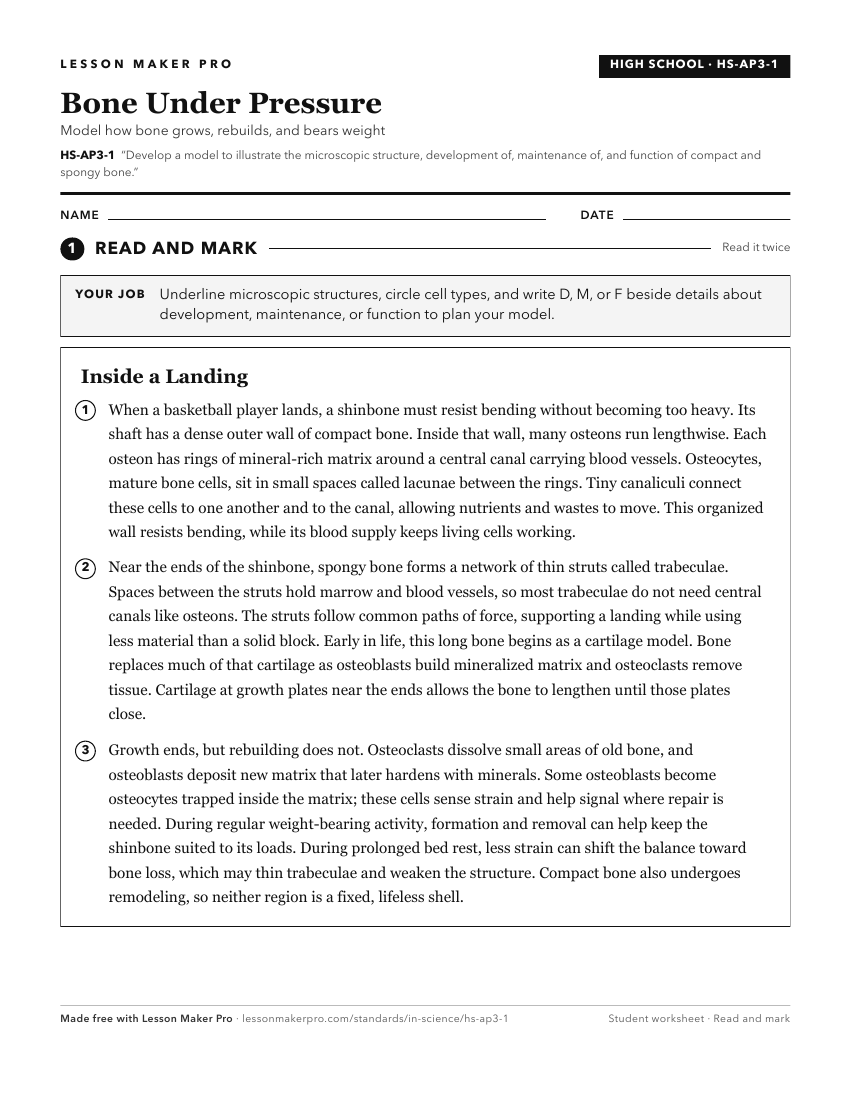
A ready-to-print activity worksheet aligned to HS-AP3-1, with an answer key for the teacher on its own page. No account needed.
PDF, US Letter, prints cleanly in black and white.
Download the worksheetKeep exploring
Related Standards
- HS-AP3-2
Observe the characteristics of a bone from the axial or appendicular skeleton. Then construct an argument to support how the structure determines the function
- HS-AP5-1
Develop a model that illustrates the structural components and functional subdivisions of the nervous system.
- HS-AP1-2
Develop and use a model to illustrate the hierarchical organization of structural body systems that provide specific functions within the Human Body.
- HS-AP4-2
Develop a model to illustrate the components of a muscle fiber and how they interact in contraction and relaxation.
Turn this exact standard into a lesson
Grade, subject, topic, and the complete standard are prefilled. Create one free, no account needed.
Also for this standard:Make a WorksheetMake a QuizMake a Sub Lesson