Indiana Science HS-AP5-1
The Standard
Develop a model that illustrates the structural components and functional subdivisions of the nervous system.
Indiana Academic Standards for Science (2023) · Integration and Coordination, the Nervous System
Teacher's field guide
What This Standard Means
What Students Need to Do
- Students draw and label the brain, spinal cord, and peripheral nerves. They trace sensory signals into the central nervous system and motor signals out through somatic and autonomic pathways.
What Mastery Looks Like
- A student labels the brain and spinal cord as central, and nerves as peripheral. They trace a hot-pan signal in through a sensory nerve and a response out through a somatic motor nerve. They show sympathetic and parasympathetic signals changing heart rate in opposite directions.
Common Misconceptions
- Students may place the spinal cord in the peripheral nervous system or think sensory nerves carry commands to muscles. Some think autonomic actions are voluntary or mix up the effects of sympathetic and parasympathetic signals on heart rate.
How to Assess It
- Exit ticket: Draw a nervous system map with the brain, spinal cord, and nerves. Use arrows to show sensory input, somatic motor output, and the opposite effects of sympathetic and parasympathetic signals on heart rate.
Lesson moves
Ways to Teach It
Use string, paper labels, and a body outline to map a sensory path to the spinal cord and a motor path to a hand muscle.
Ask: Why can your hand pull away from heat before you decide to move it? Have students explain using their diagrams.
Have pairs race to arrange skin, sensory nerve, spinal cord, motor nerve, muscle, and brain cards into a reflex pathway with branching arrows.
Compare resting and post-walk pulse counts, then mark sympathetic and parasympathetic effects on a sketch of the heart.
Free download
Printable HS-AP5-1 Worksheet
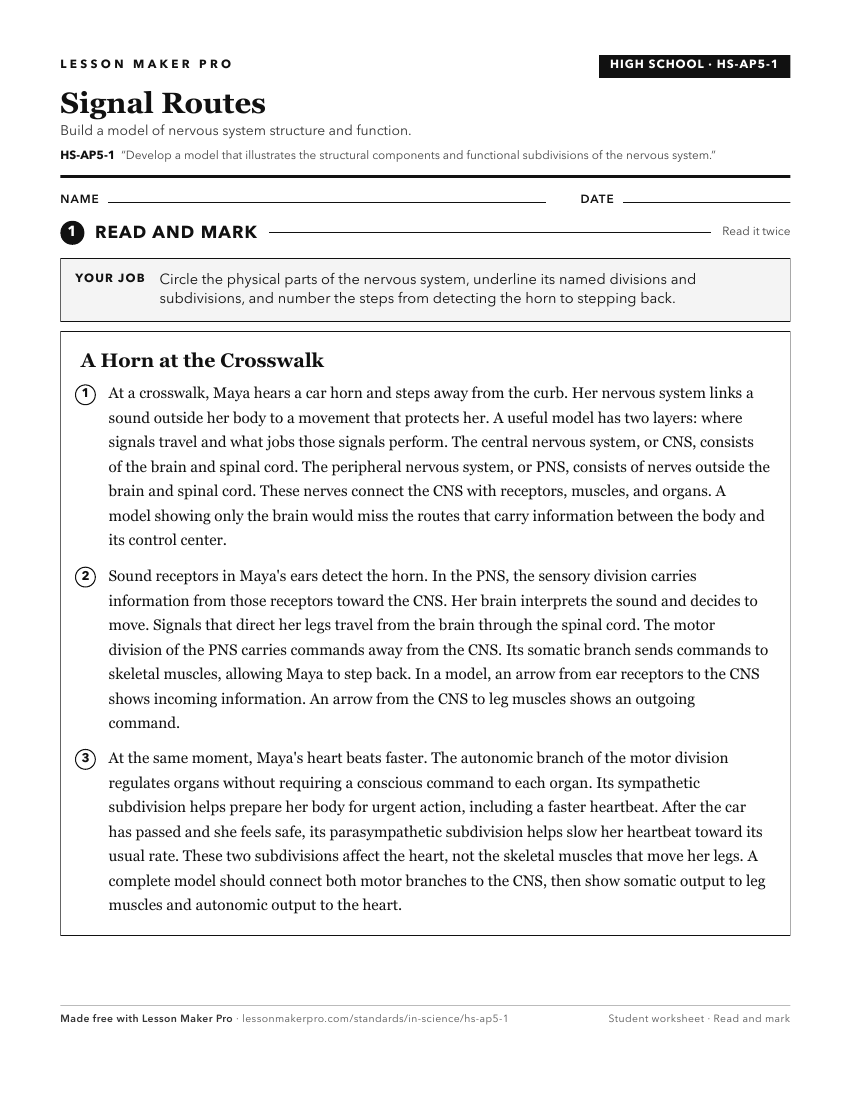
A ready-to-print activity worksheet aligned to HS-AP5-1, with an answer key for the teacher on its own page. No account needed.
PDF, US Letter, prints cleanly in black and white.
Download the worksheetKeep exploring
Related Standards
- HS-AP3-1
Develop a model to illustrate the microscopic structure, development of, maintenance of, and function of compact and spongy bone.
- HS-AP5-2
Observe and identify the structure and function of the various neurons and neuroglia. Explain how the varying structures determine the specified function.
- HS-AP1-2
Develop and use a model to illustrate the hierarchical organization of structural body systems that provide specific functions within the Human Body.
Turn this exact standard into a lesson
Grade, subject, topic, and the complete standard are prefilled. Create one free, no account needed.
Also for this standard:Make a WorksheetMake a QuizMake a Sub Lesson