Indiana Science HS-AP12-3
The Standard
Develop a model of the nephron to explore its structural components, associated hormones, and the functional processes of filtration, excretion, secretion, and reabsorption.
Indiana Academic Standards for Science (2023) · Absorption and Excretion, the Urinary System
Teacher's field guide
What This Standard Means
What Students Need to Do
- Students build a nephron model that shows where blood is filtered and how materials move between the tubule and blood. They use it to explain what leaves as urine and how hormones change water and salt movement.
What Mastery Looks Like
- A student can show filtration into the nephron, reabsorption back to blood, secretion into the tubule, and excretion as urine. They can show that ADH increases water reabsorption and aldosterone increases sodium reabsorption and potassium secretion.
Common Misconceptions
- Students may think everything filtered from blood leaves as urine, including glucose and most water. They may confuse secretion into the tubule with excretion from the body, or think hormones filter the blood directly.
How to Assess It
- Give students a blank nephron diagram. Ask them to draw arrows for filtration, reabsorption, secretion, and excretion, then mark how ADH and aldosterone change water and salt movement.
Lesson moves
Ways to Teach It
Lay yarn for a labeled nephron and blood vessel; move water, salt, and waste beads across them, then collect urine beads in a cup.
Ask: Why does a healthy person's urine contain urea but little glucose, even though both enter the nephron during filtration?
Give pairs four arrow cards labeled filtration, reabsorption, secretion, and excretion; have them place each on a blank nephron diagram.
Present a hiker who drank little water; have students mark where ADH acts and predict the change in urine volume.
Free download
Printable HS-AP12-3 Worksheet
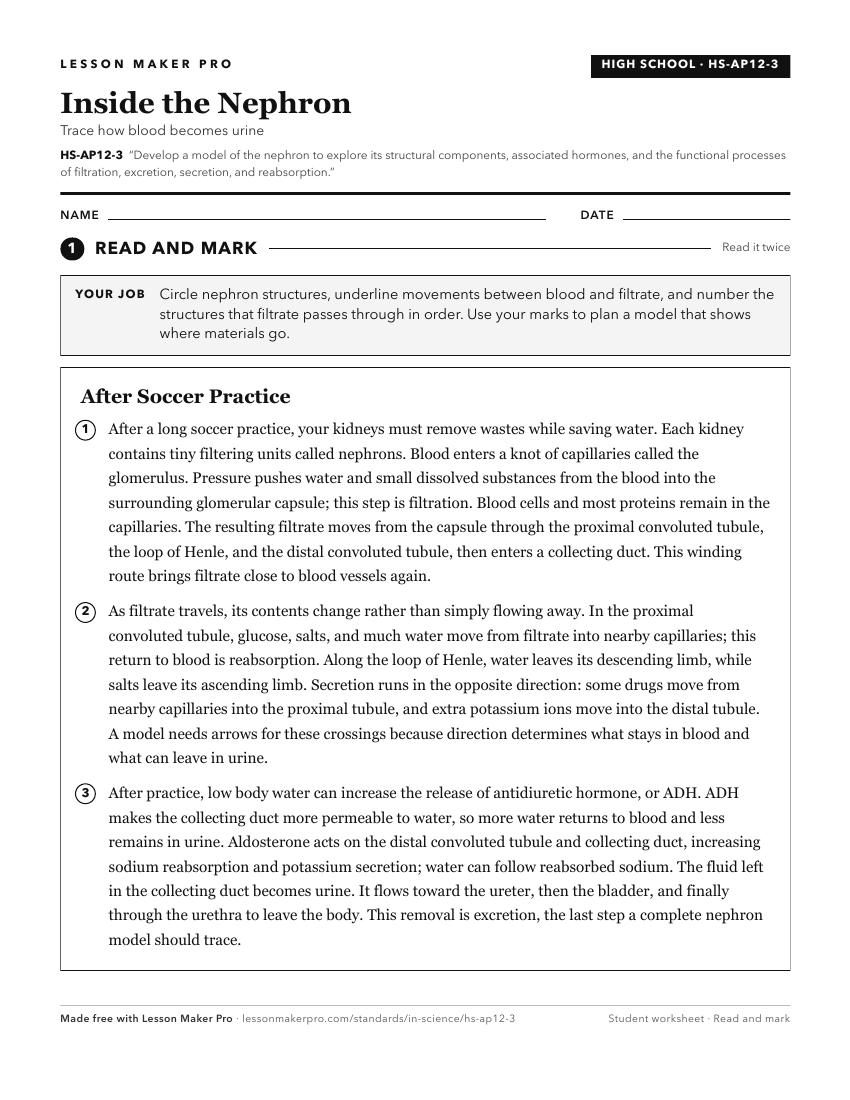
A ready-to-print activity worksheet aligned to HS-AP12-3, with an answer key for the teacher on its own page. No account needed.
PDF, US Letter, prints cleanly in black and white.
Download the worksheetKeep exploring
Related Standards
- HS-AP3-1
Develop a model to illustrate the microscopic structure, development of, maintenance of, and function of compact and spongy bone.
- HS-AP12-2
Observe and identify the structures of the kidney; then construct an explanation for maintaining blood volume via kidney function.
- HS-AP5-1
Develop a model that illustrates the structural components and functional subdivisions of the nervous system.
- HS-AP1-2
Develop and use a model to illustrate the hierarchical organization of structural body systems that provide specific functions within the Human Body.
Turn this exact standard into a lesson
Grade, subject, topic, and the complete standard are prefilled. Create one free, no account needed.
Also for this standard:Make a WorksheetMake a QuizMake a Sub Lesson