Indiana Science HS-AP12-2
The Standard
Observe and identify the structures of the kidney; then construct an explanation for maintaining blood volume via kidney function.
Indiana Academic Standards for Science (2023) · Absorption and Excretion, the Urinary System
Teacher's field guide
What This Standard Means
What Students Need to Do
- Students identify the cortex, medulla, renal pelvis, and nephrons on a kidney diagram or model. They explain how kidneys return water to the blood or release it in urine to help keep blood volume steady.
What Mastery Looks Like
- A student can label the main kidney structures on an unfamiliar diagram. When given a case of heavy sweating, they can explain why the kidneys return more water to the blood and produce less urine.
Common Misconceptions
- Students may think all water filtered by the kidneys leaves as urine. They may confuse the renal pelvis with the bladder or think the kidneys make new blood to replace lost fluid.
How to Assess It
- Give students an unlabeled kidney diagram and ask them to label the cortex, medulla, and renal pelvis. Then ask: After heavy sweating, would urine volume rise or fall, and how would that help blood volume?
Lesson moves
Ways to Teach It
Build a kidney cross section with clay, mark the cortex, medulla, and renal pelvis, then use string to trace urine to the ureter.
Have students write two sentences explaining why a person who skipped water all day produces less urine and how this protects blood volume.
Hand pairs kidney diagram cards and job cards; have them match each structure to its job, then check against a labeled diagram.
Use a hot-day soccer practice scenario: students predict urine volume after heavy sweating and explain why kidneys return more water to blood.
Free download
Printable HS-AP12-2 Worksheet
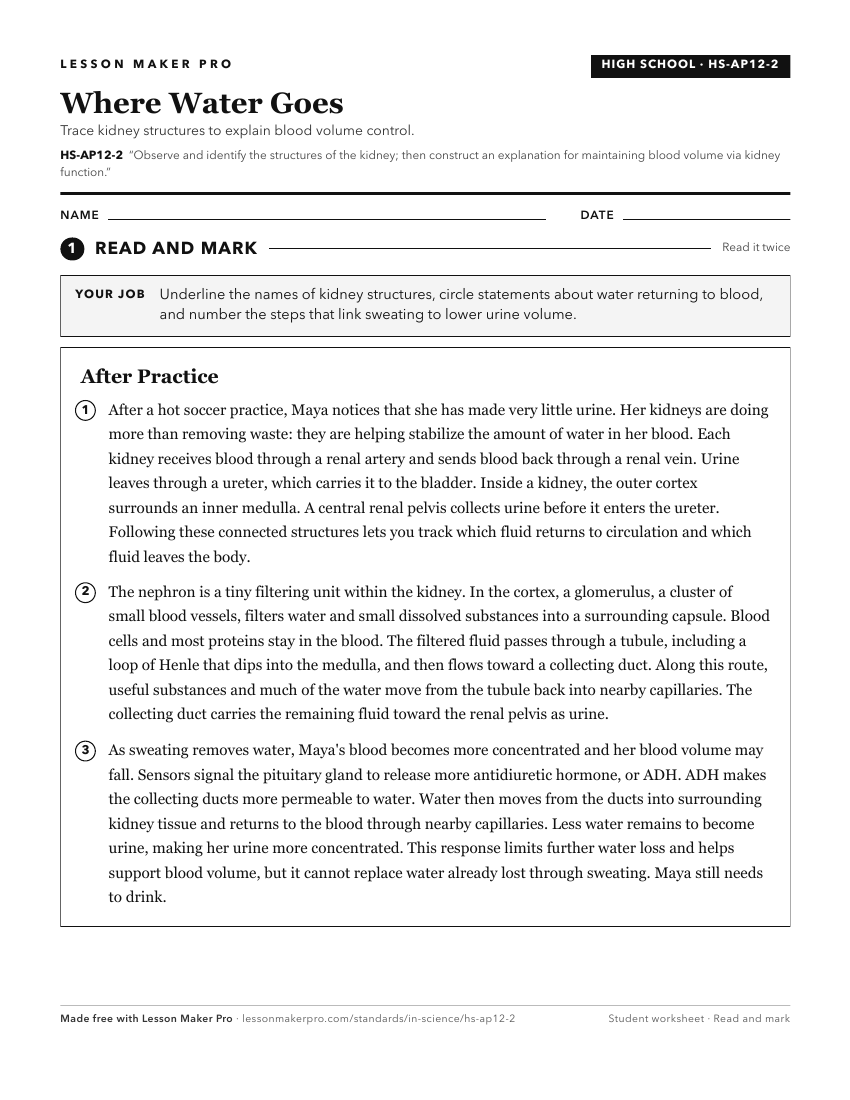
A ready-to-print activity worksheet aligned to HS-AP12-2, with an answer key for the teacher on its own page. No account needed.
PDF, US Letter, prints cleanly in black and white.
Download the worksheetKeep exploring
Related Standards
- HS-AP8-3
Investigate the primary structures of the cardiovascular system and explore their functional importance to maintaining homeostasis.
- HS-AP7-5
Construct an explanation for maintaining blood sugar levels via endocrine and exocrine functions of the pancreas.
- HS-AP12-3
Develop a model of the nephron to explore its structural components, associated hormones, and the functional processes of filtration, excretion, secretion, and ...
- HS-AP12-1
Identify and locate major organs of the urinary system and discuss their functions.
Turn this exact standard into a lesson
Grade, subject, topic, and the complete standard are prefilled. Create one free, no account needed.
Also for this standard:Make a WorksheetMake a QuizMake a Sub Lesson