Indiana Science HS-AP7-5
The Standard
Construct an explanation for maintaining blood sugar levels via endocrine and exocrine functions of the pancreas.
Indiana Academic Standards for Science (2023) · Integration and Coordination, the Endocrine System
Teacher's field guide
What This Standard Means
What Students Need to Do
- Students trace how pancreatic enzymes help break down starch in the small intestine before glucose enters the blood. They explain how the pancreas releases insulin or glucagon into the blood to keep glucose levels steady.
What Mastery Looks Like
- After a meal, a student can show insulin helping cells take in glucose and the liver store it. During a fast, they can show glucagon prompting the liver to release glucose. They can place digestive enzymes in the intestine, not the blood.
Common Misconceptions
- Students may say insulin raises blood glucose or glucagon lowers it. They may think insulin digests starch, or that pancreatic digestive enzymes enter the blood.
How to Assess It
- Exit ticket: After eating oatmeal, where does pancreatic amylase go, and how does insulin help lower blood glucose? What does glucagon do if you skip lunch?
Lesson moves
Ways to Teach It
Use starch and sugar cards in a paper small intestine; apply an amylase card, then move glucose counters between blood, liver, and cells.
Ask, “Why does pancreatic amylase go to the small intestine while insulin enters the blood?” Have students trace a slice of toast.
Give pairs meal and fasting cards; have them match each to insulin or glucagon and sketch glucose movement between blood and liver.
Read a cereal box carbohydrate label; have students sketch starch digestion after breakfast and the insulin response, then predict what happens before dinner.
Free download
Printable HS-AP7-5 Worksheet
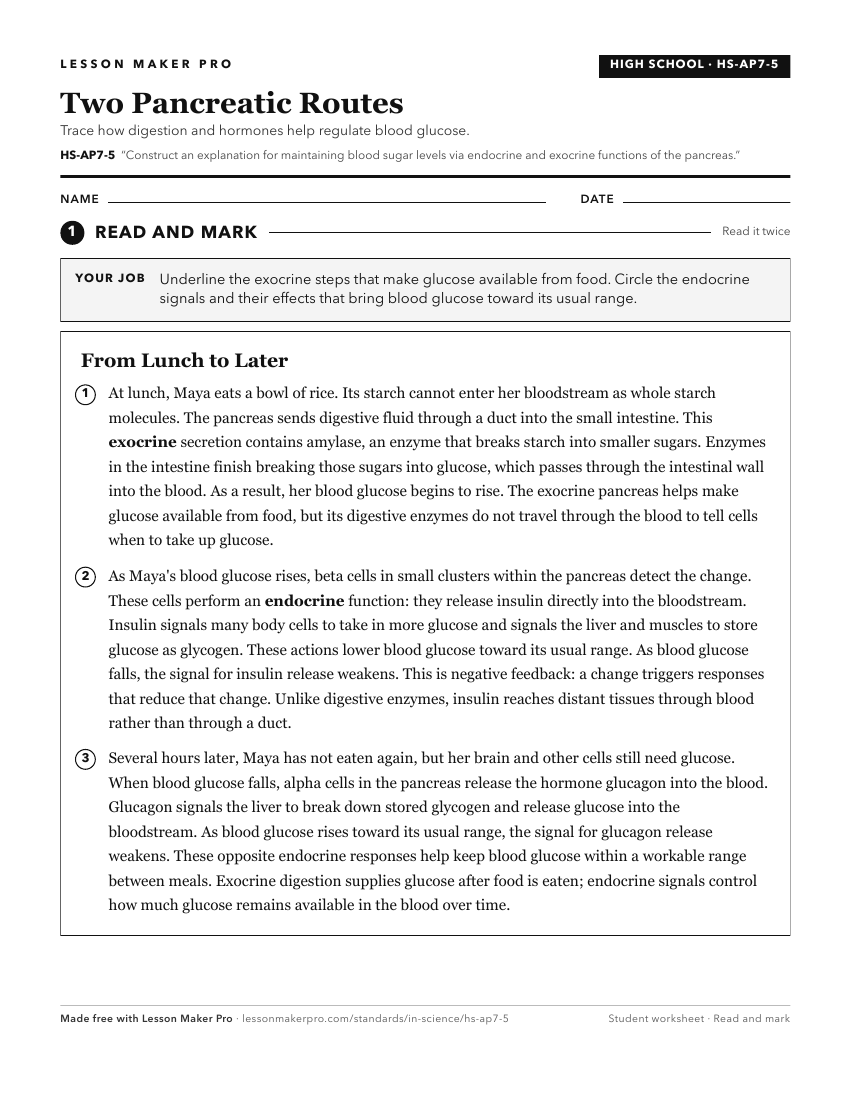
A ready-to-print activity worksheet aligned to HS-AP7-5, with an answer key for the teacher on its own page. No account needed.
PDF, US Letter, prints cleanly in black and white.
Download the worksheetKeep exploring
Related Standards
- HS-AP10-2
Construct an explanation for enzymes involved in the processing of, digestion of and absorbance of macromolecules.
- HS-AP12-2
Observe and identify the structures of the kidney; then construct an explanation for maintaining blood volume via kidney function.
- HS-AP7-4
Construct an explanation to show the impact of stress on the hypothalamus-pituitary complex, sympathetic nervous system, and the adrenal medulla.
- HS-AP11-4
Construct an explanation for maintaining blood pH via specialized carbon dioxide receptors and the respiratory response.
Turn this exact standard into a lesson
Grade, subject, topic, and the complete standard are prefilled. Create one free, no account needed.
Also for this standard:Make a WorksheetMake a QuizMake a Sub Lesson