Indiana Science HS-AP11-3
The Standard
Analyze data to investigate how percentages and partial pressure gradients of oxygen and carbon dioxide impact net gas exchange.
Indiana Academic Standards for Science (2023) · Absorption and Excretion, the Respiratory System
Teacher's field guide
What This Standard Means
What Students Need to Do
- Students read oxygen and carbon dioxide percentages and partial pressures for air, alveoli, and blood. They use pressure differences to predict which way each gas moves and explain how a change in gas percentage could change that movement.
What Mastery Looks Like
- Given alveolar oxygen at 100 mmHg and incoming blood at 40 mmHg, a student predicts oxygen moves into blood. Given carbon dioxide at 46 mmHg in blood and 40 mmHg in alveoli, they predict it moves into alveoli and cite both pressure differences.
Common Misconceptions
- Students may assume oxygen always enters blood and carbon dioxide always leaves it, regardless of the pressure data. They may treat gas percentage and partial pressure as the same thing or think gases move from lower to higher partial pressure.
How to Assess It
- Show alveolar oxygen at 13% (100 mmHg), alveolar carbon dioxide at 5% (40 mmHg), and incoming blood at 40 mmHg oxygen and 46 mmHg carbon dioxide. Ask students to draw an arrow for each gas and predict how lowering alveolar oxygen to 10% would change its pressure difference.
Lesson moves
Ways to Teach It
Place oxygen and carbon dioxide counters on an alveolus-and-blood mat, then move counters from higher to lower pressure using data cards.
Ask pairs, "Why does oxygen enter blood while carbon dioxide leaves it when both gases are present on each side?"
Give teams four alveolus-and-blood data cards, and award a point for each correct gas arrow and pressure comparison.
Compare sea-level and mountain cards listing 21% air oxygen plus alveolar and blood pressures, then predict which setting has a smaller oxygen gradient.
Free download
Printable HS-AP11-3 Worksheet
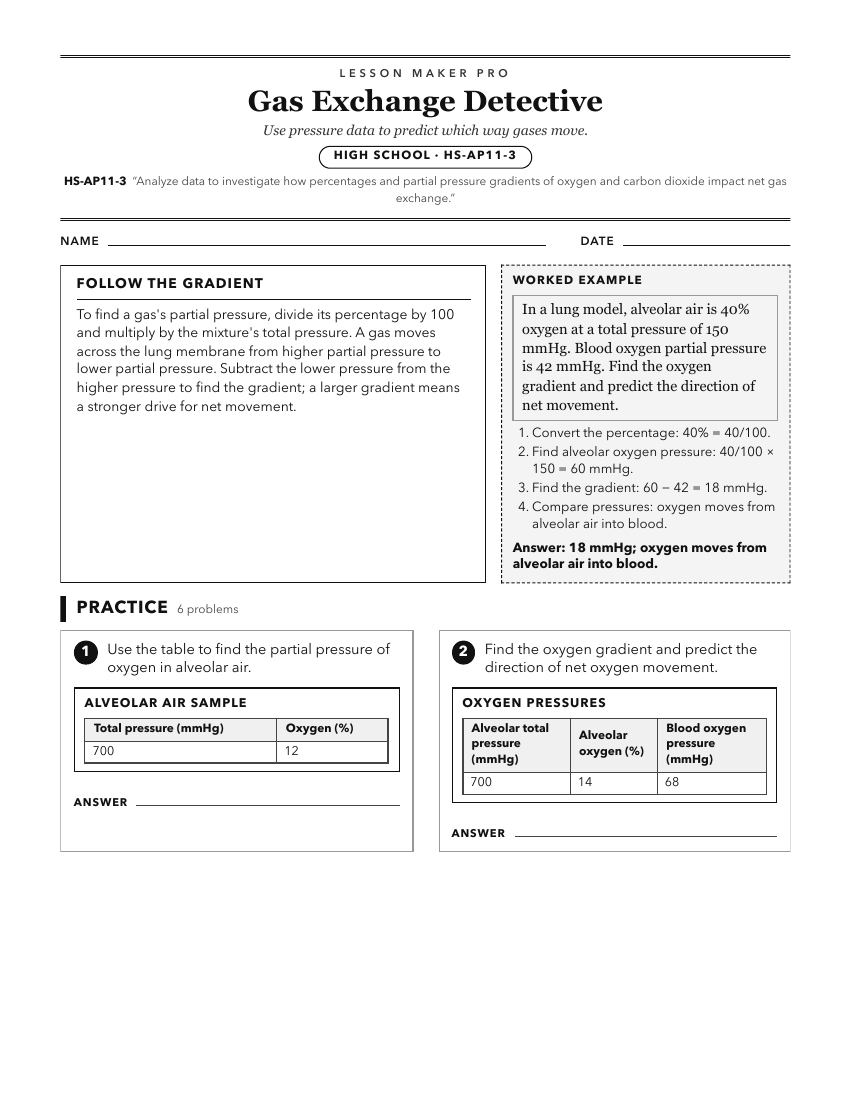
A ready-to-print activity worksheet aligned to HS-AP11-3, with an answer key for the teacher on its own page. No account needed.
PDF, US Letter, prints cleanly in black and white.
Download the worksheetKeep exploring
Related Standards
- HS-AP10-4
Differentiate between metabolic and respiratory acidosis and alkalosis.
- HS-AP11-2
Observe the anatomical structures and explain the physiological processes involved in inspiration & expiration.
- HS-AP8-7
Design an experiment to illustrate how the cardiovascular system maintains homeostasis.
- HS-AP11-4
Construct an explanation for maintaining blood pH via specialized carbon dioxide receptors and the respiratory response.
Turn this exact standard into a lesson
Grade, subject, topic, and the complete standard are prefilled. Create one free, no account needed.
Also for this standard:Make a WorksheetMake a QuizMake a Sub Lesson