Indiana Science HS-AP11-2
The Standard
Observe the anatomical structures and explain the physiological processes involved in inspiration & expiration.
Indiana Academic Standards for Science (2023) · Absorption and Excretion, the Respiratory System
Teacher's field guide
What This Standard Means
What Students Need to Do
- Students identify the lungs, ribs, diaphragm, trachea, and bronchi on a diagram or model. They explain how changes in chest volume and air pressure move air into and out of the lungs.
What Mastery Looks Like
- A student can trace the path of air into the lungs. They can explain that the ribs lift and the diaphragm flattens during inhalation, then describe what changes during exhalation.
Common Misconceptions
- Students may think the lungs pull in air by themselves, rather than air entering when pressure inside the chest falls. Some think the diaphragm moves up during inhalation.
How to Assess It
- Show two chest diagrams, one with a flat diaphragm and raised ribs, the other with a domed diaphragm and lowered ribs. Ask students to label inhalation and exhalation and explain the volume and pressure change in each.
Lesson moves
Ways to Teach It
Pull and release the balloon membrane on a bottle lung model, then have students point out what represents the lungs and diaphragm.
Ask pairs, 'Why does the balloon lung inflate when the model diaphragm moves down?' Have them answer using volume and pressure.
Give groups cards showing ribs lift, diaphragm flattens, volume increases, pressure falls, and air enters; have them order the cards.
Count breaths at rest and after 30 seconds of stepping in place, then discuss why breathing becomes faster.
Free download
Printable HS-AP11-2 Worksheet
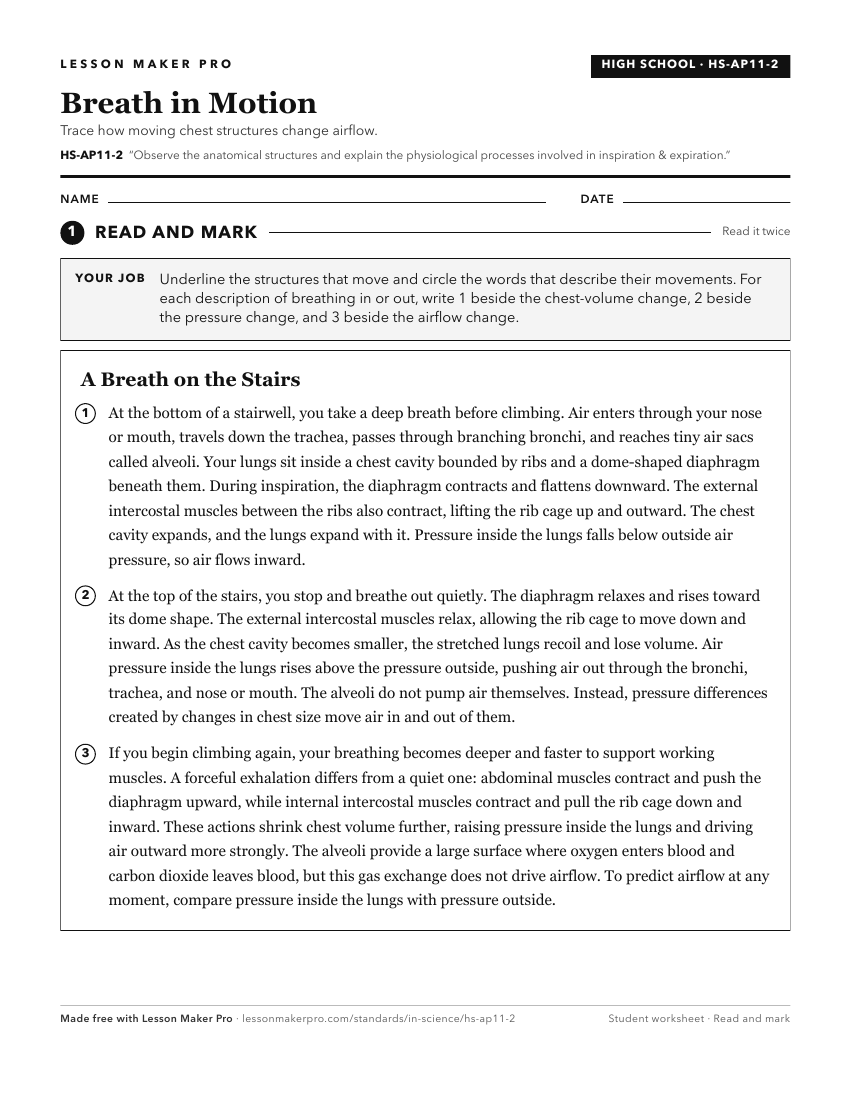
A ready-to-print activity worksheet aligned to HS-AP11-2, with an answer key for the teacher on its own page. No account needed.
PDF, US Letter, prints cleanly in black and white.
Download the worksheetKeep exploring
Related Standards
- HS-AP10-1
Identify and locate major and accessory organs of the digestive system and investigate their physiological functions.
- HS-AP8-3
Investigate the primary structures of the cardiovascular system and explore their functional importance to maintaining homeostasis.
- HS-AP1-6
Identify anatomical terms (including anatomical orientation, regions, planes) on a diagram, model, or through dissection.
- HS-AP11-1
Identify and locate major organs of the respiratory system and discuss their functions. Differentiate between the components of the upper and lower respiratory ...
Turn this exact standard into a lesson
Grade, subject, topic, and the complete standard are prefilled. Create one free, no account needed.
Also for this standard:Make a WorksheetMake a QuizMake a Sub Lesson