Indiana Science HS-AP10-1
The Standard
Identify and locate major and accessory organs of the digestive system and investigate their physiological functions.
Indiana Academic Standards for Science (2023) · Absorption and Excretion, the Digestive System
Teacher's field guide
What This Standard Means
What Students Need to Do
- Students locate digestive organs on a body diagram. They trace food from mouth to anus and explain where it breaks down and where nutrients and water are absorbed. They identify the liver, gallbladder, and pancreas as organs outside the food path.
What Mastery Looks Like
- A student can label the food path and the liver, gallbladder, and pancreas on an unlabeled diagram. They explain that the stomach churns food, the small intestine absorbs most nutrients, and the large intestine absorbs water. They show where bile and pancreatic juices enter the small intestine.
Common Misconceptions
- Students may draw food passing through the liver or pancreas. They may say the gallbladder makes bile, rather than stores it. Many think the stomach absorbs most nutrients instead of the small intestine.
How to Assess It
- Give students a blank body diagram. Ask them to label the stomach, small intestine, liver, gallbladder, and pancreas, draw food's path, and write which organ makes bile and where most nutrients enter the blood.
Lesson moves
Ways to Teach It
Shake oil and water in two clear jars, add dish soap to one, and compare the droplets as a model of bile's action.
Ask students to write two sentences answering: Why does food never pass through the liver, even though the liver helps digest it?
Give pairs organ, location, and job cards to match, then have them correct one mismatched set.
Show a gallbladder removal diagram and ask how bile still reaches the small intestine after surgery.
Free download
Printable HS-AP10-1 Worksheet
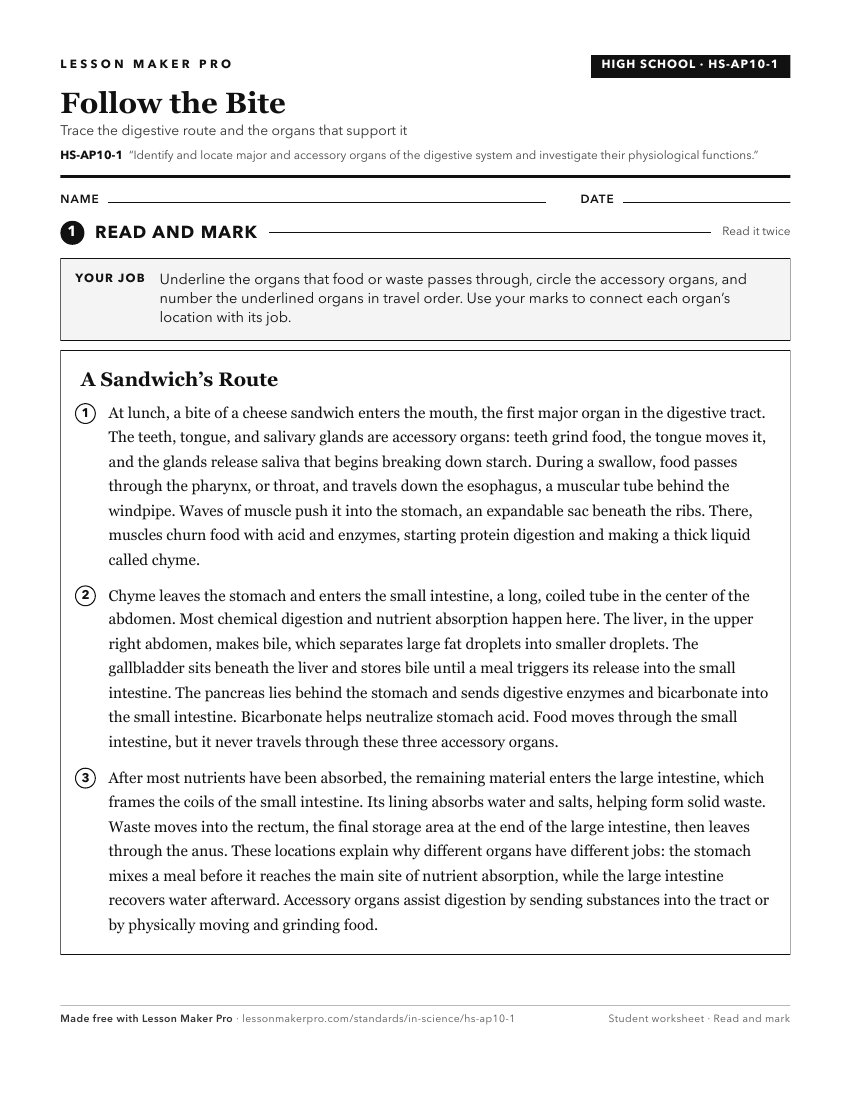
A ready-to-print activity worksheet aligned to HS-AP10-1, with an answer key for the teacher on its own page. No account needed.
PDF, US Letter, prints cleanly in black and white.
Download the worksheetKeep exploring
Related Standards
- HS-AP8-3
Investigate the primary structures of the cardiovascular system and explore their functional importance to maintaining homeostasis.
- HS-AP11-1
Identify and locate major organs of the respiratory system and discuss their functions. Differentiate between the components of the upper and lower respiratory ...
- HS-AP12-1
Identify and locate major organs of the urinary system and discuss their functions.
- HS-AP13-1
Identify and locate major and accessory organs of the female and male reproductive systems and discuss their functions.
Turn this exact standard into a lesson
Grade, subject, topic, and the complete standard are prefilled. Create one free, no account needed.
Also for this standard:Make a WorksheetMake a QuizMake a Sub Lesson