Indiana Science HS-AP11-1
The Standard
Identify and locate major organs of the respiratory system and discuss their functions. Differentiate between the components of the upper and lower respiratory systems.
Indiana Academic Standards for Science (2023) · Absorption and Excretion, the Respiratory System
Teacher's field guide
What This Standard Means
What Students Need to Do
- Students locate the main parts of the respiratory system on a body diagram. They trace the path air takes and explain what each part does. They sort the parts into upper and lower airways.
What Mastery Looks Like
- A student places the nasal cavity and pharynx in the head and throat, and the trachea, bronchi, and lungs in the neck and chest. They sort the nasal cavity and pharynx as upper airways and the trachea, bronchi, and lungs as lower airways. They explain that alveoli inside the lungs move oxygen into the blood and carbon dioxide out.
Common Misconceptions
- Students may draw air going straight from the nose to the lungs, skipping the pharynx, trachea, and bronchi. Some think oxygen enters the blood in the bronchi rather than in the alveoli. Others label the diaphragm as an airway.
How to Assess It
- Give students a blank body outline. Ask them to label the nasal cavity, pharynx, trachea, bronchi, and lungs, circle the upper airways, and mark where oxygen enters the blood.
Lesson moves
Ways to Teach It
Tape straws and balloons to a paper torso to model the trachea, branching bronchi, and lungs; add labels for the nose and pharynx.
Ask pairs, “Why does oxygen enter the blood in the alveoli rather than in the trachea?” Have them write a two-sentence answer.
Give pairs organ cards and a blank body outline; have them place each card, sort upper and lower parts, and name each function.
Show an inhaler and ask students to trace the medicine’s path from the mouth through the trachea and bronchi to the lungs.
Free download
Printable HS-AP11-1 Worksheet
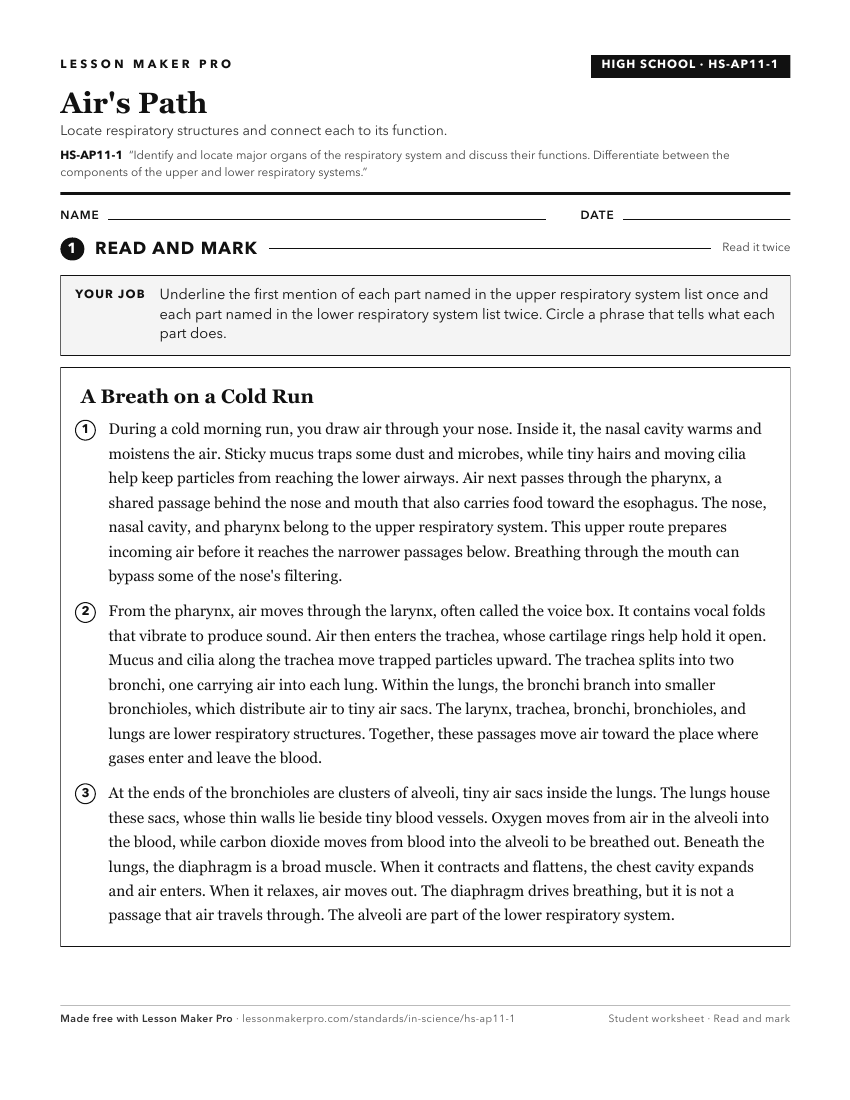
A ready-to-print activity worksheet aligned to HS-AP11-1, with an answer key for the teacher on its own page. No account needed.
PDF, US Letter, prints cleanly in black and white.
Download the worksheetKeep exploring
Related Standards
- HS-AP10-1
Identify and locate major and accessory organs of the digestive system and investigate their physiological functions.
- HS-AP1-5
Compare and contrast the major organ systems and describe their basic functional importance.
- HS-AP12-1
Identify and locate major organs of the urinary system and discuss their functions.
- HS-AP13-1
Identify and locate major and accessory organs of the female and male reproductive systems and discuss their functions.
Turn this exact standard into a lesson
Grade, subject, topic, and the complete standard are prefilled. Create one free, no account needed.
Also for this standard:Make a WorksheetMake a QuizMake a Sub Lesson