Indiana Science HS-AP10-3
The Standard
Compare and contrast mechanical and chemical digestion.
Indiana Academic Standards for Science (2023) · Absorption and Excretion, the Digestive System
Teacher's field guide
What This Standard Means
What Students Need to Do
- Students identify chewing and stomach churning as mechanical digestion, and enzyme action as chemical digestion. They explain what changes about food in each process and how the processes work together.
What Mastery Looks Like
- A student can tell why crushing bread makes smaller pieces but does not break down its starch molecules. They can explain that salivary amylase breaks starch into smaller molecules.
Common Misconceptions
- Students may think chewing chemically breaks down starch because both chewing and saliva act in the mouth. They may also think stomach churning changes food molecules or that enzymes grind food into pieces.
How to Assess It
- Ask: “You chew a piece of bread, then salivary amylase acts on its starch. Which step is mechanical, which is chemical, and what changes in each?”
Lesson moves
Ways to Teach It
Give pairs a cracker and a resealable bag to crush, then ask what salivary amylase could change that crushing cannot.
Ask students to draw two arrows from a bite of bread, one for chewing and one for salivary amylase, and label each change.
Call out chewing, stomach churning, salivary amylase, and pancreatic lipase; students hold up M or C cards and explain one choice.
Read a lactase tablet label and ask why chewing dairy cannot replace the enzyme for someone who cannot digest lactose.
Free download
Printable HS-AP10-3 Worksheet
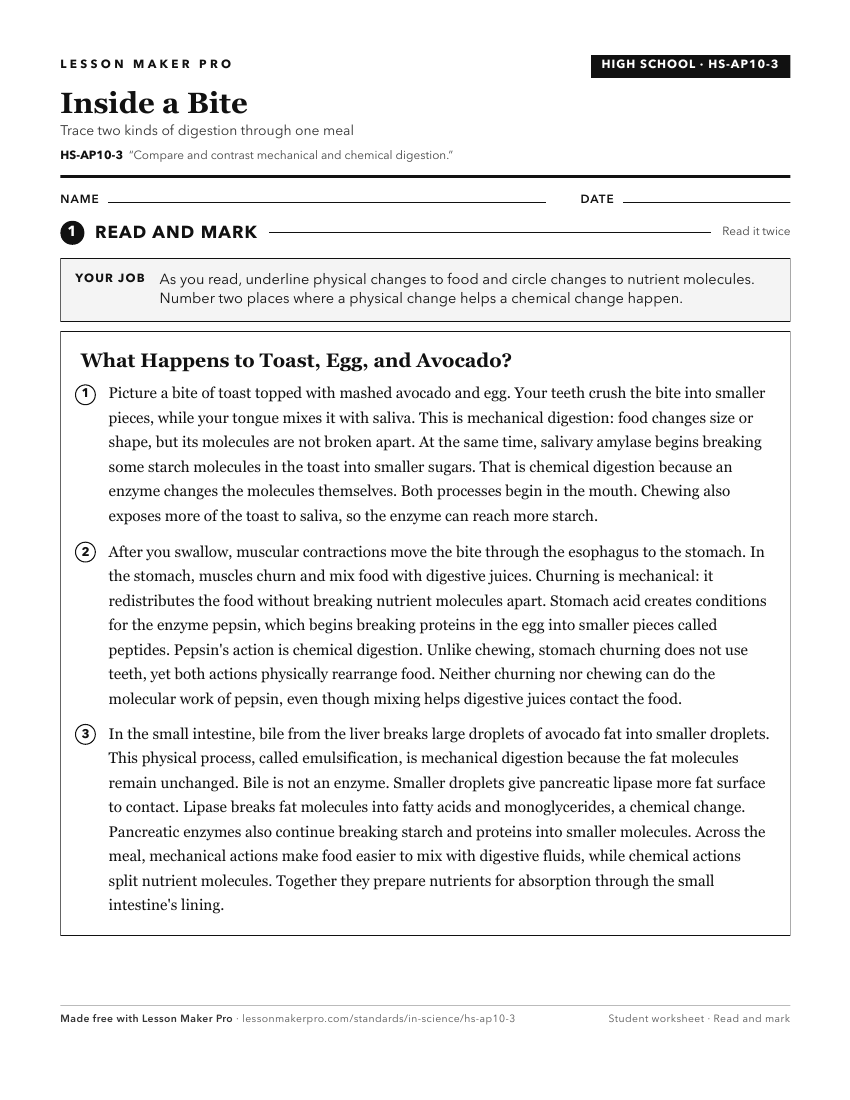
A ready-to-print activity worksheet aligned to HS-AP10-3, with an answer key for the teacher on its own page. No account needed.
PDF, US Letter, prints cleanly in black and white.
Download the worksheetKeep exploring
Related Standards
- HS-AP7-2
Assess the structural and functional differences between an endocrine gland and an exocrine gland.
- HS-AP10-2
Construct an explanation for enzymes involved in the processing of, digestion of and absorbance of macromolecules.
- HS-AP10-1
Identify and locate major and accessory organs of the digestive system and investigate their physiological functions.
- HS-AP4-1
Compare and contrast between the structural and functional characteristics of skeletal, cardiac, and smooth muscle.
Turn this exact standard into a lesson
Grade, subject, topic, and the complete standard are prefilled. Create one free, no account needed.
Also for this standard:Make a WorksheetMake a QuizMake a Sub Lesson