Indiana Science HS-AP7-2
The Standard
Assess the structural and functional differences between an endocrine gland and an exocrine gland.
Indiana Academic Standards for Science (2023) · Integration and Coordination, the Endocrine System
Teacher's field guide
What This Standard Means
What Students Need to Do
- Students look for a duct and trace where a gland’s secretion goes. They explain that endocrine glands release hormones into blood, while exocrine glands send substances through ducts to a surface or organ cavity.
What Mastery Looks Like
- Given diagrams of a thyroid gland and a sweat gland, a student traces each secretion’s path. They use the presence or absence of a duct to explain which gland is endocrine and which is exocrine.
Common Misconceptions
- Students may think all glands release hormones or that exocrine glands release into blood. They may call pancreatic digestive enzymes endocrine because the pancreas also makes insulin.
How to Assess It
- Exit ticket: A gland releases insulin into nearby blood vessels. Another sends digestive enzymes through a duct into the small intestine. Label each gland type and explain your evidence.
Lesson moves
Ways to Teach It
Build clay models of a sweat gland and thyroid; use a straw for the sweat duct and red yarn for nearby blood vessels.
Ask pairs: Why does insulin enter blood while digestive enzymes enter a duct? Have them draw and explain both routes.
Sort cards labeled thyroid, sweat gland, salivary gland, and adrenal gland into ducted or ductless groups; draw one secretion route for each.
Compare sweat reaching skin during exercise with insulin entering blood after lunch; sketch the path from each gland.
Free download
Printable HS-AP7-2 Worksheet
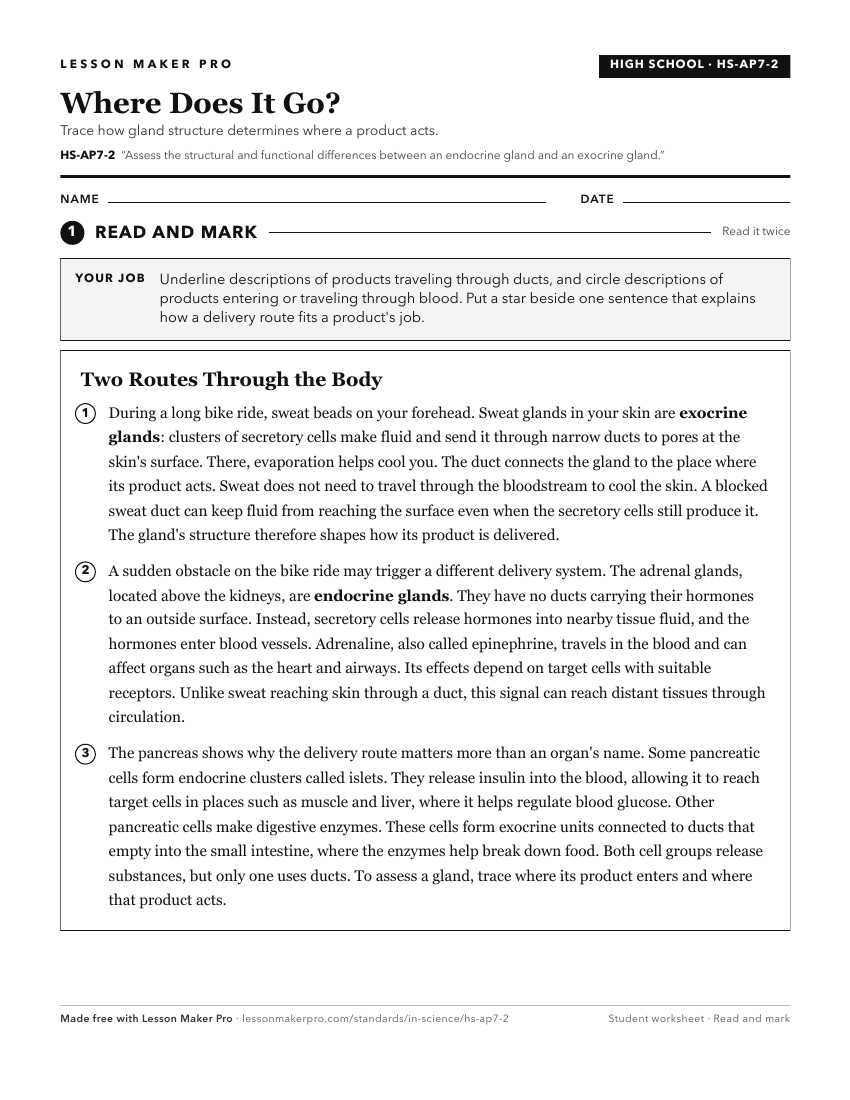
A ready-to-print activity worksheet aligned to HS-AP7-2, with an answer key for the teacher on its own page. No account needed.
PDF, US Letter, prints cleanly in black and white.
Download the worksheetKeep exploring
Related Standards
- HS-AP7-1
Investigate the structure and function of the endocrine system and develop models showing how changes in prominent hormone levels impact homeostasis throughout ...
- HS-AP5-2
Observe and identify the structure and function of the various neurons and neuroglia. Explain how the varying structures determine the specified function.
- HS-AP7-3
Compare and contrast the hormones of the hypothalamus-pituitary complex. Analyze the function of each hormone and connect them to feedback signals for the gonad...
- HS-AP4-1
Compare and contrast between the structural and functional characteristics of skeletal, cardiac, and smooth muscle.
Turn this exact standard into a lesson
Grade, subject, topic, and the complete standard are prefilled. Create one free, no account needed.
Also for this standard:Make a WorksheetMake a QuizMake a Sub Lesson