Indiana ELA 3.RC
Standard Cluster
Students comprehend grade-level text, including fiction and nonfiction, and can demonstrate their comprehension orally and through writing.
Indiana Academic Standards for English/Language Arts (2023)
Cluster contents
Standards in This Cluster
3.RC is a cluster heading. These are the individual standards under it.
- 3.RC.2
Recount folktales, fables, and tall tales from diverse cultures; identify the themes in these works. (E)
- 3.RC.3
Describe characters in a story (e.g., their traits, motivations, or feelings), and explain how their actions contribute to the plot.
- 3.RC.6
Describe the relationship between a series of historical events, scientific ideas or concepts, or steps in processes or procedures in a text, using words such a...
- 3.RC.7
Apply knowledge of text features to locate information and gain meaning from a text (e.g., maps, illustrations, charts, font/format).
- 3.RC.8
Identify how a nonfiction text can be structured to indicate a problem and solution or to put events in chronological order. (E)
- 3.RC.9
Distinguish between fact and opinion; explain how an author uses reasons and facts to support specific points in a text.
- 3.RC.11
Apply context clues (e.g., word, phrase, and sentence-level context) and text features (e.g., maps, illustrations, charts) to determine the meanings of unknown ...
- 3.RC.12
Identify relationships among words, including synonyms, antonyms, homographs, homonyms, and multiple-meaning words (e.g., puzzle, fire). (E)
- 3.RC.13
Use a known word as a clue to the meaning of an unknown word with the same root, and identify when an affix is added to a known root word.
- 3.RC.1aAsk and answer questions about a main idea in a short text heard or read, referring explicitly to the text as the basis for the answers. (E)
- 3.RC.2aRecount key details in the beginning, middle, and end of a folktale, fable, or tall tale from diverse cultures; identify one theme in these works. (E)
- 3.RC.3aDescribe the feelings or traits of at least one character in a story and explain how a character responded to a conflict or event.
- 3.RC.4aFind similarities and/or differences between the points of view of the narrator and/or characters in a story with one's personal point of view.
- 3.RC.5aIdentify the main idea of a text and two or more supporting key details. (E)
- 3.RC.6aUse words such as first, next, then, because, same, or different to describe relationships between two historical events, two ideas, or steps in a process.
- 3.RC.7aUse text features (e.g., maps, illustrations, charts) to locate information and gain meaning about a specific topic.
- 3.RC.8aIdentify words that help to define the structure of nonfiction text (e.g., problem/solution, chronological order). (E)
- 3.RC.9aDistinguish between fact and opinion.
- 3.RC.9bIdentify how an author uses facts and reasons to support specific points in a text.
- 3.RC.10aCompare and contrast important points and key details presented in two texts on the same topic.
- 3.RC.11aUse context clues (e.g., word, phrase, and sentence-level context) and text features (e.g., maps, illustrations, charts) to determine the meanings of unknown words.
- 3.RC.12aUse pictures and/or paired pictures and words to identify and demonstrate knowledge of word relationships, including synonyms, antonyms, homographs, homonyms, and/or multiple-meaning words (e.g., puzzle, fire). (E)
- 3.RC.13aSeparate known root words from affixes, and use a known word as a clue for determining the meaning of an unknown word with the same root.
Teacher's field guide
What This Cluster Means
What Students Need to Do
- Students read third-grade stories and informational passages. They explain what happened or what the text teaches, both aloud and in writing, using details from the page.
What Mastery Looks Like
- A student can retell a story's main events in order without adding made-up details. They can explain an article's main idea and support it with a fact from the text, aloud or in writing.
Common Misconceptions
- Students may list small details but miss the main point. They may answer from what they already know instead of using the passage. They may retell a story out of order.
How to Assess It
- Hand out a short story about a lost dog and a short article about service dogs. Have students tell a partner what happened in the story, then write what the article teaches and give one supporting fact.
Lesson moves
Ways to Teach It
Give pairs sentence strips from a short story; have them order the events and match each strip to a line in the story.
After reading an article about frogs, ask, 'What does the author teach about where frogs live? Which sentence supports your answer?'
Play detail detective: read a paragraph aloud, show three answers to 'Why did Mia leave?', and have students point to the supported answer.
Read a library flyer listing three summer events; ask which event fits a child who loves animals and why.
Free download
Printable 3.RC Worksheet
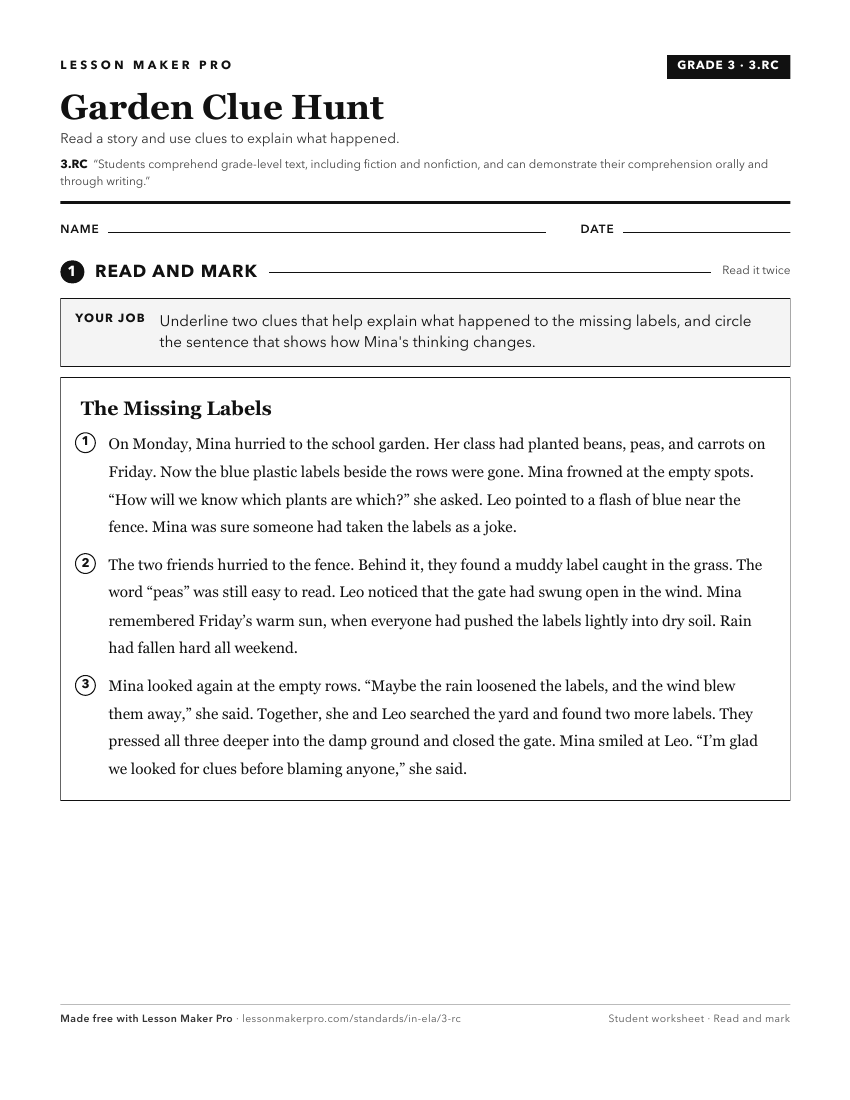
A ready-to-print activity worksheet aligned to 3.RC, with an answer key for the teacher on its own page. No account needed.
PDF, US Letter, prints cleanly in black and white.
Download the worksheetKeep exploring
Related Standards
Turn this cluster into a lesson
Grade, subject, topic, and the complete cluster are prefilled. Create one free, no account needed.
Also for this cluster:Make a WorksheetMake a QuizMake a Sub Lesson