Indiana ELA 3.RC.12
The Standard
- 3.RC
- Students comprehend grade-level text, including fiction and nonfiction, and can demonstrate their comprehension orally and through writing.
Identify relationships among words, including synonyms, antonyms, homographs, homonyms, and multiple-meaning words (e.g., puzzle, fire).
Indiana Academic Standards for English/Language Arts (2023)
Teacher's field guide
What This Standard Means
What Students Need to Do
- Students find words that mean nearly the same thing or opposite things. They use sentence clues to explain words with more than one meaning, including words that change sound, such as tear.
What Mastery Looks Like
- A student can match glad with happy and name sad as its opposite. They can explain what bat means in two different sentences and read tear correctly in 'A tear fell' and 'Tear the page.'
Common Misconceptions
- Students may call hot and sun synonyms because the words are related. They may read tear the same way in both sentences or assume fire always means flames.
How to Assess It
- Exit ticket: Label happy/glad and happy/sad as synonyms or antonyms, then explain bat in 'A bat flew' and 'She swung a bat.' Have students read 'A tear fell' and 'Tear the page' aloud.
Lesson moves
Ways to Teach It
Give students sentence strips with bat, tear, and fire; have them match each strip to a drawing of its meaning.
Ask, 'What does bat mean in "The bat flew" and "She swung the bat"? Which words helped you decide?'
Play a word-pair sort with happy/glad, happy/sad, and sentence cards showing the two meanings of bat and tear.
Show a fire safety sign and a comic caption reading 'The boss will fire me'; have students explain fire in each.
Free download
Printable 3.RC.12 Worksheet
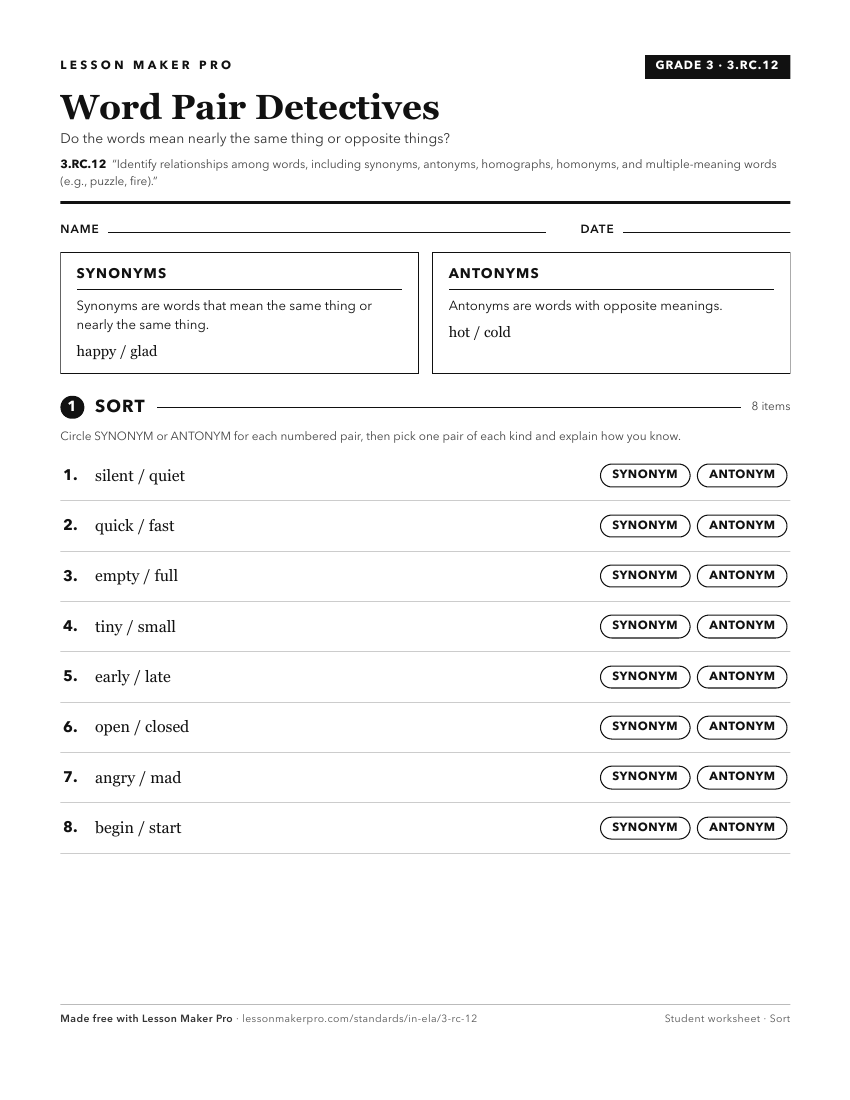
A ready-to-print activity worksheet aligned to 3.RC.12, with an answer key for the teacher on its own page. No account needed.
PDF, US Letter, prints cleanly in black and white.
Download the worksheetKeep exploring
Related Standards
- 4.RC.11
Identify relationships among words, including more complex homographs, homonyms, synonyms, antonyms, and multiple meanings. (E)
- 2.RC.12
Identify relationships among words, including common synonyms and antonyms, and simple, multiple-meaning words (e.g., change, duck). (E)
- 5.RC.12
Identify relationships among words, including multiple meanings, synonyms and antonyms, homographs, metaphors, similes, and analogies.
Turn this exact standard into a lesson
Grade, subject, topic, and the complete standard are prefilled. Create one free, no account needed.
Also for this standard:Make a WorksheetMake a QuizMake a Sub Lesson