Indiana ELA 2.RC
Standard Cluster
Students comprehend grade-level text, including fiction and nonfiction, and can demonstrate their comprehension orally and through writing.
Indiana Academic Standards for English/Language Arts (2023)
Cluster contents
Standards in This Cluster
2.RC is a cluster heading. These are the individual standards under it.
- 2.RC.1
Ask and answer questions about the main idea and key details in a text to demonstrate comprehension. (E)
- 2.RC.2
Recount the beginning, middle, and ending of stories, including fables and folktales from diverse cultures, and determine their central message, lesson, or mora...
- 2.RC.3
Describe how characters in a story respond to major events and how characters affect the plot.
- 2.RC.5
Acknowledge differences in the points of view of characters, and identify dialogue as words spoken by characters, usually enclosed in quotation marks.
- 2.RC.6
Identify the main idea of a multiparagraph text and the topic of each paragraph.
- 2.RC.7
Use various text features (e.g., table of contents, index, headings, captions) to locate key facts or information, and explain how they contribute to and clarif...
- 2.RC.8
Identify how a nonfiction text can be structured to compare and contrast, to describe a procedure, and to explain a cause and effect relationship. (E)
- 2.RC.9
Describe how an author uses facts to support specific points in a text.
- 2.RC.11
Use context clues (e.g., words and sentence clues) and text features (e.g., table of contents, headings) to determine the meanings of unknown words.
- 2.RC.12
Identify relationships among words, including common synonyms and antonyms, and simple, multiple-meaning words (e.g., change, duck). (E)
- 2.RC.1aAsk and answer more than one question about the main idea and key details in a text heard or read. (E)
- 2.RC.2aRecount the beginning, middle, and ending of familiar stories, fables, or folktales from diverse cultures, and determine their central message, lesson, or moral.
- 2.RC.3aIdentify a description of how characters in a story respond to major events.
- 2.RC.4aIdentify the structure of the story, including describing that the beginning introduces the story and that the ending concludes the action. (E)
- 2.RC.5aIdentify different points of view of two characters in a story.
- 2.RC.5bIdentify dialogue as indicated by quotation marks in a story.
- 2.RC.6aIdentify the main idea of a text with more than one paragraph and/or the topic of each paragraph.
- 2.RC.7aLocate various text features including headings, captions, and/or glossary of a nonfiction text.
- 2.RC.7bUse headings, captions, or glossary to describe key facts or information in a nonfiction text.
- 2.RC.8aIdentify the structure of a nonfiction text as descriptive, compare and contrast, or cause and effect. (E)
- 2.RC.9aIdentify more than one fact that an author uses to support specific points in a text.
- 2.RC.10aIdentify at least one similarity and one difference between important points presented by two texts on the same topic.
- 2.RC.11aUse context clues (e.g., words and sentence clues) and/or text features (e.g., table of contents, headings) to determine the meanings of unknown words.
- 2.RC.12aUse pictures and/or paired pictures and words to identify and demonstrate knowledge of word relationships, including common synonyms and antonyms and/or simple multiple-meaning words (e.g., change, duck). (E)
Teacher's field guide
What This Cluster Means
What Students Need to Do
- Students read second-grade stories and articles. They explain what happened or what they learned, using details from the text when they talk and write.
What Mastery Looks Like
- A student can retell a story in order and explain its main problem and ending. For an article, they can name the main idea and give a detail from the page.
Common Misconceptions
- Some students list every story event but cannot explain what happened overall. Others choose an interesting article detail as the main idea or answer from memory instead of checking the text.
How to Assess It
- After reading a short animal article, ask, 'What does this article teach us about the animal? Name one detail from the page.' Students tell a partner, then write their answer.
Lesson moves
Ways to Teach It
Give pairs sentence strips from a story; have them put the events in order and retell the story using the strips.
Ask, 'Why did the character make that choice?' Have students point to a line in the story before they answer.
Play Detail Detective: students read a short animal article, draw a question card, and earn a point by finding the answer in the text.
Read a school library flyer, tell a partner when books are due, and write the line that gives the deadline.
Free download
Printable 2.RC Worksheet
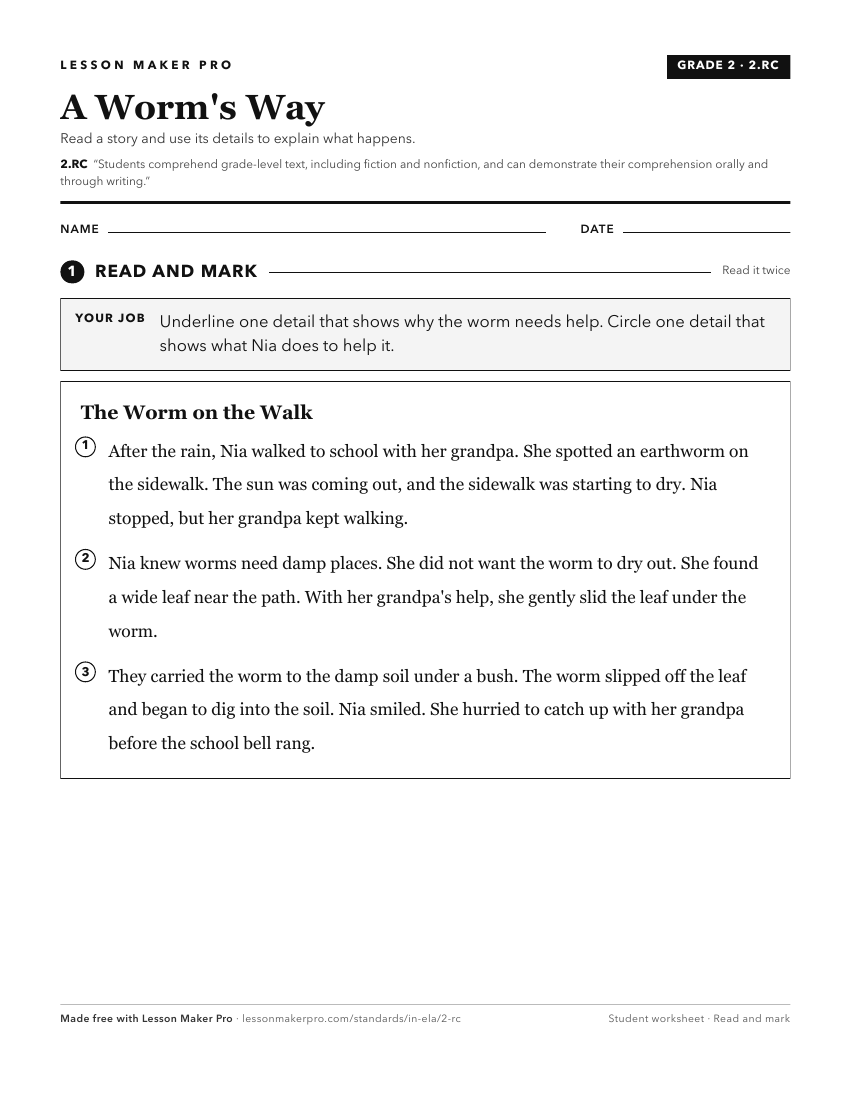
A ready-to-print activity worksheet aligned to 2.RC, with an answer key for the teacher on its own page. No account needed.
PDF, US Letter, prints cleanly in black and white.
Download the worksheetKeep exploring
Related Standards
Turn this cluster into a lesson
Grade, subject, topic, and the complete cluster are prefilled. Create one free, no account needed.
Also for this cluster:Make a WorksheetMake a QuizMake a Sub Lesson