Indiana ELA 5.RC
Standard Cluster
Students comprehend grade-level text, including fiction and nonfiction, and can demonstrate their comprehension orally and through writing.
Indiana Academic Standards for English/Language Arts (2023)
Cluster contents
Standards in This Cluster
5.RC is a cluster heading. These are the individual standards under it.
- 5.RC.3
Describe two or more characters, settings, or events in a story or play, drawing on specific details in the text and how they impact the plot.
- 5.RC.7
Apply knowledge of text features in multiple print and digital sources to locate information, gain meaning from a text, or solve a problem.
- 5.RC.9
Explain how an author uses reasons and evidence to support claims in a text, identifying which reasons and evidence support which claims. (E)
- 5.RC.10
Combine information from several texts or digital sources on the same topic in order to demonstrate knowledge about the subject.
- 5.RC.11
Select and apply context clues (e.g., word, phrase, sentence, and paragraph clues) and text features to determine the meanings of unknown words.
- 5.RC.12
Identify relationships among words, including multiple meanings, synonyms and antonyms, homographs, metaphors, similes, and analogies.
- 5.RC.13
Apply knowledge of word structure elements, known words, and word patterns to determine meaning (e.g., word origins, common Greek and Latin affixes and roots, p...
- 5.RC.14
Determine how words and phrases provide meaning to works of literature, including imagery, symbolism, and figurative language (e.g., similes, metaphors, hyperbo...
- 5.RC.1aIdentify at least one quote from a text to explain what a text says explicitly or implicitly. (E)
- 5.RC.2aUse details from a story, play, or poem to determine the theme, and summarize the text. (E)
- 5.RC.3aUse specific details in a text to describe the traits of at least two characters, settings, or events in a story or play; explain how the plot might change if these traits were different.
- 5.RC.4aIdentify a narrator's or speaker's point of view, and explain how that point of view influences how events are portrayed.
- 5.RC.5aCompare and contrast how two stories from the same genre approach similar themes or topics.
- 5.RC.6aIdentify more than one main idea of a text with key supporting details; summarize the text. (E)
- 5.RC.7aUse text features in multiple print and digital sources to locate information and gain meaning about a specific topic. (E)
- 5.RC.8aCompare and contrast the organizational structures of two or more nonfiction texts. (E)
- 5.RC.9aIdentify an author's claim and at least two reasons or pieces of evidence that support that claim. (E)
- 5.RC.10aCombine information from two texts or digital resources on the same topic in order to demonstrate knowledge about the subject.
- 5.RC.11aSelect and apply context clues (e.g., word, phrase, sentence, and paragraph clues) and text features to determine the meanings of unknown words. (E)
- 5.RC.12aIdentify and demonstrate knowledge of word relationships, including more complex multiple meanings, synonyms and antonyms, homographs, metaphors, similes, and analogies.
- 5.RC.13aIdentify and use word structure elements including common suffixes, prefixes, common Greek and Latin affixes or roots, word patterns, and/or basic parts of speech to help determine meaning.
- 5.RC.14aIdentify the meaning of words and phrases, including imagery, symbolism, and figurative language (e.g., similes, metaphors, hyperbole, or allusion) used in a text, and determine how their use adds meaning to a work of literature.
Teacher's field guide
What This Cluster Means
What Students Need to Do
- Students read stories and articles closely enough to explain what happens and what they learn. They answer questions aloud and in writing, using details from the text.
What Mastery Looks Like
- After a story, a student explains a character’s choice using a detail from the page. After an article, the student states the main idea and writes a short summary in their own words.
Common Misconceptions
- Some students retell every event instead of naming the main point. Others guess a character’s motive without checking the story, or copy a sentence from an article without explaining it.
How to Assess It
- After a short article on bee pollination, ask students to write its main idea and one supporting fact. Have them explain to a partner why that fact fits.
Lesson moves
Ways to Teach It
Give pairs a short story and an article; they place sticky notes beside lines that answer who, what, and why questions.
Ask partners to explain what the main character wants in a short story and point to the line that shows it.
Read a short article on bee pollination, then have teams match four question cards to sentences that answer them.
Give students a lunch menu with ingredient labels and a vegetarian request; they choose a meal and cite the ingredients.
Free download
Printable 5.RC Worksheet
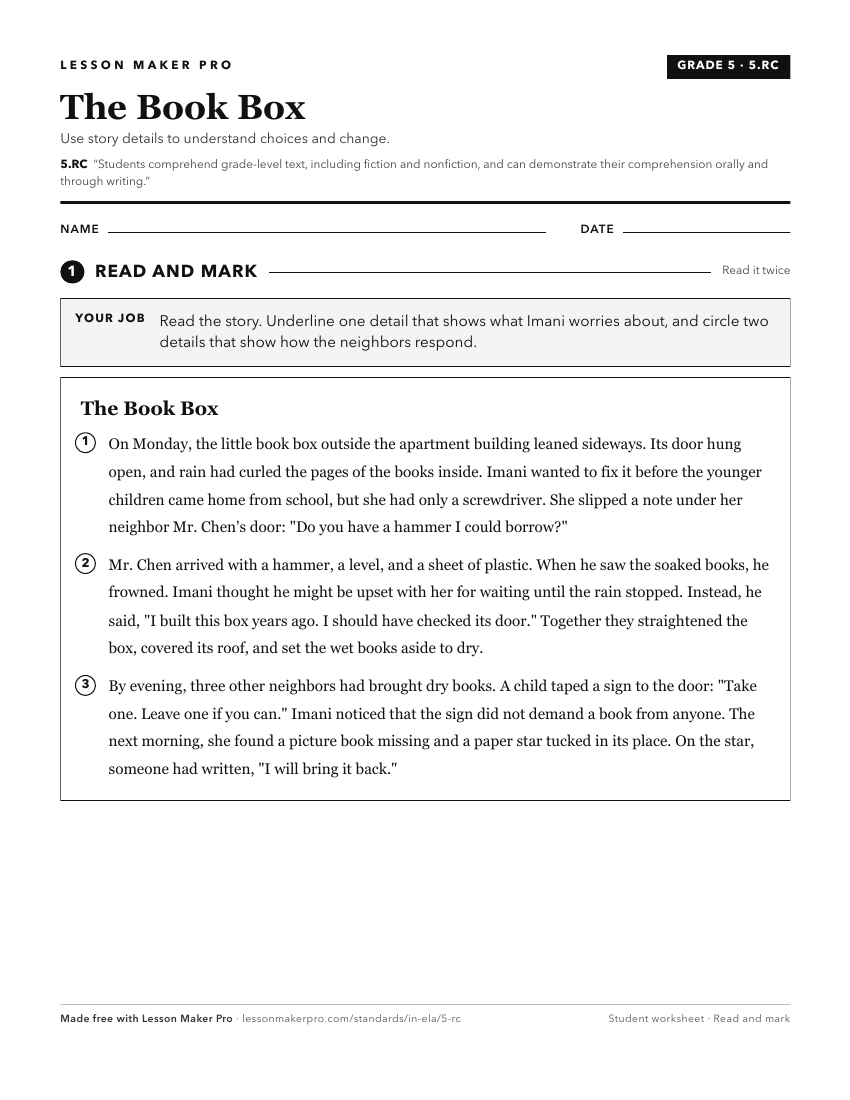
A ready-to-print activity worksheet aligned to 5.RC, with an answer key for the teacher on its own page. No account needed.
PDF, US Letter, prints cleanly in black and white.
Download the worksheetKeep exploring
Related Standards
Turn this cluster into a lesson
Grade, subject, topic, and the complete cluster are prefilled. Create one free, no account needed.
Also for this cluster:Make a WorksheetMake a QuizMake a Sub Lesson