Indiana ELA 5.RC.14
The Standard
- 5.RC
- Students comprehend grade-level text, including fiction and nonfiction, and can demonstrate their comprehension orally and through writing.
Determine how words and phrases provide meaning to works of literature, including imagery, symbolism, and figurative language (e.g., similes, metaphors, hyperbole, or allusion).
Indiana Academic Standards for English/Language Arts (2023)
Teacher's field guide
What This Standard Means
What Students Need to Do
- Students find sensory details, symbols, and nonliteral language in stories and poems. They use clues in the text to explain what those words suggest and how they shape the scene.
What Mastery Looks Like
- A student can explain that “her knees were jelly” shows a character is nervous, not that her knees changed. They can use details from the story to explain what an object, such as Grandma’s paper star, means to the character.
Common Misconceptions
- Students may name a simile or metaphor without explaining what it means. They may read an exaggeration as a fact or assume a symbol means the same thing in every story.
How to Assess It
- Exit ticket: Read “Lena stepped onto the stage; her knees were jelly, but she held Grandma’s paper star tight.” Explain what “knees were jelly” means and what the star might stand for, using clues from the line.
Lesson moves
Ways to Teach It
Give pairs the line “Rain tapped the roof like impatient fingers”; have them sketch the scene and label the words that create its sound.
Read a paragraph about a character saving an old ticket; ask students to write what the ticket might mean and cite one clue.
Put four phrase cards on each desk; students sort them as simile, metaphor, exaggeration, or sensory detail, then explain one phrase’s effect.
Show a greeting card that says “You are my sunshine”; ask students what the writer means and why they chose that image.
Free download
Printable 5.RC.14 Worksheet
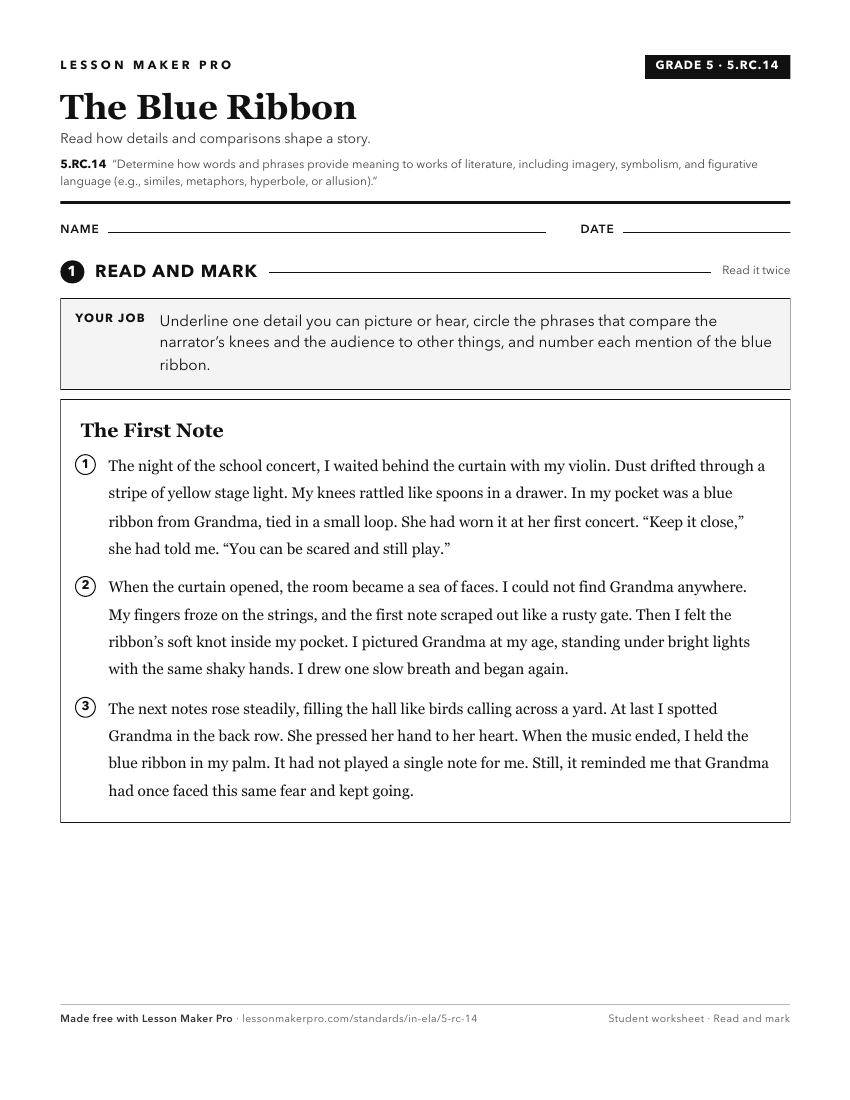
A ready-to-print activity worksheet aligned to 5.RC.14, with an answer key for the teacher on its own page. No account needed.
PDF, US Letter, prints cleanly in black and white.
Download the worksheetKeep exploring
Related Standards
- 4.RC.13
Determine how words and phrases provide meaning to works of literature, including figurative language (e.g., similes, metaphors, or hyperbole).
- 9-10.RC.12
Analyze the meaning of words and phrases as they are used in works of literature, including figurative, connotative, and denotative meanings; analyze the impact...
- 9-10.RC.13
Determine the meaning of words and phrases as they are used in a nonfiction text, including figurative, connotative, denotative, and technical meanings; evaluat...
Turn this exact standard into a lesson
Grade, subject, topic, and the complete standard are prefilled. Create one free, no account needed.
Also for this standard:Make a WorksheetMake a QuizMake a Sub Lesson