Indiana ELA 9-10.RC.12
The Standard
- 9-10.RC
- Students analyze the author's technique, structure, main ideas, purpose, and perspective in grade-level fiction and nonfiction text, using textual evidence to support analysis.
Analyze the meaning of words and phrases as they are used in works of literature, including figurative, connotative, and denotative meanings; analyze the impact of specific word choices on meaning and tone, including words with multiple meanings.
Indiana Academic Standards for English/Language Arts (2023)
Teacher's field guide
What This Standard Means
What Students Need to Do
- Students work out what words and phrases mean in a story or poem. They notice when a word means more than one thing or suggests more than its dictionary definition. They explain how word choices shape the tone.
What Mastery Looks Like
- A student can explain why “staggered” gives a different impression than “walked.” They can use nearby lines to explain a word’s meaning and show how it affects the mood of the scene.
Common Misconceptions
- Students may read a figurative phrase literally, as if a hallway could swallow footsteps. They may take “cold” to mean only temperature when it describes an unfriendly welcome. Some name a tone but cannot point to the words that create it.
How to Assess It
- Give students this line: “The hallway swallowed her footsteps, and a cold welcome waited behind the door.” Ask what “swallowed” and “cold” mean here and how each word affects the tone.
Lesson moves
Ways to Teach It
Print “Mara strolled into the room” and “Mara staggered into the room”; pairs annotate what each verb suggests about Mara and the mood.
Ask students to write two sentences explaining whether “a bright smile” describes light, happiness, or both in a short story excerpt.
Put “grin,” “smirk,” and “smile” on cards; teams sort them by implied attitude and write a character’s line using each word.
Show book jacket blurbs that call a character “stubborn” and “steadfast”; students explain how each label changes their expectations.
Free download
Printable 9-10.RC.12 Worksheet
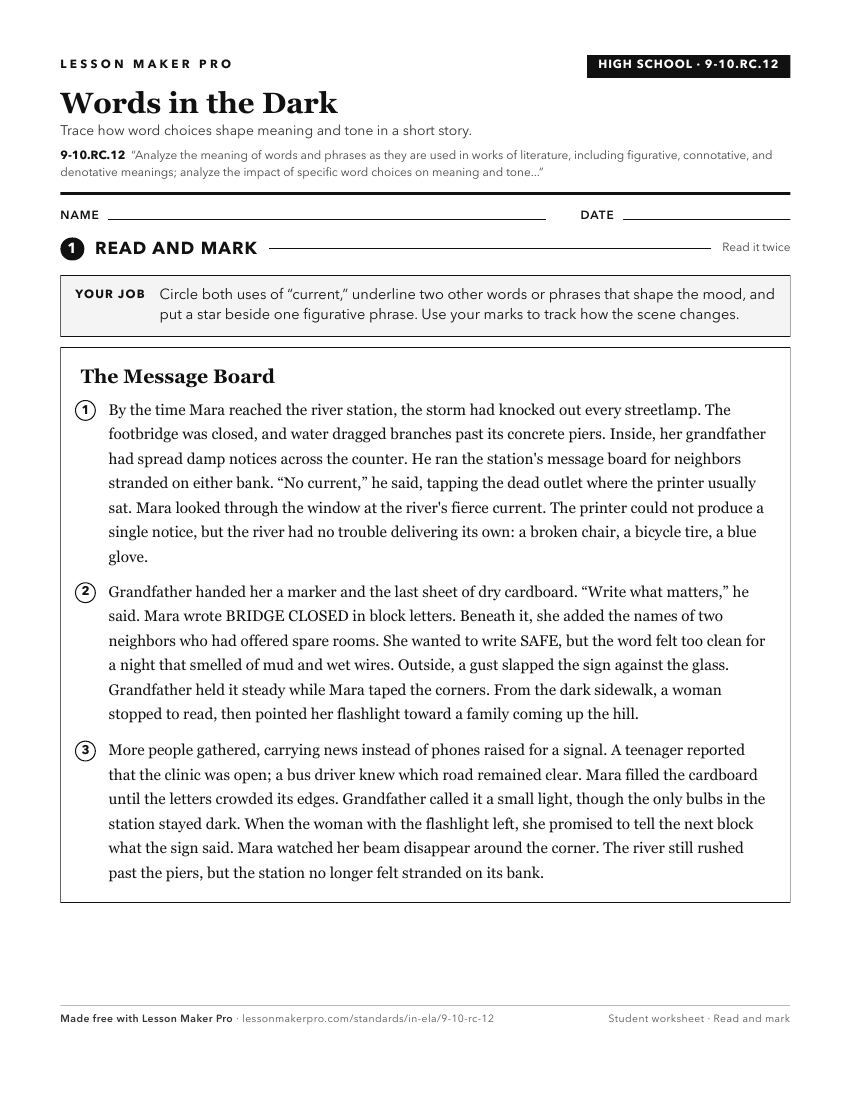
A ready-to-print activity worksheet aligned to 9-10.RC.12, with an answer key for the teacher on its own page. No account needed.
PDF, US Letter, prints cleanly in black and white.
Download the worksheetKeep exploring
Related Standards
- 11-12.RC.14
Determine the meaning of words and phrases as they are used in a nonfiction text, including figurative, connotative, denotative, and technical meanings; evaluat...
- 9-10.RC.13
Determine the meaning of words and phrases as they are used in a nonfiction text, including figurative, connotative, denotative, and technical meanings; evaluat...
- 5.RC.14
Determine how words and phrases provide meaning to works of literature, including imagery, symbolism, and figurative language (e.g., similes, metaphors, hyperbo...
Turn this exact standard into a lesson
Grade, subject, topic, and the complete standard are prefilled. Create one free, no account needed.
Also for this standard:Make a WorksheetMake a QuizMake a Sub Lesson