Indiana ELA 4.RC.13
The Standard
- 4.RC
- Students comprehend grade-level text, including fiction and nonfiction, and can demonstrate their comprehension orally and through writing.
Determine how words and phrases provide meaning to works of literature, including figurative language (e.g., similes, metaphors, or hyperbole).
Indiana Academic Standards for English/Language Arts (2023)
Teacher's field guide
What This Standard Means
What Students Need to Do
- Students find words and phrases in a story or poem that shape what readers picture or feel. They explain what a comparison or exaggeration means in context, not just name its type.
What Mastery Looks Like
- Given “The hallway was a beehive,” a student explains that the hallway was busy and noisy, not full of bees. They use nearby details to support that meaning and explain how the phrase changes the scene.
Common Misconceptions
- Students may read figurative language literally or think every comparison uses “like” or “as.” They may name a metaphor or hyperbole without explaining what it helps the reader understand.
How to Assess It
- Put this sentence on an exit ticket: “The rain hit the roof like handfuls of pebbles as Mia waited.” Ask what the comparison tells them about the sound.
Lesson moves
Ways to Teach It
Give pairs “The hallway was noisy” and “The hallway was a beehive”; have them sketch each scene and circle the words that change it.
Ask: In “The wind whispered through the trees,” what does “whispered” suggest about the sound? Have students write one sentence.
Play phrase detective: display “I waited a million years,” then have teams write its plain meaning and explain the exaggeration before revealing answers.
Show the sports headline “The goalie was a wall”; have students explain its meaning, then compare it with a metaphor in a class story.
Free download
Printable 4.RC.13 Worksheet
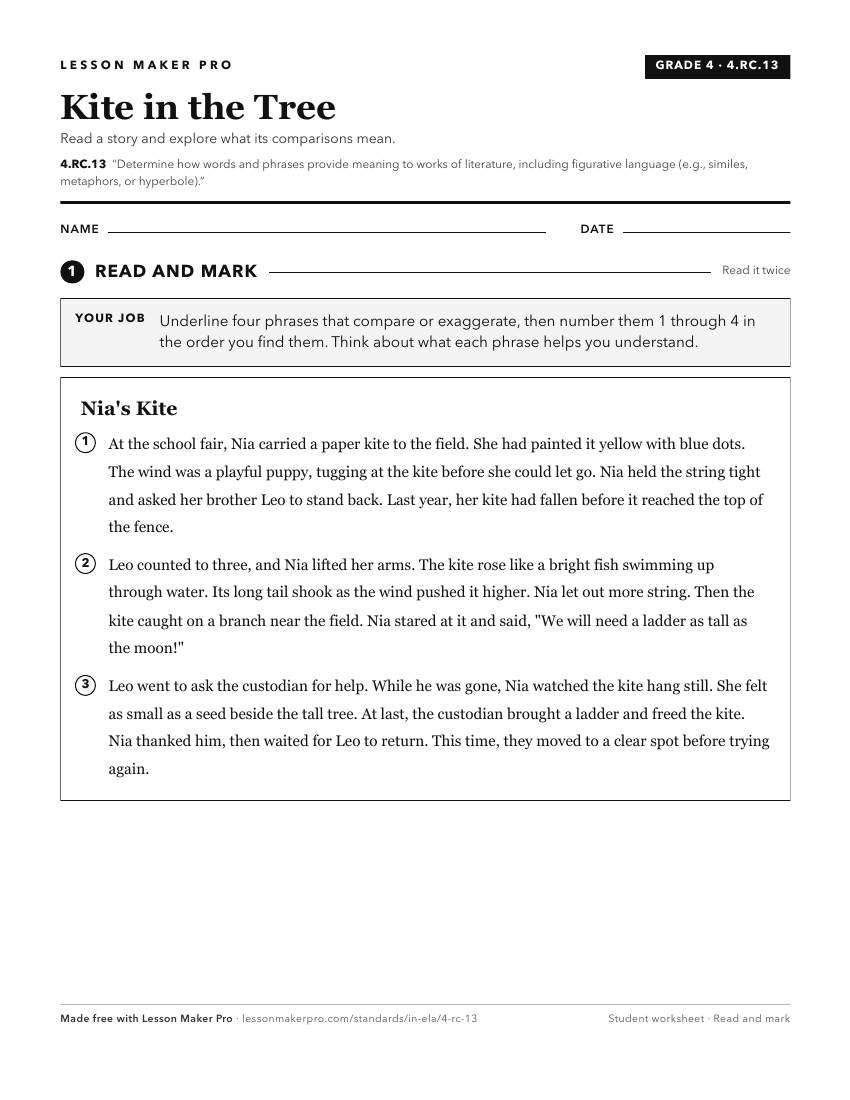
A ready-to-print activity worksheet aligned to 4.RC.13, with an answer key for the teacher on its own page. No account needed.
PDF, US Letter, prints cleanly in black and white.
Download the worksheetKeep exploring
Related Standards
- 5.RC.14
Determine how words and phrases provide meaning to works of literature, including imagery, symbolism, and figurative language (e.g., similes, metaphors, hyperbo...
- 9-10.RC.12
Analyze the meaning of words and phrases as they are used in works of literature, including figurative, connotative, and denotative meanings; analyze the impact...
- 9-10.RC.13
Determine the meaning of words and phrases as they are used in a nonfiction text, including figurative, connotative, denotative, and technical meanings; evaluat...
Turn this exact standard into a lesson
Grade, subject, topic, and the complete standard are prefilled. Create one free, no account needed.
Also for this standard:Make a WorksheetMake a QuizMake a Sub Lesson