Indiana ELA K.RC
Standard Cluster
Students comprehend grade-level text, including fiction and nonfiction, and can demonstrate their comprehension orally and through writing.
Indiana Academic Standards for English/Language Arts (2023)
Cluster contents
Standards in This Cluster
K.RC is a cluster heading. These are the individual standards under it.
- K.RC.1
With support, ask and answer questions about main topics and key details in a text heard or read.
- K.RC.2
With support, retell familiar stories, poems, and nursery rhymes, including key details. (K)
- K.RC.3
Identify important elements within a text (e.g., characters, settings, or events). (K)
- K.RC.4
With support, make predictions about what will happen in a text.
- K.RC.5
With support, retell the main idea and key details of a text.
- K.RC.6
Identify text features of a nonfiction text (e.g., title, author, illustrations), and describe the relationship between those features and the text in which the...
- K.RC.7
Identify and sort pictures of objects into categories (e.g., colors, shapes, opposites) through oral discussions. (E)
- K.RC.1aWith support, ask and answer questions about main topics in a text heard or read. (E)
- K.RC.2aWith support, retell shared and familiar stories, poems, or nursery rhymes, recalling at least two key details. (E)
- K.RC.3aIdentify two or more important elements within a text (e.g., characters, settings, or events). (E)
- K.RC.4aWith support, identify, given two options, a prediction about what might happen next in a story.
- K.RC.5aWith support, answer questions about a main idea and key details in a short text.
- K.RC.6aIdentify two or more nonfiction text features (e.g., title, author, illustrations). (E)
- K.RC.7aIdentify and sort pictures of objects into categories (e.g., colors, shapes, opposites). (E)
Teacher's field guide
What This Cluster Means
What Students Need to Do
- Children listen to or read simple stories and nonfiction pages. They tell what happened or what they learned, then show their understanding through speech and early writing.
What Mastery Looks Like
- After a story, a child names a character and retells two events in order. After a nonfiction page, the child states a fact and writes or labels a detail that matches the text.
Common Misconceptions
- Some children describe only the picture and miss what the words say. Others give a guess that the text does not support or mix up a story event with a nonfiction fact.
How to Assess It
- Read a four-sentence story about a lost frog and a short fact card about frogs, then ask each child to tell you what happened and name one frog fact. Have them write or label one answer from each text.
Lesson moves
Ways to Teach It
Give pairs three picture cards from a story read aloud to put in order, then ask them to label the ending.
Read a page about how ants carry food, then ask children to tell a partner what ants carry and write one word from the page.
Play a matching game with character, event, and fact cards from two read-alouds, and have children explain each match.
Read a classroom plant care card, then have children explain and write one step they would follow to water the plant.
Free download
Printable K.RC Worksheet
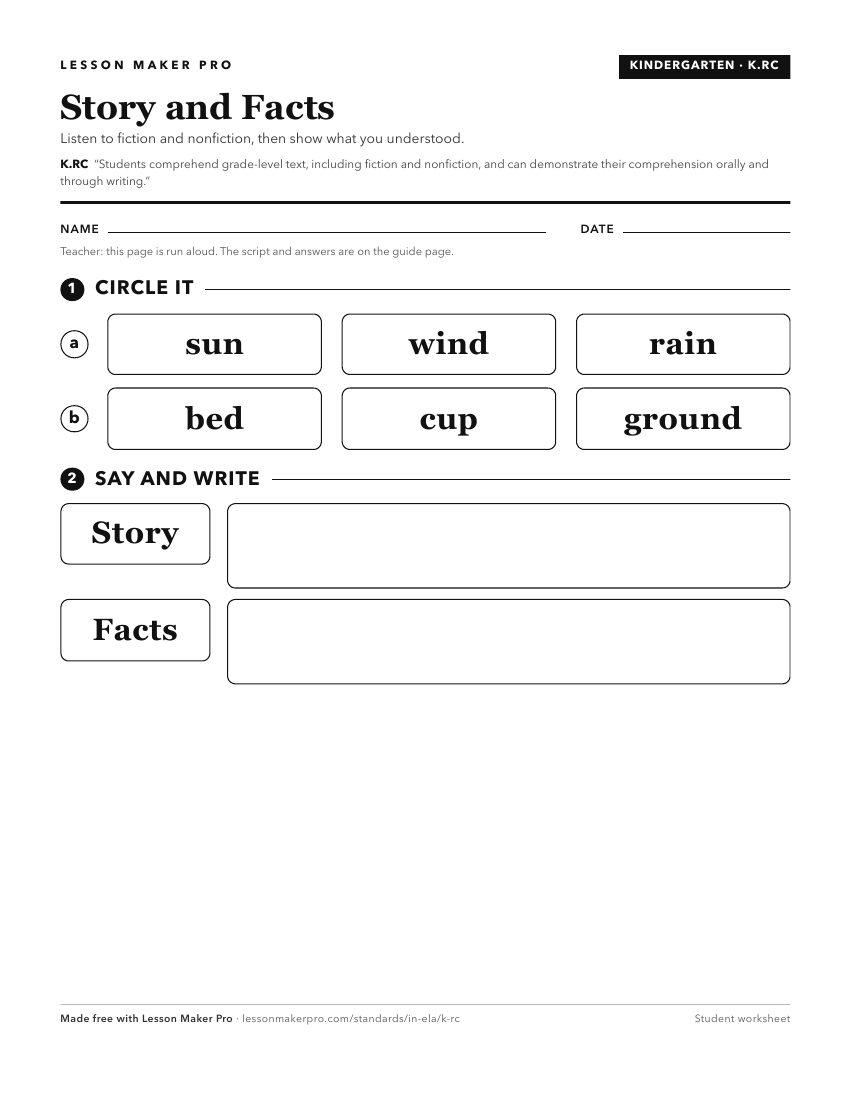
A ready-to-print activity worksheet aligned to K.RC, with an answer key for the teacher on its own page. No account needed.
PDF, US Letter, prints cleanly in black and white.
Download the worksheetKeep exploring
Related Standards
Turn this cluster into a lesson
Grade, subject, topic, and the complete cluster are prefilled. Create one free, no account needed.
Also for this cluster:Make a WorksheetMake a QuizMake a Sub Lesson