Indiana ELA 3.RC.11
The Standard
- 3.RC
- Students comprehend grade-level text, including fiction and nonfiction, and can demonstrate their comprehension orally and through writing.
Apply context clues (e.g., word, phrase, and sentence-level context) and text features (e.g., maps, illustrations, charts) to determine the meanings of unknown words.
Indiana Academic Standards for English/Language Arts (2023)
Teacher's field guide
What This Standard Means
What Students Need to Do
- Students use nearby words and sentences to work out unfamiliar words. They also check maps, illustrations, and charts for clues, then explain how the clues support their answer.
What Mastery Looks Like
- A student can explain an unfamiliar word in their own words. They can point to a clue in the text or a visual feature and show why their meaning fits the passage.
Common Misconceptions
- Students may choose a familiar meaning of a word even when it does not fit the sentence. They may guess from a picture alone or miss useful labels on a map or chart.
How to Assess It
- Write, 'Bring boots because precipitation is expected Tuesday,' beside a chart with a rain icon under Tuesday. Ask, 'What does precipitation mean, and which word and chart clue helped you?'
Lesson moves
Ways to Teach It
Give pairs a moth article saying 'Camouflage helps it blend into bark' and a moth photo; have them underline clues to camouflage.
Ask, 'In the sentence The desert was arid, with almost no rain, what does arid mean and which words helped?'
Play clue match: pairs match unfamiliar words to sentence strips and picture cards, then name the clue that proves each match.
Read a zoo exhibit sign with a moon icon and the phrase 'awake at night'; ask students to explain nocturnal.
Free download
Printable 3.RC.11 Worksheet
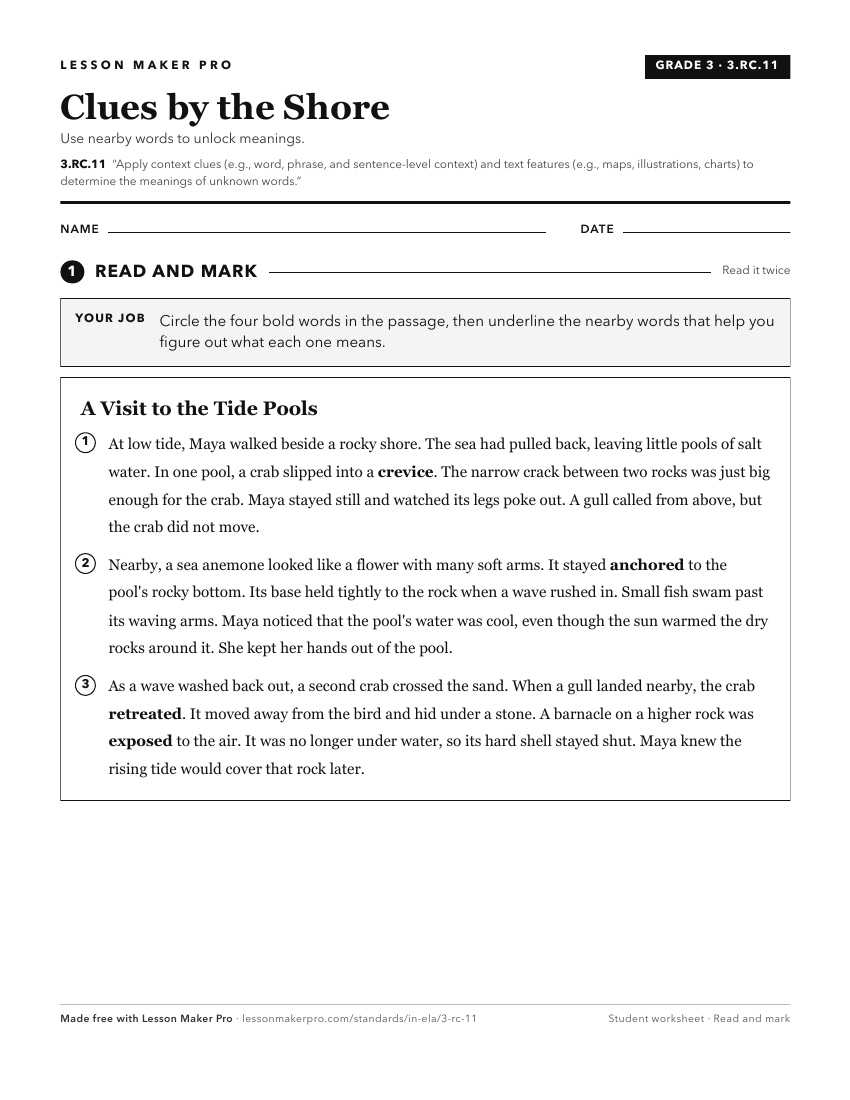
A ready-to-print activity worksheet aligned to 3.RC.11, with an answer key for the teacher on its own page. No account needed.
PDF, US Letter, prints cleanly in black and white.
Download the worksheetKeep exploring
Related Standards
- 4.RC.10
Apply context clues (e.g., word, phrase, sentence, and paragraph context) and text features (e.g., charts, headings/subheadings, font/format) to determine the m...
- 5.RC.11
Select and apply context clues (e.g., word, phrase, sentence, and paragraph clues) and text features to determine the meanings of unknown words.
- 2.RC.11
Use context clues (e.g., words and sentence clues) and text features (e.g., table of contents, headings) to determine the meanings of unknown words.
- 1.RC.9
Demonstrate comprehension that context clues (e.g., words and sentence clues) and text features (e.g., glossaries, illustrations) may be used to help understand...
Turn this exact standard into a lesson
Grade, subject, topic, and the complete standard are prefilled. Create one free, no account needed.
Also for this standard:Make a WorksheetMake a QuizMake a Sub Lesson