Idaho Social Studies 9-12.WC.9
The Standard
Describe the class system of ancient Rome, including the role of patricians, plebeians, and slaves in Roman society.
Idaho Content Standards: K-12 Social Studies · Ancient Rome (c. 500 BC – 500 AD)
Teacher's field guide
What This Standard Means
What Students Need to Do
- Students identify patricians, plebeians, and enslaved people by their family background, freedom, and rights. They describe the kinds of work people in each group did.
What Mastery Looks Like
- A student can sort short descriptions of Romans into the three groups and explain each choice. They know a wealthy plebeian was not a patrician, and an enslaved worker did not have a free citizen's rights.
Common Misconceptions
- Students may think all plebeians were poor or that anyone rich was a patrician. They may also call enslaved people citizens with fewer rights, rather than people who were not free.
How to Assess It
- Exit ticket: Classify a patrician senator, a plebeian citizen shopkeeper, and an enslaved household worker. For each, name one clue that supports your choice.
Lesson moves
Ways to Teach It
Give pairs role cards showing family background, freedom, and work; have them sort the cards into three groups and defend one tricky choice.
Ask, "Could a rich shopkeeper become a patrician just by earning money?" Have students write two sentences explaining their answer.
Play three rounds of "Who Am I?" using clues about birth and legal freedom; students hold up patrician, plebeian, or enslaved cards.
Compare a Roman free male citizen's voting rights with your state's voter registration form; identify who can vote today but could not vote in Rome.
Free download
Printable 9-12.WC.9 Worksheet
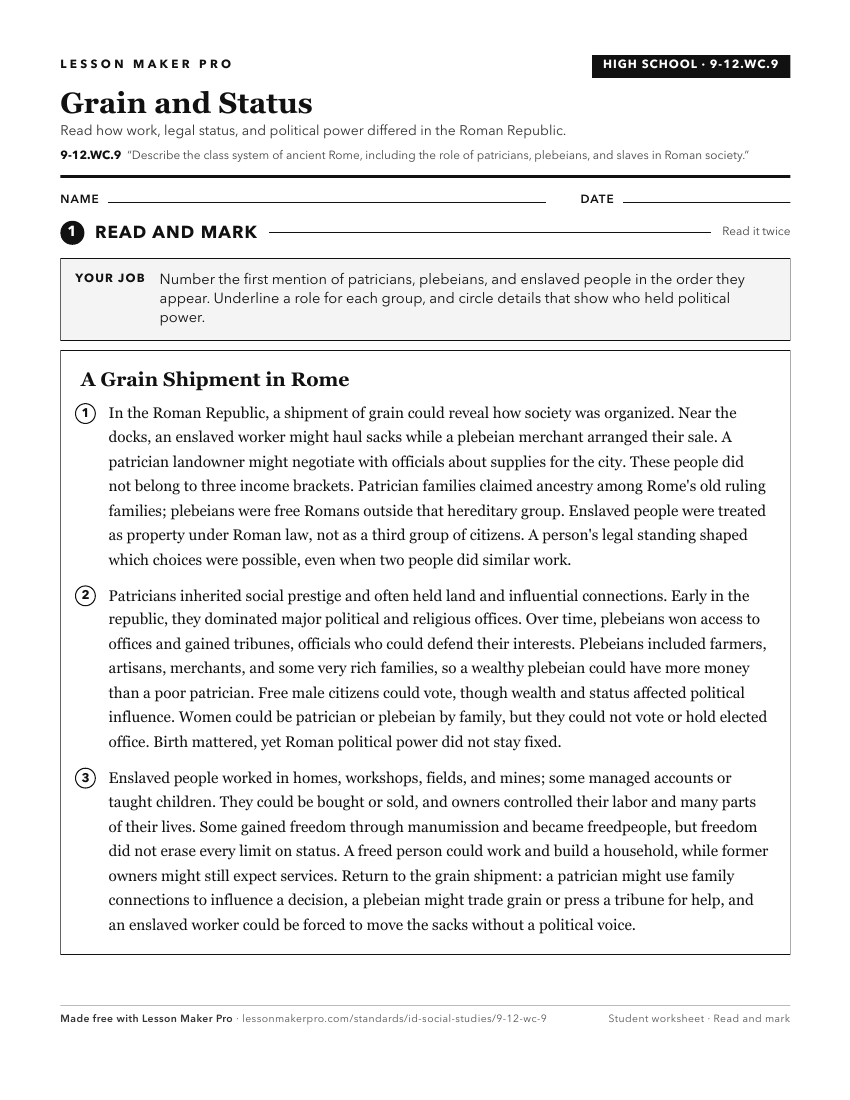
A ready-to-print activity worksheet aligned to 9-12.WC.9, with an answer key for the teacher on its own page. No account needed.
PDF, US Letter, prints cleanly in black and white.
Download the worksheetKeep exploring
Related Standards
- 9-12.WC.21
Describe the orders of medieval social hierarchy, the changing role of the Church, the emergence of feudalism and the development of feudal obligations.
- 9-12.WC.11
Describe the fall of the Roman Republic including, but not limited to the role of Julius Caesar taking the role of Dictator for Life.
- 6-9.WH.1.8
Analyze different social classes and their impact on societies and civilizations throughout the world, including Ancient, Middle Age, Early-Modern, and Modern.
- 9-12.WC.8
Describe the government of the Roman Republic and its contribution to the development of modern democratic principles including, but not limited to separation o...
Turn this exact standard into a lesson
Grade, subject, topic, and the complete standard are prefilled. Create one free, no account needed.
Also for this standard:Make a WorksheetMake a QuizMake a Sub Lesson