Idaho Social Studies 6-9.WH.1.8
The Standard
Analyze different social classes and their impact on societies and civilizations throughout the world, including Ancient, Middle Age, Early-Modern, and Modern.
Idaho Content Standards: K-12 Social Studies
Teacher's field guide
What This Standard Means
What Students Need to Do
- Students identify who owned land, did the work, and made decisions in societies from different times and places. They explain how social class shaped daily life and power.
What Mastery Looks Like
- A student can compare class in two societies without assuming the rules were the same. They use details about work, rights, or wealth to explain who had power and why.
Common Misconceptions
- Students may think class was only about money and miss the role of birth or legal rights. They may assume a wealthy merchant had high status everywhere, or that all farmers had the same rights.
How to Assess It
- Exit ticket: In medieval Europe, many peasants farmed land owned by nobles. In early modern Japan, some merchants grew wealthy but held low official rank. How did class shape power in each society?
Lesson moves
Ways to Teach It
Give pairs ancient Egyptian role cards for a ruler, priest, scribe, and farmer; have them sort the cards by work and decision-making power.
Write three sentences: Why could a wealthy merchant in early modern Japan still rank below a farmer?
Play a matching game: pair Egyptian scribes, medieval serfs, Tokugawa merchants, and British factory workers with descriptions of their work and rights.
Bring local manager and cashier job ads with posted pay; compare pay and decision-making power with factory owners and workers in industrial Britain.
Free download
Printable 6-9.WH.1.8 Worksheet
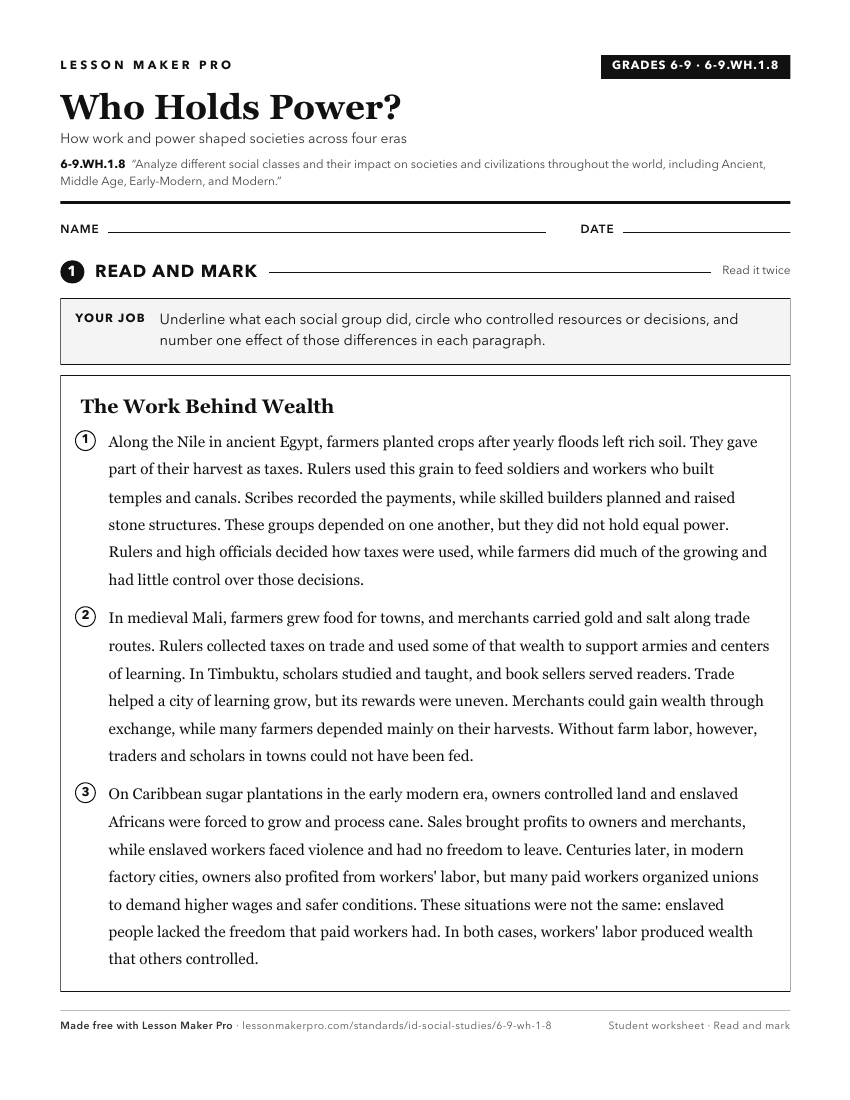
A ready-to-print activity worksheet aligned to 6-9.WH.1.8, with an answer key for the teacher on its own page. No account needed.
PDF, US Letter, prints cleanly in black and white.
Download the worksheetKeep exploring
Related Standards
- 6-9.WH.1.6
Identify the technological advances developed by Ancient, Middle Age, Early-Modern, and Modern societies and civilizations throughout the world.
- 6-9.WH.1.4
Analyze the characteristics of early civilizations throughout the world including government, religion/belief systems, arts/architecture, technology, physical g...
- 6-9.WH.4.2
Analyze the various political systems that shaped civilizations throughout the world, including the City-State, Monarchy, Republic, Nation-State, or Democracy.
- 6-12.HT2.4
Analyze complex and interacting factors that influenced the perspectives of people during different historical eras and how those perspectives are reflected thr...
Turn this exact standard into a lesson
Grade, subject, topic, and the complete standard are prefilled. Create one free, no account needed.
Also for this standard:Make a WorksheetMake a QuizMake a Sub Lesson