Idaho Social Studies 6-9.WH.4.2
The Standard
Analyze the various political systems that shaped civilizations throughout the world, including the City-State, Monarchy, Republic, Nation-State, or Democracy.
Idaho Content Standards: K-12 Social Studies
Teacher's field guide
What This Standard Means
What Students Need to Do
- Students compare how places were governed and who made decisions. They use historical examples to sort political systems and explain why more than one label can fit a place.
What Mastery Looks Like
- A student can identify Athens as a city-state with limited democracy and the Roman Republic as a republic. They can explain why modern Japan is a nation-state, a democracy, and a constitutional monarchy.
Common Misconceptions
- Students may think a city-state is just a city, or that everyone could vote in ancient Athens. They may also think a monarchy cannot have elections, or that a nation-state has only one ethnic group.
How to Assess It
- Exit ticket: Athens governed its own city and nearby land, and eligible male citizens voted on laws. Name two political labels that fit and explain each.
Lesson moves
Ways to Teach It
Give pairs cards for Athens, the Roman Republic, the Mali Empire, and modern Japan; have them sort by who held power and mark overlapping labels.
Ask students to write two sentences answering: How could Athens be both a city-state and a democracy?
Read short descriptions of four governments aloud; pairs hold up every matching label card and explain one choice.
Give students a short fact sheet on Japan's emperor and elected parliament; have them explain how monarchy and democracy operate together.
Free download
Printable 6-9.WH.4.2 Worksheet
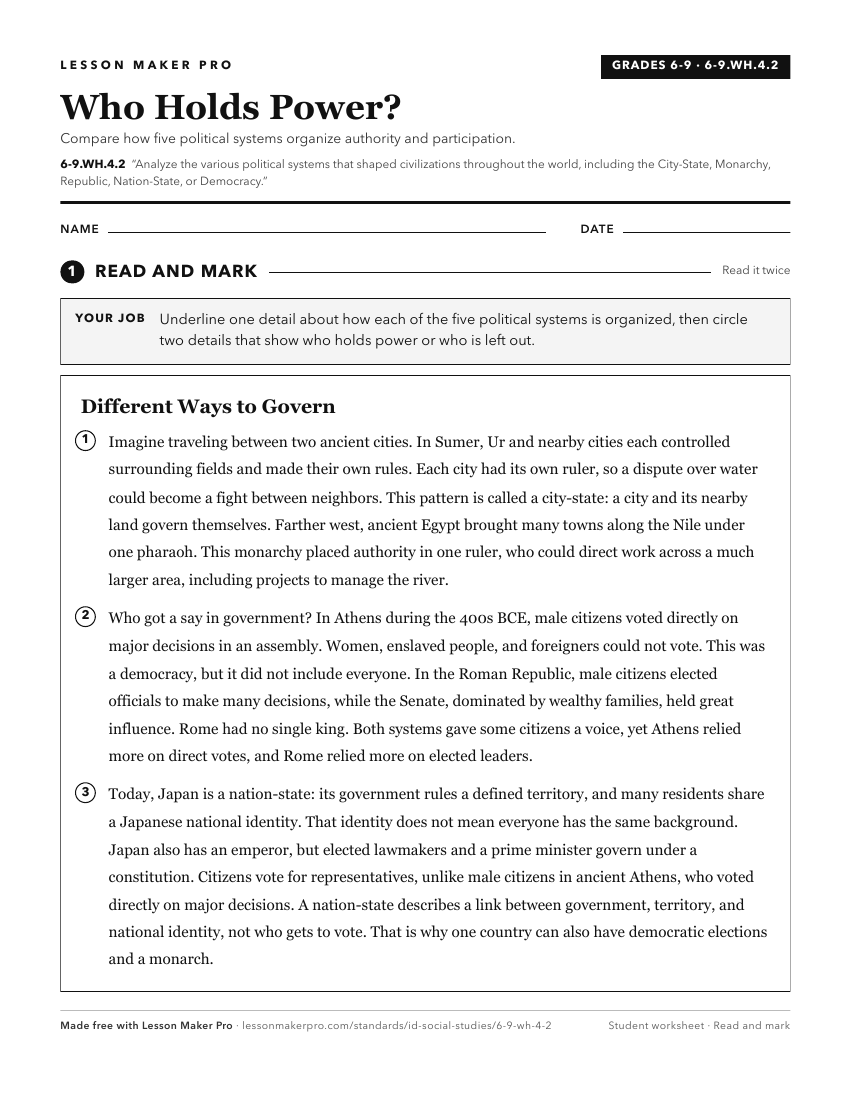
A ready-to-print activity worksheet aligned to 6-9.WH.4.2, with an answer key for the teacher on its own page. No account needed.
PDF, US Letter, prints cleanly in black and white.
Download the worksheetKeep exploring
Related Standards
- 6-9.WH.1.4
Analyze the characteristics of early civilizations throughout the world including government, religion/belief systems, arts/architecture, technology, physical g...
- 9-12.GOV.56
Compare the different forms of domestic and foreign political systems, electoral systems, economic systems, and civil societies including presidential vs parlia...
- 6-9.WH.1.8
Analyze different social classes and their impact on societies and civilizations throughout the world, including Ancient, Middle Age, Early-Modern, and Modern.
- 6-9.WG.1.1
Describe major aspects of the civilizations in regions throughout the world prior to European contact including government, religion/belief systems, arts/archit...
Turn this exact standard into a lesson
Grade, subject, topic, and the complete standard are prefilled. Create one free, no account needed.
Also for this standard:Make a WorksheetMake a QuizMake a Sub Lesson