Idaho Social Studies 6-9.WH.1.4
The Standard
Analyze the characteristics of early civilizations throughout the world including government, religion/belief systems, arts/architecture, technology, physical geography, economics, and social order.
Idaho Content Standards: K-12 Social Studies
Teacher's field guide
What This Standard Means
What Students Need to Do
- Students compare early civilizations in Africa, Asia, and the Americas using maps, artifacts, and short texts. They explain how land and water shaped farming, trade, and cities. They compare ways people governed, worshipped, built, worked, and used tools.
What Mastery Looks Like
- A student can explain a similarity and a difference between two civilizations, such as Egypt and Shang China. They can describe who held power, how people lived, and what buildings and tools were used. They support their claims with details from a map, artifact, or text.
Common Misconceptions
- Students may assume all early civilizations had kings or the same gods. They often think a nearby river made farming easy, without considering canals and floods. They may treat a large temple as proof that everyone shared the same beliefs.
How to Assess It
- Give students a map of the Nile and Tigris-Euphrates rivers and labeled images of a pyramid and ziggurat. Ask them to explain one way geography shaped both societies and one difference between the buildings.
Lesson moves
Ways to Teach It
Give pairs a Nile map, blue yarn, and counters; have them mark farms, canals, cities, and trade routes, then explain each choice.
Show labeled images of an Egyptian pyramid and a Maya temple; ask what each suggests about belief and power, and what remains uncertain.
Deal cards showing oracle bones, Indus drains, Egyptian grain records, and Mesopotamian laws; teams match each to a society feature and explain why.
Compare a local floodplain map with a Nile settlement map; ask where people built homes and farms, and who manages water now.
Free download
Printable 6-9.WH.1.4 Worksheet
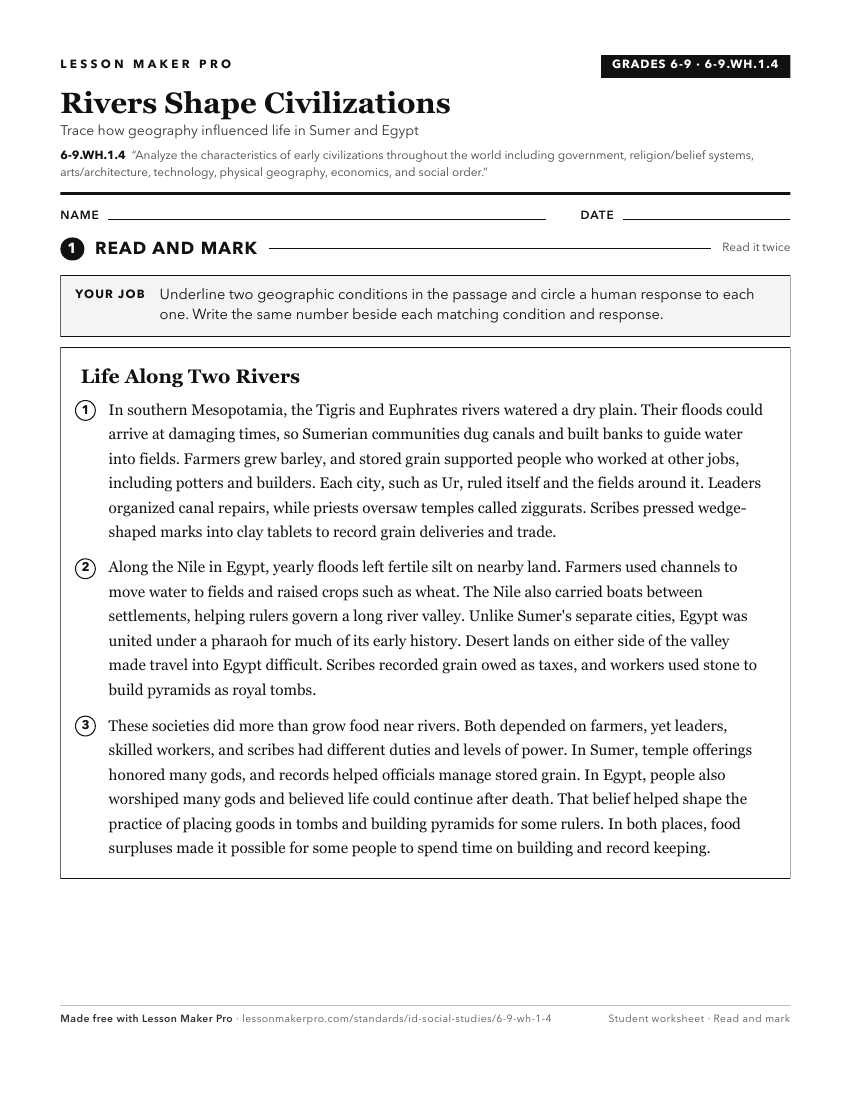
A ready-to-print activity worksheet aligned to 6-9.WH.1.4, with an answer key for the teacher on its own page. No account needed.
PDF, US Letter, prints cleanly in black and white.
Download the worksheetKeep exploring
Related Standards
- 6-9.WH.4.2
Analyze the various political systems that shaped civilizations throughout the world, including the City-State, Monarchy, Republic, Nation-State, or Democracy.
- 6-9.WH.1.8
Analyze different social classes and their impact on societies and civilizations throughout the world, including Ancient, Middle Age, Early-Modern, and Modern.
- 6-9.WH.1.7
Identify examples of how writing, art, architecture, mathematics, and science have evolved over time, such as in Ancient, Middle Age, Early-Modern, or Modern so...
- 6-9.WG.1.1
Describe major aspects of the civilizations in regions throughout the world prior to European contact including government, religion/belief systems, arts/archit...
Turn this exact standard into a lesson
Grade, subject, topic, and the complete standard are prefilled. Create one free, no account needed.
Also for this standard:Make a WorksheetMake a QuizMake a Sub Lesson