Idaho Social Studies 9-12.WC.21
The Standard
Describe the orders of medieval social hierarchy, the changing role of the Church, the emergence of feudalism and the development of feudal obligations.
Idaho Content Standards: K-12 Social Studies · The Middle Ages (c. 330 AD – 1450 AD)
Teacher's field guide
What This Standard Means
What Students Need to Do
- Students identify clergy, nobles, and peasants and explain why local lords gained power when rulers could not keep order. They trace exchanges of land, labor, military service, and protection. They describe how the Church's roles in learning, landholding, and politics changed over time.
What Mastery Looks Like
- A student can explain what a lord, knight, and serf each owed without treating their relationships as the same. They can connect weak central rule to the need for local protection. They can compare a monastery's work in learning with a pope's claim to political authority.
Common Misconceptions
- Students may assume every peasant was a serf or confuse serfdom with slavery. They may mistake a knight's pledge of military service for a peasant's labor dues. Some assume clergy had no land or political power.
How to Assess It
- On an exit ticket, have students label clergy, nobles, and peasants, then draw arrows for land, military service, labor, and protection among a lord, knight, and serf. Ask why local lords gained power and name one political role the Church took on.
Lesson moves
Ways to Teach It
Give pairs lord, knight, serf, and priest cards; have them connect the roles with string labeled land, service, labor, protection, or tithes.
Compare a monk copying texts in 800 with a pope challenging a king in 1100; write what changed about Church power.
Play a card sort matching weak kings, local threats, land grants, and military service to causes or obligations; explain one match.
Give students a sample apartment lease and a short manor dues record; have them mark each person's duties and one major difference.
Free download
Printable 9-12.WC.21 Worksheet
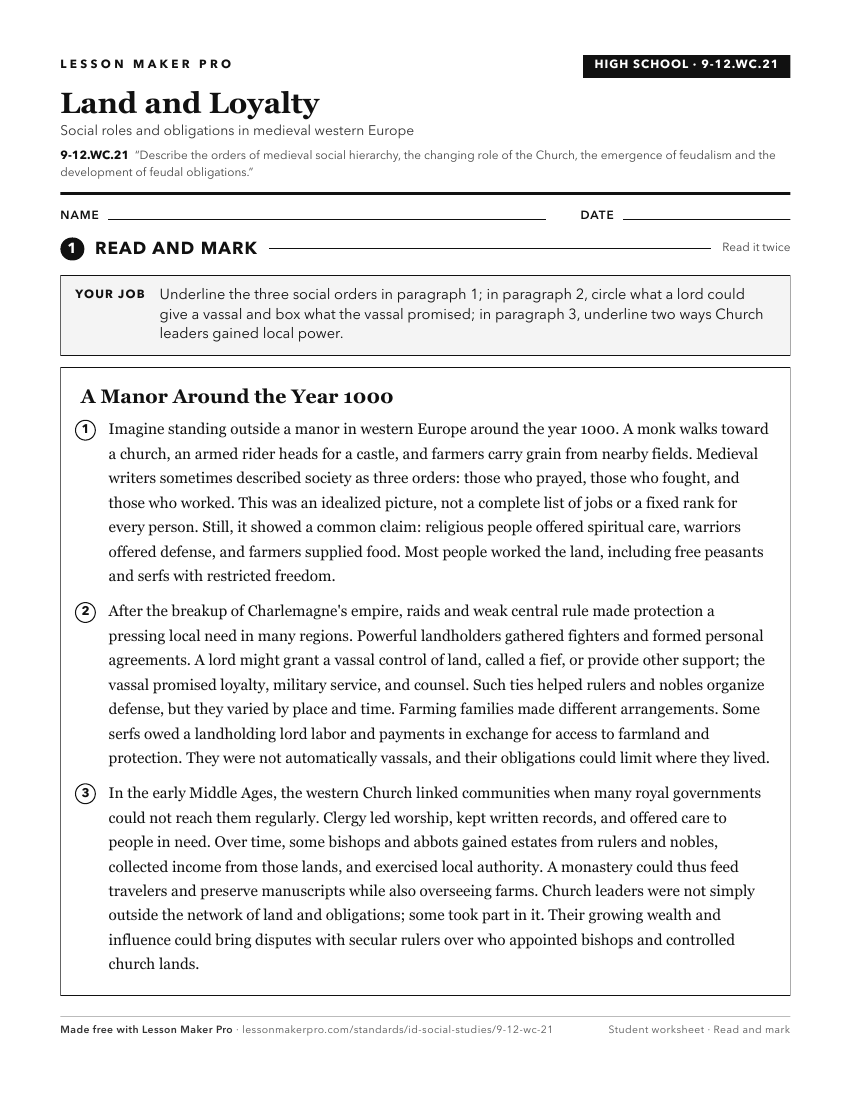
A ready-to-print activity worksheet aligned to 9-12.WC.21, with an answer key for the teacher on its own page. No account needed.
PDF, US Letter, prints cleanly in black and white.
Download the worksheetKeep exploring
Related Standards
- 6-9.WH.1.11
Discuss how religion, belief systems, economics, and politics influenced social behavior and were used to maintain social order.
- 9-12.WC.30
Explain key developments in medieval English legal and constitutional history, including the impact of the Magna Carta on limiting the monarch’s power, the deve...
- 9-12.WC.23
Identify key figures, artistic and intellectual achievements of the medieval period in Western Europe, (e.g. Thomas Aquinas, Hildegard von Bingen, Dante, Gothic...
- 6-9.WH.1.8
Analyze different social classes and their impact on societies and civilizations throughout the world, including Ancient, Middle Age, Early-Modern, and Modern.
Turn this exact standard into a lesson
Grade, subject, topic, and the complete standard are prefilled. Create one free, no account needed.
Also for this standard:Make a WorksheetMake a QuizMake a Sub Lesson