Idaho Social Studies 9-12.WC.23
The Standard
Identify key figures, artistic and intellectual achievements of the medieval period in Western Europe, (e.g. Thomas Aquinas, Hildegard von Bingen, Dante, Gothic architecture, scholasticism, etc.).
Idaho Content Standards: K-12 Social Studies · The Middle Ages (c. 330 AD – 1450 AD)
Teacher's field guide
What This Standard Means
What Students Need to Do
- Students connect Aquinas, Hildegard von Bingen, and Dante to their ideas and works. They spot Gothic features in cathedral images and explain how scholastic thinkers used questions and arguments to examine faith.
What Mastery Looks Like
- A student can connect Aquinas to reasoned arguments about faith, Hildegard to sacred music, and Dante to The Divine Comedy. They can name a pointed arch or flying buttress in a photo and explain how it helped builders create taller spaces.
Common Misconceptions
- Students may think scholasticism means simply going to school, rather than working through questions and arguments. They may call any old church Gothic or think Gothic means dark and gloomy. Some place Dante in the Renaissance rather than the Middle Ages.
How to Assess It
- Exit ticket: Match Aquinas, Hildegard, and Dante to scholastic arguments, sacred music, and The Divine Comedy. Then circle and name one Gothic feature in a cathedral photo.
Lesson moves
Ways to Teach It
Give pairs interior and exterior cathedral photos; have them trace and label a pointed arch, ribbed vault, and flying buttress.
Read a short Aquinas argument and a translated Hildegard song; ask, “How did each use learning or art to explore faith?”
Play a card match: pair Aquinas, Hildegard, Dante, and Gothic cathedrals with an argument, song lyric, poem excerpt, and building photo.
Show a photo of Washington National Cathedral; students circle its pointed arches and note how a modern building uses medieval design.
Free download
Printable 9-12.WC.23 Worksheet
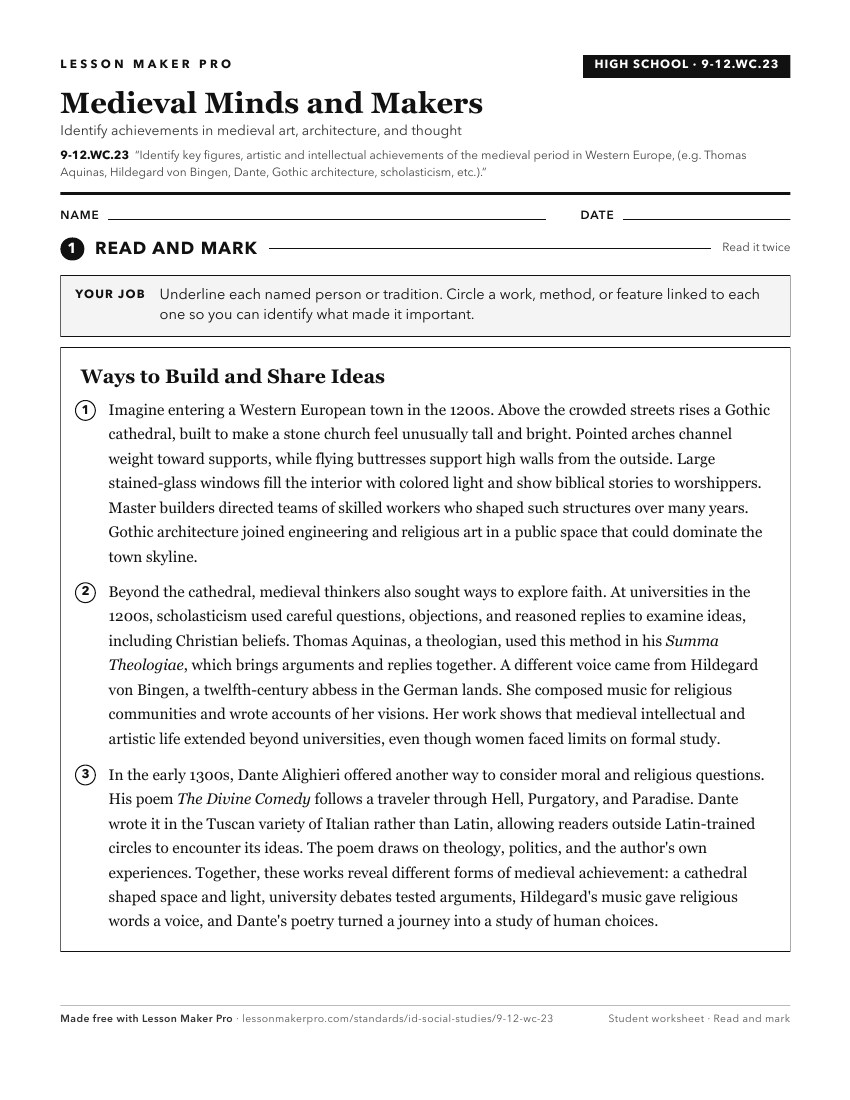
A ready-to-print activity worksheet aligned to 9-12.WC.23, with an answer key for the teacher on its own page. No account needed.
PDF, US Letter, prints cleanly in black and white.
Download the worksheetKeep exploring
Related Standards
- 9-12.WC.35
Summarize religious reforms associated with key figures and movements, including, but not limited to Luther, Calvin, Zwingli, Henry VIII, John of Leyden, Ignati...
- 9-12.WC.33
Analyze the significance of Renaissance art, including, but not limited to:
- 6-9.WH.1.7
Identify examples of how writing, art, architecture, mathematics, and science have evolved over time, such as in Ancient, Middle Age, Early-Modern, or Modern so...
- 9-12.WC.20
Identify key figures of the Byzantine Empire, including but not limited to Justinian and Theodora, and explain their contributions to its history and culture.
Turn this exact standard into a lesson
Grade, subject, topic, and the complete standard are prefilled. Create one free, no account needed.
Also for this standard:Make a WorksheetMake a QuizMake a Sub Lesson