Idaho Social Studies 9-12.WC.8
The Standard
Describe the government of the Roman Republic and its contribution to the development of modern democratic principles including, but not limited to separation of powers, rule of law, representative government, and civic duty.
Idaho Content Standards: K-12 Social Studies · Ancient Rome (c. 500 BC – 500 AD)
Teacher's field guide
What This Standard Means
What Students Need to Do
- Students map what consuls, the Senate, assemblies, and tribunes did. They explain how shared power, written laws, elected officials, and citizen duties shaped later democracies. They identify who could not vote.
What Mastery Looks Like
- A student can explain that assemblies elected officials, tribunes could veto actions, and the Twelve Tables made laws public. They can connect these features to modern checks on power and representative government without claiming everyone in Rome had a vote.
Common Misconceptions
- Students may assume Roman senators were directly elected like U.S. senators. They may think all Romans could vote or that Roman offices matched today's three branches of government.
How to Assess It
- On an exit ticket, ask: How did a tribune's veto limit power, and what is one modern check on government that works in a similar way?
Lesson moves
Ways to Teach It
Give groups consul, tribune, senator, and citizen cards; act out a proposed law and mark who advises, votes, or vetoes.
Ask: Can a government represent its people if women, enslaved people, and noncitizens cannot vote? Cite Roman offices in a five-sentence response.
Play a matching relay: pair consul, tribune, assembly, and Twelve Tables cards with their roles, then name one modern parallel.
Compare a local city council agenda with a Roman assembly diagram; mark who votes on proposals and who cannot.
Free download
Printable 9-12.WC.8 Worksheet
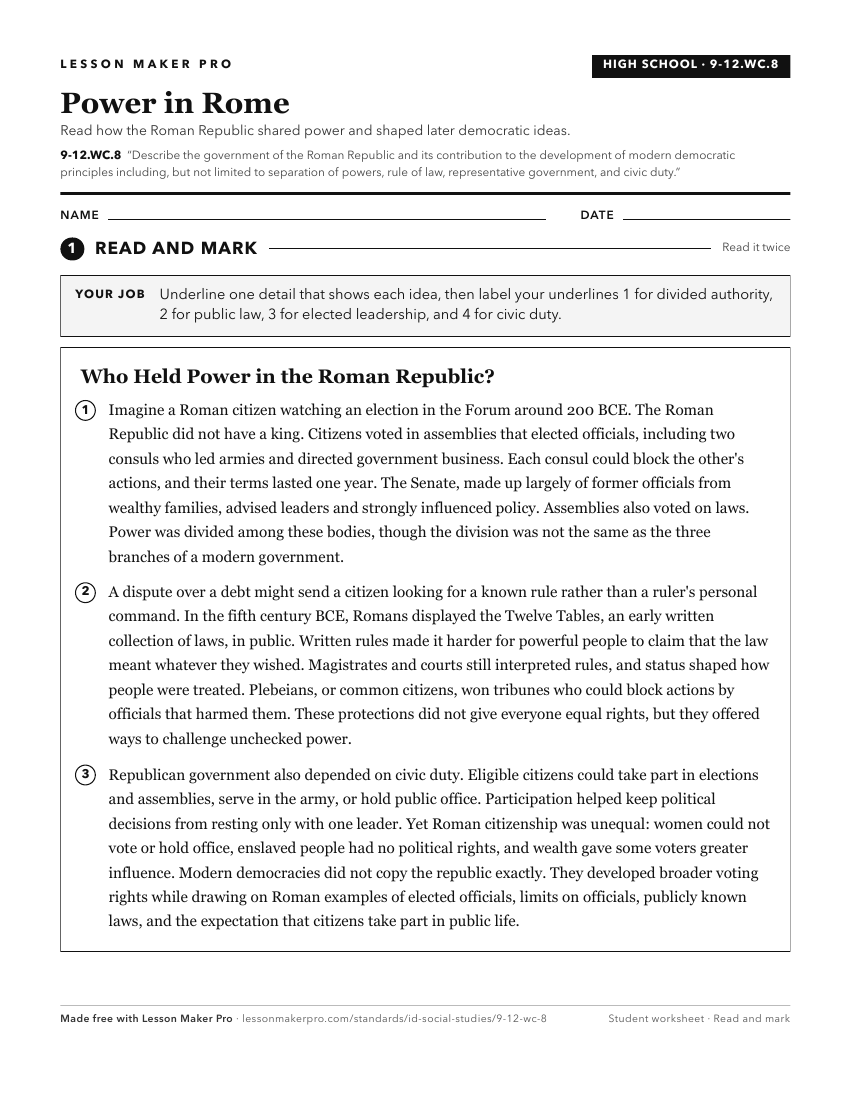
A ready-to-print activity worksheet aligned to 9-12.WC.8, with an answer key for the teacher on its own page. No account needed.
PDF, US Letter, prints cleanly in black and white.
Download the worksheetKeep exploring
Related Standards
- 9-12.WC.10
Describe the causes and consequences of the Punic Wars on the development of the Roman Republic.
- 9-12.WC.3
Examine the Hellenic concept of the polis in Greek city-states, including, but not limited to the ideas of democracy, citizenship, civic participation, and the ...
- 9-12.WC.11
Describe the fall of the Roman Republic including, but not limited to the role of Julius Caesar taking the role of Dictator for Life.
- 9-12.GOV.10
Define the concepts of democracy and republic and examine the relationship between the two.
Turn this exact standard into a lesson
Grade, subject, topic, and the complete standard are prefilled. Create one free, no account needed.
Also for this standard:Make a WorksheetMake a QuizMake a Sub Lesson